
The robots exploring the ocean: the seabed we know worse than Mars
We have sent rovers to Mars, photographed the moons of Jupiter and built telescopes that gaze at the edge of the universe. But 80% of our own planet is still unexplored. We are not the ones saying it: every map of the seafloor says it.
The problem is simple: water hides things, and the sea is immense, dark and hostile. Humans cannot dive much beyond a few hundred metres. That is where the robots come in.
They are machines that go down where light does not reach and pressure crushes. And they are finally mapping the planet we live on.
What exactly these robots are
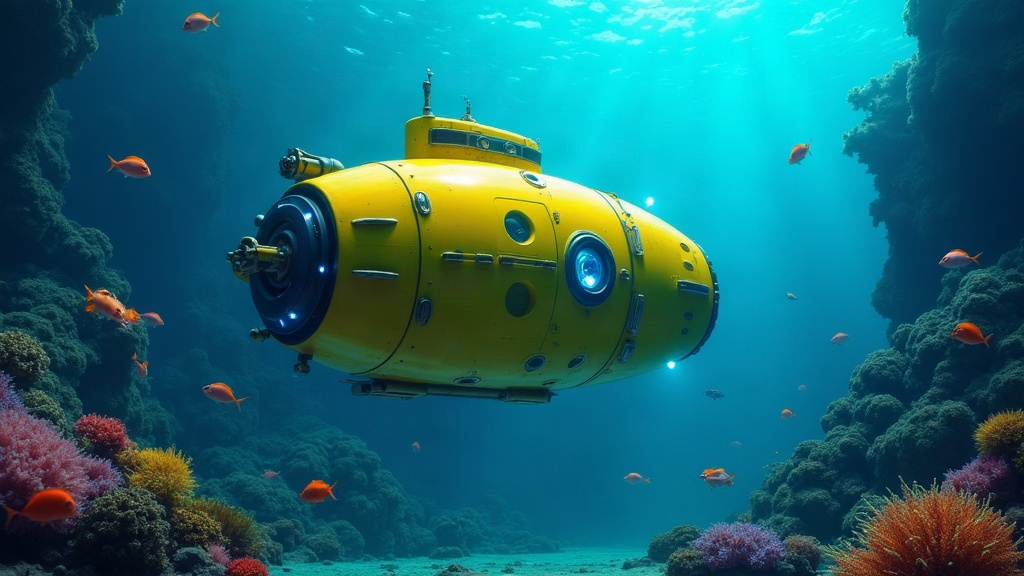
Most fall into two families. Those attached by a cable, called ROVs (Remote Operated Vehicles), are connected to a surface ship by a tether that gives them power and transmits commands. Those that roam free, the AUVs (Autonomous Underwater Vehicles), are launched on a mission and work alone for hours or days.
There is also a third, growing group: the gliders. They are machines without propellers that propel themselves by changing their buoyancy, like a sailboat gliding up and down. They are slow, but they can last for months in the water using very little energy.
They all share one obsession: seeing in the dark. They carry sonars that map the bottom with sound waves, cameras capable of working without light and sensors that measure temperature, salinity or dissolved chemicals.
What they are used for
Let us start with the most visible: finding things. Rescue teams use robots to locate aircraft black boxes, sunken ships or historical wrecks. The famous Titanic was first photographed with one of these vehicles in the mid-1980s.
Industry is another giant customer. Before installing a gas pipeline or an undersea cable, you need to know what is on the bottom. And once installed, robots are in charge of inspecting and repairing them. In fact, we could say that the internet you use every day is kept standing by a few metal tubes and pods working hundreds of metres deep.
Then there is science. Scientists use these robots to measure the effects of climate change, study underwater volcanoes or discover new species. It is estimated that there are still millions of marine species left to describe. Every dive can be a record of something never seen before.
And there are also applications that touch you directly. Fishing, the search for water resources or coastal surveillance depend more and more on these vehicles. They are even used to clean the bottom of ports or inspect the dykes of a dam.
Communication is still the challenge
With a Mars rover we can talk almost in real time because radio waves travel through empty space. Underwater it is impossible: the signal is lost within a few metres. That forces the use of sound waves, which are much slower and clumsier.
That is why autonomous robots are so important. They cannot receive constant commands, so they have to decide on their own where to go, dodge obstacles and make their way home alone. They look more and more like self-driving cars, but in a far more hostile environment.
The good news is that artificial intelligence is speeding up that path. The new models allow these machines to interpret what they see, recognise a fish or a coral and adapt their route without waiting for anyone. The ocean is slowly becoming a more understandable place.
Why all this matters to you
It may sound like a story of ships and cables, but it has a very personal angle.
Life depends on the sea. The ocean produces a large part of the oxygen we breathe, regulates the climate and is the route through which almost everything we buy travels. Knowing what happens beneath the water is deciding how to protect it.
Moreover, the seabed is rich in minerals that new technologies need. Deciding who extracts them and how will be one of the great debates of the coming years. The robots are not just telling us what is down there; they are also revealing the board on which that game will be played.
You do not need to dive to understand it. Just imagine that, while you read this, there are thousands of small machines moving in the darkness, sending the first real maps of a world we have been ignoring for centuries.
Mars may grab the headlines, but the greatest discovery is in our own backyard. And little by little, one robot after another, we are bringing it to light.