
Every time your phone syncs its clock, it is trusting a number the scientific community fixed in 1967: the duration of 9,192,631,770 oscillations of the radiation corresponding to the transition between the two hyperfine levels of the ground state of the caesium-133 atom. Sixty years later the second is still the same, but the clocks we know how to build are not. Today’s optical standards beat the accuracy of the best realisation of that caesium second by almost two orders of magnitude, and that margin has set in motion the formal process to redefine the unit of time.
A clock is a frequency you can count
Every atomic clock does the same thing: it picks a transition between two energy states, whose frequency is fixed by the physics of the atom, and counts how many cycles fit into an interval. In caesium the hyperfine transition sits in the microwave band, around 9.19 gigahertz, and laboratory primary standards reach uncertainties of roughly one part in 1016 — one second of error every 300 million years.
The lever for improvement is to go up in frequency. Electronic transitions in atoms such as strontium, ytterbium, aluminium or calcium lie in the optical range, around 429 terahertz for the strontium-87 line: nearly 50,000 times more oscillations per second. Dividing the transition frequency by its natural linewidth gives what is called the quality factor, and there the optical world wins by many orders of magnitude. The narrower the line and the higher the frequency, the finer the tick that can be interrogated, and the smaller the uncertainty that can be quoted.
Cool, trap, interrogate
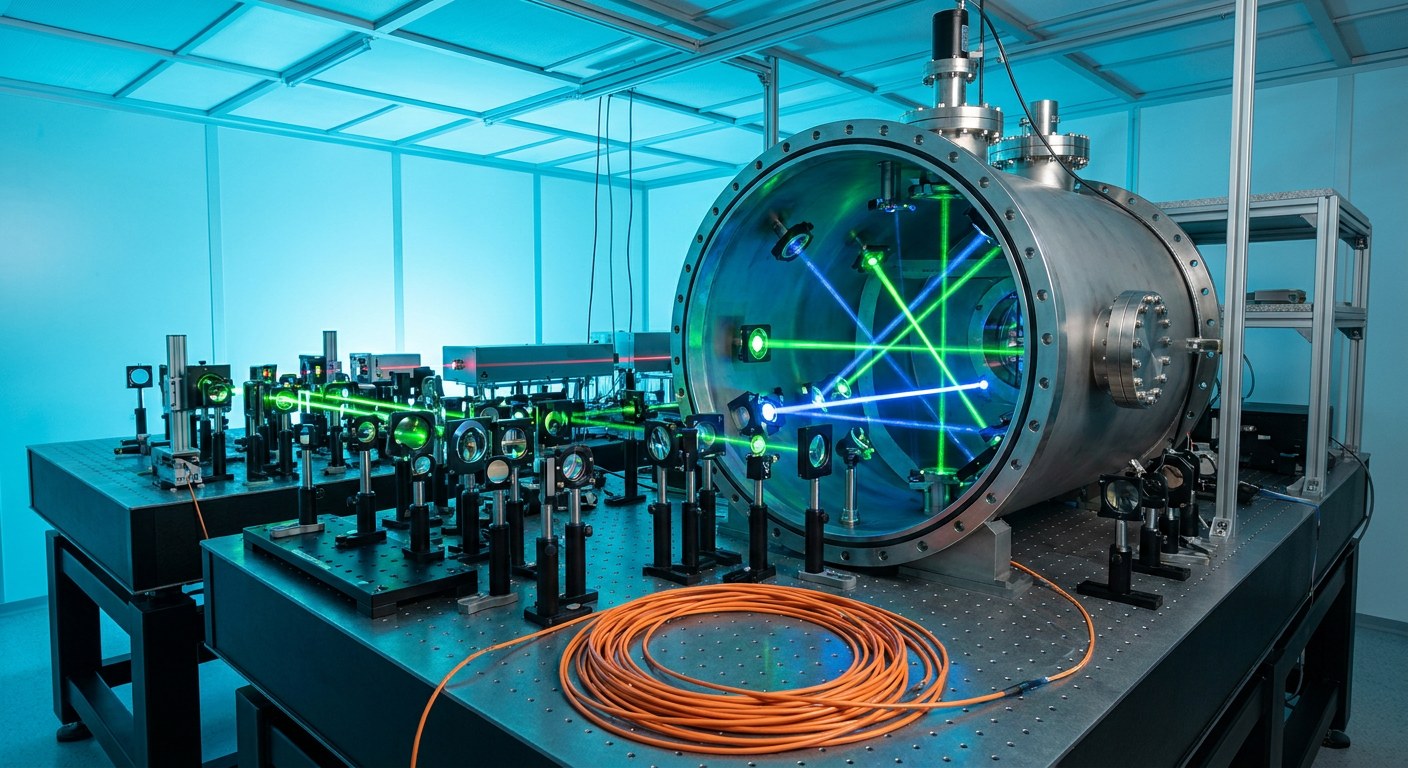
An optical lattice clock is built in stages. First the atoms are laser-cooled: by illuminating them from opposite directions with slightly detuned light their motion is slowed to a few microkelvin. They are then loaded into an optical lattice, an interference pattern made of laser beams that acts as a grid of wells in which thousands of atoms stay almost motionless. To keep the lattice from shifting the measured frequency, a “magic” wavelength is chosen at which both states involved feel the same shift.
The next component is the local oscillator: an ultrastable laser, locked to a cavity of extremely high-reflectivity mirrors, often held at cryogenic temperatures and mechanically isolated so that neither thermal noise nor vibration pollutes its frequency. That laser interrogates the transition using Ramsey spectroscopy: two pulses separated by a dark time of hundreds of milliseconds. The longer the interrogation time, the narrower the line, until the pulse duration itself becomes the limit.
Counting 429 trillion oscillations per second
No digital electronics counts directly at hundreds of terahertz. That is what the optical frequency comb is for: an ultrashort-pulse, femtosecond laser whose spectrum in the frequency domain is a series of thousands of evenly spaced lines, separated by the laser’s repetition rate and shifted by a phase term. The comb links an optical frequency to a microwave or radio-frequency oscillator with a precision of 1018, so the clock can divide its optical frequency down and count it with conventional electronics. The technique earned Theodor Hänsch and John Hall the 2005 Nobel Prize in Physics, and today it is the gearing that connects time scales worldwide.
The error that shows up one step higher
General relativity imposes an unavoidable consequence: a clock sitting in a different gravitational potential runs at a different rate. The relative frequency difference equals the ratio between the potential difference and the square of the speed of light, Δν/ν = ΔU/c². At uncertainties of 1018 the effect becomes tangible: a height difference of one centimetre above the geoid is enough for two optical clocks to drift apart measurably. This has given rise to “chronometric levelling”, a way of measuring height differences using clocks as gravitational sensors. In a now classic demonstration, two strontium clocks 457 kilometres apart, linked by a 940-kilometre interferometric fibre, measured a potential difference equivalent to 27 centimetres of height — comparable to what classical GNSS geodesy delivers. International campaigns with transportable clocks between the UK’s NPL, Germany’s PTB and Japan’s RIKEN have kept sharpening that comparison.
The same capability that lets us measure mountains turns these instruments into hunters of new physics: comparing different clocks constrains possible drifts in the fundamental constants and light dark-matter signals that, if they exist, would alter one transition’s frequency differently from another’s.
The timetable for changing the second
The second is not changed out of technological enthusiasm but by agreement. In 2022 the General Conference on Weights and Measures adopted the resolution asking the International Committee for Weights and Measures to prepare the redefinition proposal, following the roadmap of the Consultative Committee for Time and Frequency (CCTF), updated in 2025. At its 28th meeting in 2026 the conference again asked the CIPM to keep the work going and to present a proposal at the 29th meeting, expected in 2030, together with an implementation date. It is not merely a matter of one atom being better than another: there are mandatory criteria to meet, such as demonstrating the contribution of optical standards to the calibration of International Atomic Time, showing that several laboratories obtain the same result, and having realistic dissemination routes.
The choice of standard itself is on the table. One option is to pick a single optical transition and use its frequency as the defining constant, just as caesium does today. The other, more ambitious, is to define the second from a weighted geometric average of several optical frequencies from a specified set, spreading the risk and acknowledging that no atom is perfect. In both cases the second would remain a second: adopting the new standard would mean adjusting the chosen frequency so that the duration matches today’s within its uncertainty, with no jumps for anyone synchronising networks.
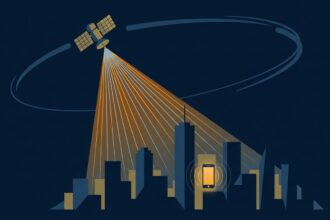
While the decision is pending, metrology is already showing what the hardware can do. Fibre links between institutes (Europe’s REFIMEVE project is the largest example) and satellite comparisons now allow clocks thousands of kilometres apart to be contrasted. The practical reward is not exotic: more stable time scales for synchronising telecom networks to nanosecond precision, verifiable timestamping, navigation, very-long-baseline interferometry and a finer watch on the planet itself.