
The machine much of the industry had written off still stores almost everything nobody needs to read right now. In 2026, with NAND memory prices having doubled and orders for 30 and 40 terabyte drives booked out into 2027, the mechanical hard disk has stopped being a relic and become the most profitable bottleneck in the storage business. The analyst Tom Coughlin estimates that roughly 2,017 exabytes of magnetic disk capacity will ship this year, and that about 18 percent of it – some 363 exabytes – exists only because AI needs somewhere to keep its data. Seagate was selling at about 15 dollars per terabyte in its 2024 fiscal year, roughly two and a half times below the price of an enterprise solid-state drive. That gap, not speed, is what keeps the disk alive.
A bit that is too small stops being a bit
To understand why a laser became necessary, start with the physics of the magnet. In today’s drives a bit is not a neatly drawn domain: it is a region containing dozens of magnetic grains of a cobalt, chromium and platinum alloy (CoCrPt) with oxide added, each about eight nanometres across. Every grain in a region points the same way, and that collective direction is the data. For the data to survive ten years without decaying, the energy needed to flip the magnetisation of one grain – the product of its magnetic anisotropy and its volume (Ku·V) – must be at least forty to sixty times the ambient thermal energy (kBT). Engineers call this the thermal stability criterion.
The trouble is arithmetic: shrink the grains to fit more per square inch and the volume falls, the energy barrier falls with it, and at some point the heat of the room itself starts flipping bits. That is the superparamagnetic limit, and perpendicular magnetic recording (PMR) hit it years ago at around one terabit per square inch. The obvious fix is a material with far higher anisotropy, and that is where the star compound appears: an iron-platinum alloy in the ordered L10 crystal structure, with roughly thirty times the anisotropy of granular CoCrPt. Its grains can measure five or six nanometres and still stay put.
Heat it up so you can write it
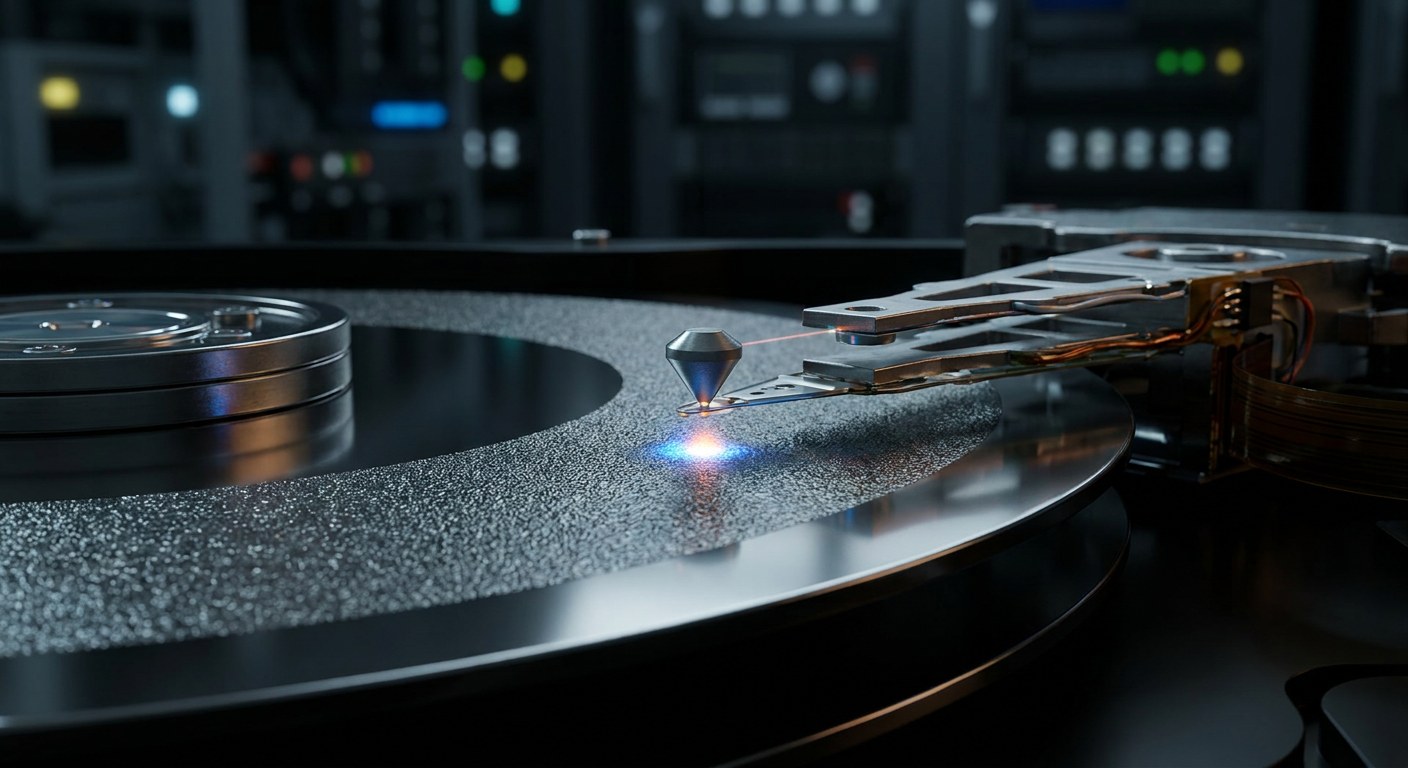
And here comes the trap: if the grain is that stable, the write head cannot flip it. A modern head generates a magnetic field limited by the physics of the material it is made of, about two teslas at best, while the media we used before switched direction with much less. Hence HAMR, heat-assisted magnetic recording: instead of fighting the stability of the media, you temporarily remove it. A laser diode mounted on the head itself heats a minuscule spot on the platter to around 450 degrees Celsius, right at the edge of the material’s Curie temperature, where coercivity collapses and the head field can finally flip the bit. The platter cools within a nanosecond, the magnetisation freezes again, and the data is written.
The interesting part is how such a small hot spot is achieved. The laser light has a wavelength of about 800 nanometres, so diffraction would never let it focus below roughly 400. The answer is a near-field transducer: a plasmonic nanoantenna, typically a small gold cone, that turns the light into an electron oscillation at its tip and concentrates it into an area twenty or thirty nanometres wide. The head itself flies about one and a half nanometres above the platter, with a heater that adjusts fly height in real time. The whole assembly – laser, waveguide, antenna, writing head and magnetoresistive read sensor – fits into a slider weighing tens of milligrams that moves thousands of times per second.
It is not just elegant physics: materials chemistry decides whether the drive lasts. Every spot on the platter is heated and cooled millions of times over a drive’s life, and the carbon layer and lubricant protecting the surface must survive that cycling without degrading. The manufacturer itself stresses that the heating pulse is so brief it does not affect the temperature of the drive.
Helium, overlapping tracks and three more platters
The laser is not the only lever. High-capacity drives are sealed with helium instead of air: helium is lighter, creates less turbulence around the platters, and that allows thinner platters to be stacked higher, with less vibration and lower power draw. An enterprise drive today carries ten platters where a decade ago it carried five or six.
The other lever is how the tracks are laid down. In conventional magnetic recording (CMR) each track is written at its full width and all of them stay apart. In SMR, shingled magnetic recording, each track is written over the edge of the previous one, like roof tiles. That buys 15 to 25 percent more capacity without touching the physics of the media, but in exchange a single track can no longer be rewritten in isolation: the write order must be respected, zone by zone. Drives handle this internally with a cache and periodic flushing, or declare themselves host-managed and hand the responsibility to the operating system through standard protocols (ZBC on SATA, ZAC on SAS, supported in Linux through dm-zoned or zonefs). For a data centre writing backups and cold data strictly in sequence, the trade is a win.
The race to 100 terabytes
With those pieces in place, the roadmap has accelerated. Seagate launched its Mozaic 3+ platform in 2024 with 30 terabyte drives and ten platters of three terabytes each, and in 2026 it began shipping the next generation: 44 terabytes on ten platters, that is 4.4 terabytes per platter, to two large cloud providers. Western Digital, which spun off SanDisk in 2025, took a parallel route with energy-assisted PMR (ePMR), which nudges the bit with a bias current instead of light, and has already shown a 40 terabyte drive with shingled tracks, aiming at 100 terabytes via HAMR around 2029. Toshiba, the third member of the club, has been sampling 30 to 34 terabyte SMR drives since March 2026 and is preparing conventional versions up to 28. Current densities sit between 1.5 and 2 terabits per square inch, and laboratories are already working on six and ten terabytes per platter, the latter using lithographically patterned magnetic islands instead of self-assembled grains.
That kind of demand has an unglamorous side effect: there is no stock. Lead times for high-capacity enterprise drives went from a few weeks to more than fifty-two during 2025, and manufacturers admit their 2026 capacity is sold out, with multi-year contracts stretching to 2028. The price per terabyte of a mechanical drive is falling more slowly than it used to, but it is still falling, while flash memory has gone up. In a year of scarcity, whoever owns the factory sets the terms.
Two hundred accesses per second is fine if nobody is waiting
The disk is slow and does not pretend otherwise. A platter spinning at 7,200 revolutions per minute turns once every 8.33 milliseconds, so average rotational latency alone is about 4.2 milliseconds, plus several more for the arm to seek. The result is 150 to 200 random accesses per second, four orders of magnitude below an NVMe SSD. Reading in sequence, however, it tops 250 megabytes per second, and with two independent arms inside the same chassis (dual-actuator drives) simultaneous operations double without adding capacity.
That division of labour explains why the disk refuses to disappear. An AI model is trained from NVMe, served from NVMe, and keeps its training data, backups and history on disks. McKinsey’s projections put about 80 percent of everything stored as cold data, read once and kept out of obligation or fear, and for that latency is irrelevant: only cost per exabyte matters. Below the disk, moreover, tape still sits, and in 2026 it remains the cheapest way to keep petabytes for decades without spending energy.
This year’s lesson is the usual infrastructure lesson: the technology that wins is not the fastest one, but the one that fits the budget of the job in front of it. The hard drive has been declared dying for a decade and has just been handed a laser to write smaller bits into a material nobody could have imagined twenty years ago. One nanosecond of heat in exchange for another decade of life.