

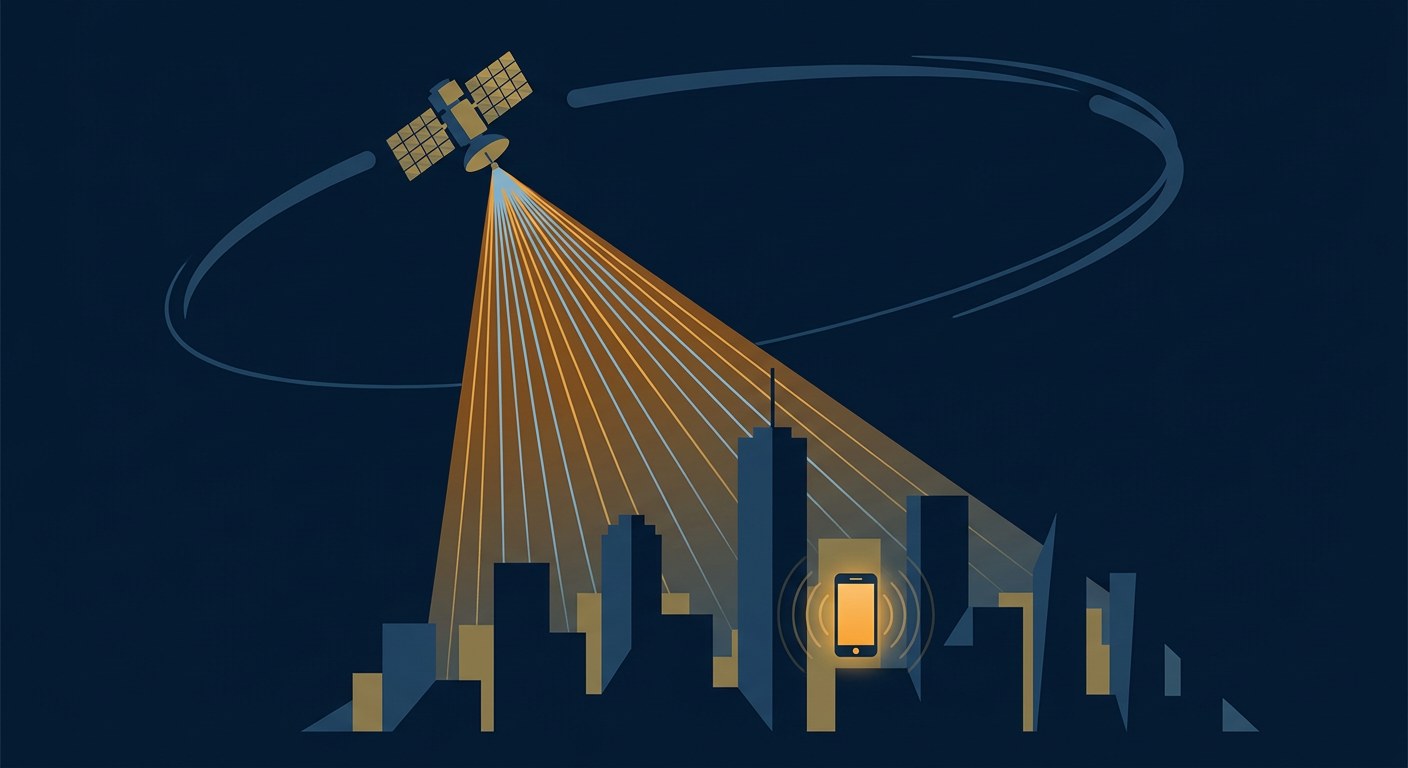
For decades, connecting a phone to a satellite meant a dish, a suitcase and patience: big terminals, aimed by hand and extremely expensive. Over the last two years the industry has done the opposite — it has made the satellite adapt to the phone you already carry in your pocket, the one whose antenna points nowhere. The technology is called NTN (non-terrestrial networks) and it is already written into the 5G standard.
The antenna that cannot aim
The first problem is the link budget. Your phone uses a practically omnidirectional antenna, with a gain close to 0 dBi (dBi measures how much an antenna concentrates energy in one direction; 0 dBi means “equally in every direction”). There is no motor, no tracking, nothing to rotate. To close the link with a satellite 550 km away, in the 2 GHz band, free-space loss is around 153 dB, and building penetration, weather and multipath add to that. In other words: of every watt leaving the satellite, the phone receives a millionth of a billionth.
The satellite supplies the power and the brains
The fix was to move all the difficulty into the sky. Direct-to-cell satellites carry phased-array panels tens of square metres across — some exceed 60 m² — with hundreds or thousands of radiating elements combined digitally to form narrow beams and steer them electronically, with no moving parts. That process, beamforming, concentrates energy exactly where the users are and drives EIRP (effective radiated power) up to levels no terrestrial tower can reach.
The second trick is where the signal gets processed. In the “transparent” architecture, also called bent pipe, the satellite only amplifies and shifts the frequency: traffic comes down to a ground station, the gateway, and that is where the genuinely expensive part of a mobile network lives (session management, authentication, billing). The satellite acts as a flying repeater between your phone and that internet-connected gateway.
Doppler and clocks: the two invisible enemies
A low-Earth-orbit satellite travels at roughly 7.5 km/s. At 2 GHz, that shifts the signal frequency by tens of kilohertz through the Doppler effect, and the shift keeps changing as the satellite crosses the sky. An ordinary mobile receiver could not even lock onto that carrier. Release 17 of the 3GPP standard solved the problem by asking the phone’s own GPS for help: using its position, the device pre-computes the Doppler shift and the propagation delay, and pre-compensates for them before transmitting.
Delay is the other obstacle. A round trip to a satellite 550 km up adds 30 to 50 milliseconds, whereas in a terrestrial network the maximum timing advance — the value that compensates for distance — is about one millisecond. That is why NTN redefines the timers: longer synchronisation windows, more patient acknowledgements and access protocols that assume a response will take ten times longer than on the ground.
A standard built for the job
NTN is not a commercial patch: it is part of the specification. Release 17 brought NB-IoT and eMTC over satellite, plus the first version of 5G NR for this environment, defining everything from Doppler correction to mobility management between moving beams. Later releases add voice, more bandwidth and optical inter-satellite links, so that traffic can hop from one satellite to the next through the vacuum and drop down to the nearest gateway without depending on any terrestrial coverage in between.
Why calls will not work like on the ground
It is worth avoiding confusion. A beam from 550 km covers hundreds of kilometres in diameter: a single “cell” spans what on the ground would be tens of thousands of towers. That giant cell shares a limited slice of bandwidth among every user inside it, so capacity per person is modest — enough for messages, emergency SOS, telemetry, compressed voice and light data, not for high-definition video. On top of that, the satellite passes and is gone: every few minutes the connection has to be handed over to the next one, a handover that in orbit is as routine as it is delicate.
The practical result is a network designed to cover what is not covered: mountains, open sea, deserts, areas with no fixed coverage and emergencies where the nearest tower has just gone down. And the technical credit does not lie in the phone — which does not change — but in having turned a satellite into a flying mobile tower, with the power, the computing and the aim all placed in the sky.