
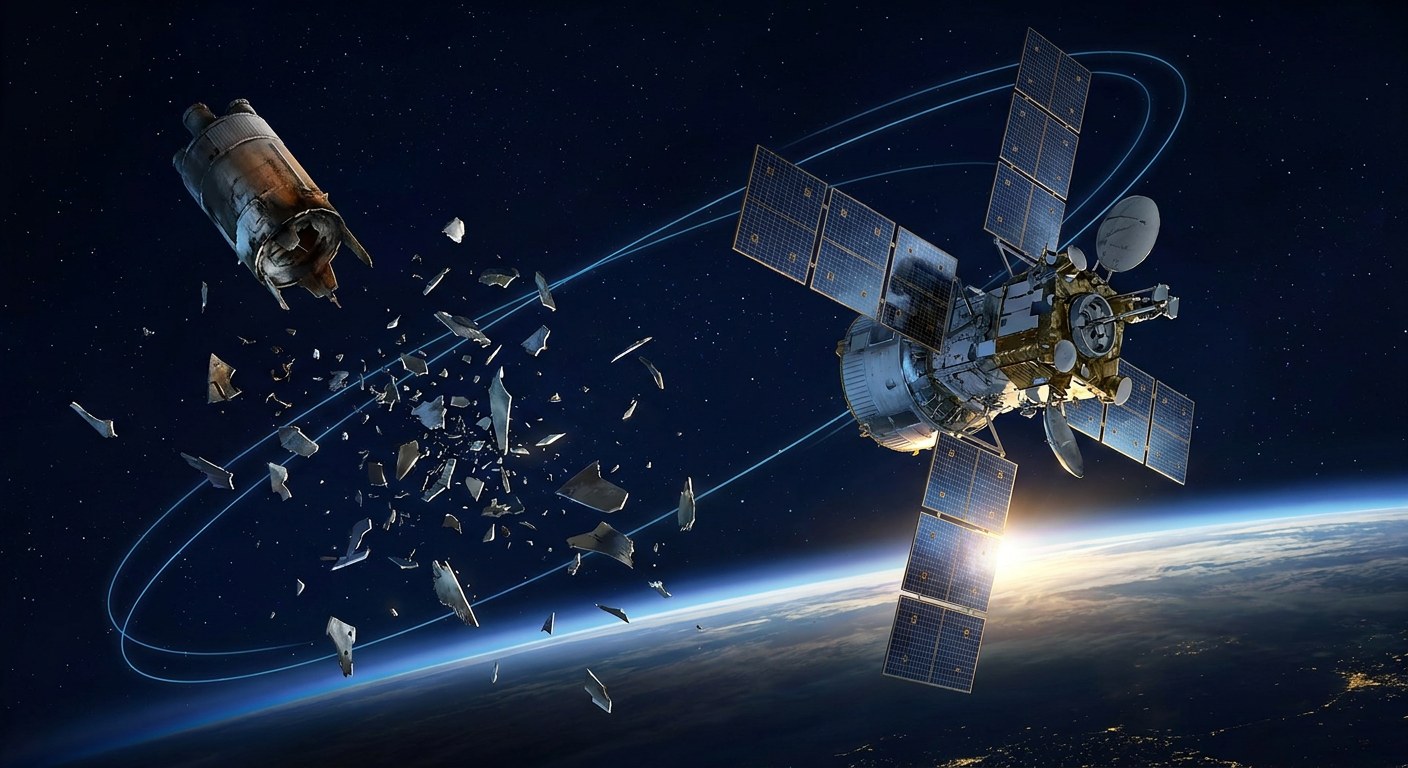
A working satellite crosses the sky at 7.6 kilometres per second. Beside it, with no engine, no battery and nobody at the controls, travels a fragment of the upper stage of a rocket launched thirty years ago. Their paths meet. There is no braking, no last-second swerve: if the two occupy the same volume for an instant, the energy of the impact is that of a lorry thrown against a wall, and the one that receives it is not the dead fragment but the working satellite. Space debris stopped being an aesthetic anecdote decades ago: today it is an engineering discipline of radar, covariance matrices, avoidance burns counted drop by drop and a legal question nobody has fully resolved.
How much junk is up there, and what it is made of
Public tracking catalogues, maintained by networks of radars and telescopes, list around 40,000 objects larger than ten centimetres in Earth orbit. Of those, only eleven to twelve thousand are intact satellites. The rest are fragments, abandoned rocket stages, payload fairing covers, leftovers from explosions and collisions: objects that no longer do anything and that nobody can switch off. Below that threshold the statistics become an estimate: roughly one million objects between one and ten centimetres are thought to be in orbit, and about 130 million between one millimetre and one centimetre.
That middle range is the truly dangerous one. A one-centimetre object does not appear in the catalogues, so nobody can warn in advance about its path, yet it punches through an aluminium plate several millimetres thick as if it were paper. That is no metaphor: impacts recovered on satellite panels and on space shuttle windows show craters several times the size of the projectile, with edges melted by the energy released.
Why energy explodes with speed
Kinetic energy depends on the square of velocity, and that is the whole problem. A one-gram nut left in low orbit travels at about 10 kilometres per second, and encounters between objects with different inclinations reach relative speeds of up to 14 kilometres per second. Applying one half of mass times velocity squared, a gram at 10 km/s carries some 50,000 joules: more than ten times the energy of a high-powered rifle bullet. At 1,200 kilometres per hour, the same nut on a road would be a bit of grit on a windscreen; up there it is an ownerless cannonball.
Speed also explains why collisions feed on themselves. When two large objects hit each other, neither disappears: the impact energy shatters them and multiplies the pieces. The 2009 collision between the Iridium 33 satellite and the Russian Cosmos 2251 stage, both intact, produced more than two thousand trackable fragments. The destruction of China’s Fengyun-1C satellite in 2007 added more than three thousand. Every fragment is a fresh projectile on a slightly different orbit, and that multiplying effect is the basis of the so-called Kessler syndrome: a cascade of hits that would leave certain orbits unusable for centuries.
Who watches the sky: radar, telescopes and orbital elements
Tracking is not a still photograph but an inverse problem in orbital mechanics. Radars pick up a return echo from the object, measure range, angle and sometimes Doppler shift, and several measurements spread over time allow its orbit to be fitted: semi-major axis, eccentricity, inclination and, above all, position in time. Those data are published as the so-called two-line elements (TLE), propagated with analytical models such as SGP4 to estimate where the object will be in the future.
The limit is physics, not computing power. In low orbit the residual atmosphere slows each object differently depending on its area and its mass, and any surge in solar activity changes that density. That is why the accuracy of a TLE degrades in chains: if the position error grows by a kilometre per day, after fifteen days the prediction is useless for deciding an avoidance manoeuvre. In a well-known episode, a geomagnetic storm in February 2022 multiplied the drag from the swollen atmosphere and contributed to the loss of a batch of freshly launched SpaceX satellites.
Computing the impact probability is cheap; getting it right is not
An orbit alone does not tell you whether there will be a collision, because the position is not a point but a cloud of probability: a covariance ellipsoid that grows with prediction time. The warning is issued as a collision probability, computed by integrating the uncertainty of both objects at the moment of closest approach. The key point is that this probability is almost always small: typical alert thresholds sit between one chance in ten thousand and one in a hundred thousand, depending on the size of the objects and the value of the one still in service.
When the probability crosses the decision threshold, the operator manoeuvres. But manoeuvring is not free: every burn consumes propellant the satellite needed to carry on with its mission, and every nudge shifts the orbit for days, interrupting service. The scale of traffic is already visible in the numbers: SpaceX reported to the FCC almost 50,000 avoidance manoeuvres across its constellation in a six-month period, roughly 270 a day. Not all of them answer a real risk, but rather the lack of precise information about the piece coming towards them.
Altitude decides the sentence
Not all orbits are equally dirty. Below about 600 kilometres the residual atmosphere still slows objects enough for a small fragment to fall within years and a large one within decades. That is the most used band — the International Space Station is there, along with much of the internet constellations — and also the most self-cleaning one. The trouble starts higher up: from 800 or 1,000 kilometres the atmospheric density is so low that a fragment’s stay is measured in centuries, and in higher orbits, indefinitely. That is where a Kessler cascade would be irreversible on a human timescale.
Hence the mitigation rules. The most widespread international norm required satellites to be removed within 25 years of the end of their mission; in 2022 the United States shortened the deadline to five years for low-orbit licences, on the idea that deorbiting early is far more effective than deorbiting well. On top of that comes passivation: venting propellant tanks and discharging batteries at the end of life so the craft does not explode and create fragments of its own, which is today the leading source of new objects in the catalogues.
Deorbiting by hand: a technology still being tested
Bringing down an object that does not cooperate is hard precisely because it does not cooperate. There are no handles, no docking port, and the exact shape of the body is not always known. Techniques flown so far include nets, harpoons, drag sails that increase the surface so the atmosphere pulls harder, and inspection approaches: the Japanese mission ADRAS-J closed in on and photographed an abandoned rocket stage, keeping its distance and rotating in step with a body that tumbles out of control. That is the step before any capture, because to grab something you first have to synchronise your motion with it.
The cost of these missions is the main obstacle: for the price of removing one large stage, several new satellites can be launched. That is why attention is shifting to design from the outset, to making everything that goes up carry its own way back down.
The legal problem: junk still belongs to its owner
Here comes the part no technology can solve on its own. The 1967 Outer Space Treaty states that a launched object remains under the jurisdiction and ownership of the state that registered it, even if it is dead and in pieces. In other words: a fragment is still somebody else’s property, and touching it without permission is, in legal terms, disposing of another party’s asset. The 1972 Liability Convention adds that the launching country is absolutely liable for damage caused on the Earth’s surface and to aircraft in flight, and liable on proof of fault for collisions in orbit. With that combination, the question of who pays for the cleanup and who authorises the removal of an object remains open in most cases.
While that is settled, shared surveillance keeps improving. Commercial tracking systems already sell conjunction alerts accurate to hundreds of metres, constellations share ephemerides with one another to coordinate, and optical and radar data are being merged into open catalogues. Space debris has moved from being a cleaning problem to a traffic management problem: predict, warn and move with the information available. And even though that effort does not remove a single gram of junk, it is the only thing today stopping the next collision from being counted by someone else.