
Tomorrow’s weather report looks like a blind promise, but it is not: it is the result of solving, over the whole atmosphere, the same physics equations that describe how a fluid moves. What sets it apart from any other calculation is the scale. To know whether it will rain on your street, a supercomputer has to simulate the behaviour of the air across the entire planet, from the ground up to 80 kilometres of altitude, and repeat the calculation billions of times.
The equations are not guessed: they are integrated
The core of a numerical weather model is the set of equations governing a rotating fluid on a sphere: conservation of momentum (an adapted version of Navier-Stokes), conservation of mass, thermodynamics — what happens when air rises and cools — and the laws that distribute the energy coming in from the Sun and the energy leaving towards space. On top of that come water vapour, cloud formation and the interaction with the sea surface, the ice and the terrain.
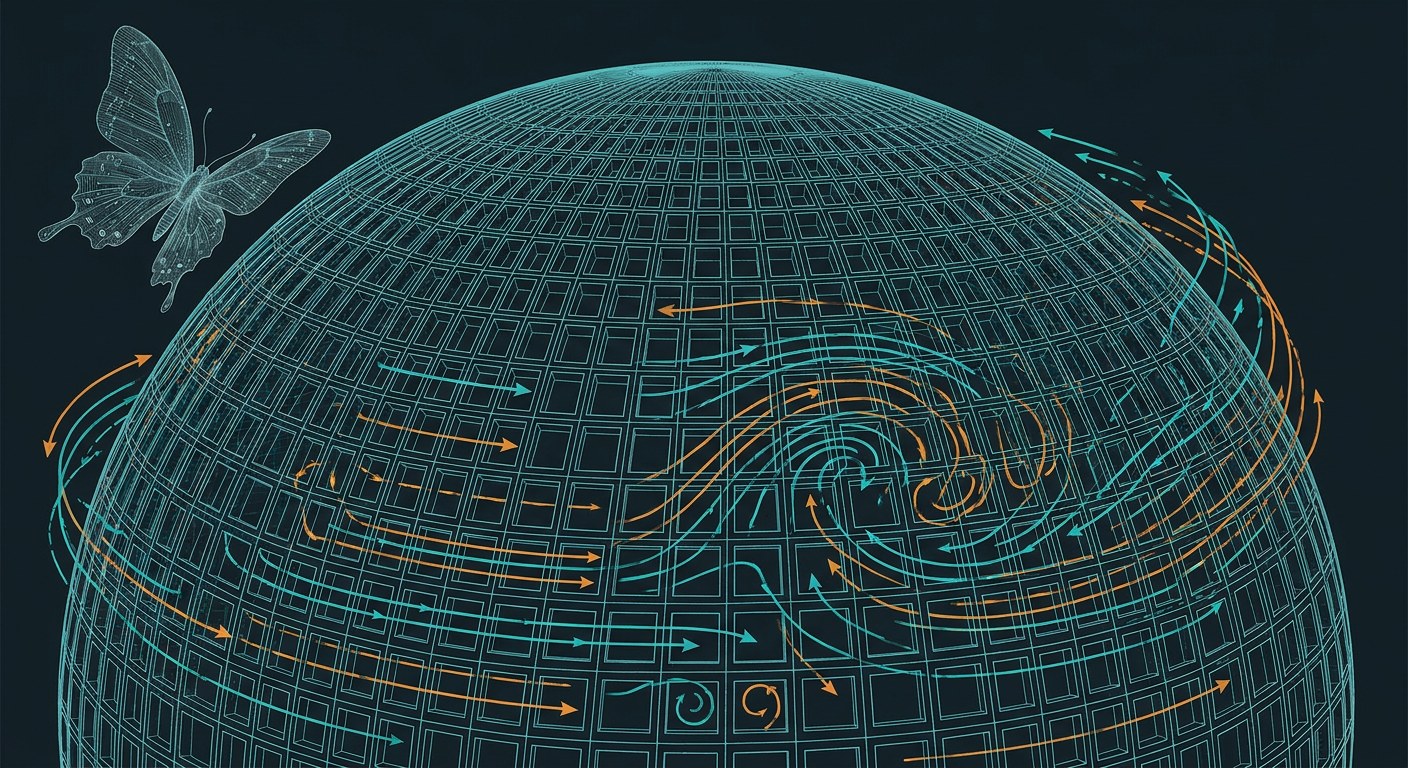
When this is solved over the entire atmosphere, the dominant term is gravitational energy: air has weight and its vertical motion organises itself around hydrostatic balance. That simplification lets classic hydrostatic models move forward in time without simulating every eddy. The forecasting system of the European Centre for Medium-Range Weather Forecasts (ECMWF), the IFS, uses a spectral scheme on a reduced Gaussian grid: it represents pressure and wind fields as a sum of waves, computes the non-linearities in physical space and returns to spectral space to solve the linear part step by step. Its current operational configuration works at about 9 kilometres of horizontal resolution, with 137 vertical levels and time steps of the order of ten minutes. Any calculation of that size carries the Courant-Friedrichs-Lewy criterion, which forbids advancing faster than information takes to cross a cell: the grid is not decoration, it is what sets the price of the computation.
The real bottleneck is the starting point
A perfect model with a wrong initial state produces a wrong forecast with enormous precision. That is why half the operational effort is not in the model but in data assimilation: reconstructing the current state of the atmosphere from scattered, heterogeneous observations. Radiosondes that rise twice a day from close to a thousand points on the planet, sensors on commercial aircraft, buoys and ships, and above all satellite radiances, which provide the vast majority of the data volume. The dominant technique is 4D-Var: it searches for the initial state that, when integrated by the model, best reproduces what was observed over a time window — usually twelve hours — using the previous forecast as the background and error covariances to know how much to trust each observation. The IFS was the first operational system to use 4D-Var, in 1997, and since May 2026 it assimilates atmosphere, ocean and sea ice in a fully coupled way, so sea temperatures no longer enter as an imposed input but are computed by the model itself.
Why a single forecast is not enough
In 1963, Edward Lorenz showed that systems as simple as three coupled equations could have completely divergent trajectories from tiny initial differences. In meteorology, an error of one degree at one point becomes an error of tens of degrees within days, because perturbations grow exponentially. The operational answer is ensembles: instead of running the model once, it is run fifty-one times, all slightly different. The European system perturbs the initial conditions with singular vectors and an ensemble of assimilations, and also perturbs the model’s physics through a scheme that samples uncertain parameters. The spread between those fifty-one results is no longer noise: it is probability. Twenty members carrying rain over your city means exactly that, forty per cent. The forecast reaches fifteen days because within that horizon the atmosphere has forgotten its starting state; for longer scales another system exists, with 101 members and a 46-day range, which only works in statistical terms of prevailing weather.
What the model cannot see
No 9-kilometre grid resolves a summer storm, which forms over just a few kilometres. Everything smaller than the cell — convection, clouds, turbulence, radiation — has to be parameterised, that is, written as an approximate formula that depends on the mean conditions. A good part of forecast uncertainty lives there, which is why convective-scale models, with cells of two or three kilometres, are used in specific domains and short windows. For the next six hours there is also a shortcut: radars see the rain that already exists and algorithms advect it with the wind. That is nowcasting, and it is what sustains immediate storm warnings.
The arrival of learned models
In recent years a new family has appeared: models that do not integrate physics but have learned the statistics of weather from forty years of reanalysis (ERA5) and operational analyses. Instead of solving equations, they are neural networks — graph encoders and decoders with a transformer-type processor at the centre — that take the current state on a quarter-degree grid and return the state six hours later, repeating the step until fifteen days are complete.
The numbers are striking. GraphCast produces ten days of global forecast in under a minute on a single accelerator and beat the reference deterministic system on 90% of 1,380 verification targets. GenCast, based on diffusion, generates a fifteen-day, 50-member ensemble in about eight minutes and outperformed ECMWF’s ensemble on 97.2% of 1,320 targets, while also improving warnings for tropical cyclones and extreme wind events. And the European centre itself launched its learned system, AIFS: the deterministic version has been operational since 25 February 2025 — the first time a major international centre has used a data-driven global model in production — and the ensemble version since 1 July 2025, with an upgrade in May 2026 that added waves and snow. The setup, according to published comparative studies, is of the order of ten times faster and consumes around a thousand times less energy than the equivalent physical model.
The limit: records
There is a problem, and it affects precisely what matters most. A learned model interpolates the behaviour it saw during training; if the climate of 2026 produces a heatwave outside anything recorded between 1979 and 2017, the network tends to fall short. A study published in 2026 compared several AI models with the physical system on record-breaking heat, cold and wind events and found that the physical model won consistently, with the largest advantage at short range, and that the learned models underestimated both the frequency and the intensity of records, as if they had a soft ceiling near the most extreme value they saw in training. The equations, by contrast, have no such ceiling: they extrapolate because they describe mechanisms, not regularities.
What comes next: two systems, not one
The operational conclusion is not to replace one with the other but to combine them. ECMWF keeps both in parallel and describes them as complementary: the physical model provides coherence between variables and the ability to represent what has never been seen, and it sustains the data assimilation that the learned model feeds on; learned models provide speed to generate large ensembles — dozens of members in minutes — and make it possible to explore uncertainty at a cost that was previously unthinkable. There are already experiments with data assimilation performed by neural networks and with models that begin and end in observations, with no reanalysis in between.
Conclusion
A forecast is not a prophecy: it is a probability distribution obtained by measuring a lot, assimilating carefully and computing without pause. Tomorrow’s report combines millions of observations, an initial state reconstructed with optimisation mathematics and billions of operations on a grid covering the entire planet. What is new is that a few passes through a GPU now fit in there too. What does not change is that, beyond two weeks, nobody can know anything: the atmosphere simply no longer remembers.