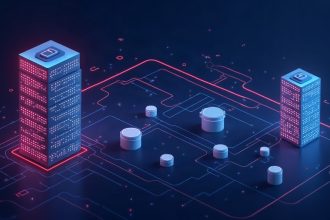


When you open an app to check the weather or watch a video, you almost never think about where that data is processed. In most cases it travels to a huge data centre that may be thousands of kilometres away. But increasingly, that work is being done closer and closer to you. It is called edge computing, and it promises to change the way the internet works.
What is the edge?
In computing we talk about the core (the data centre) and the edge (the devices we use daily: the phone, the security camera, the car, the thermostat or the sensor in a factory). Edge computing consists of processing data at that closer point, instead of always sending it to the centre.
Think of a smart traffic light. If it had to wait for its information to travel to a distant data centre and back, it would take too long. By processing on the traffic light itself or on a small server in the neighbourhood, the decision is almost instant.
Why speed matters
There are decisions that cannot wait even a fraction of a second. A self-driving car detecting an obstacle, a robotic arm that must stop, a medical system monitoring vital signs. In all these cases, the distance to the data centre works against you.
This delay is called latency. Reducing it is the great goal of the edge. The less data travels, the faster the response and the less we depend on the connection being perfect.
Less traffic, less cost
Sending data to a data centre has a cost: it consumes bandwidth, energy and, therefore, money. With millions of connected devices (the so-called internet of things), that traffic can saturate networks.
By processing at the edge, only the information that really matters is sent to the centre. For example, a security camera can analyse images on the device itself and only alert when it detects something suspicious, instead of continuously sending video.
The role of artificial intelligence
The edge is a natural ally of artificial intelligence. It is increasingly common for phones, speakers or cameras to include small AI models that work offline. That way, your assistant can recognise your voice without sending the recording to any server, with the extra advantage that your data never leaves your device.
It is a balance: small, fast models solve simple tasks at the edge, while more complex tasks still rely on the cloud. The key is distributing the work intelligently.
Not everything is perfect
Edge computing also has its challenges. Devices have less power and less memory than a large data centre. In addition, spreading intelligence across so many points makes management more complicated and raises new security questions: every device is a potential entry point for an attacker.
Even so, the trend is clear. It is not about choosing between the cloud and the edge, but about having them work together. The cloud for large capacity, the edge for speed.
A future closer than it seems
We already use edge computing more than we imagine: when our phone processes a photo, when the car brakes on its own or when the router manages the traffic at home. With the arrival of faster networks and the new mobile generation, this technology will become even more invisible and, at the same time, more present.
In the end, the goal is simple: to have technology respond at the exact moment and place where we need it. And that, often, happens closer and closer to us.