

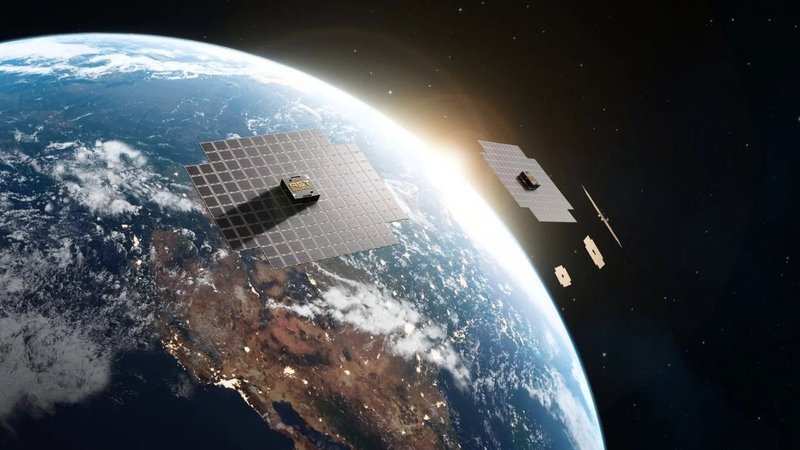
Hello techies, how are you all doing? Today I bring you news that proves the commercial space race is more alive than ever. Blue Origin, Jeff Bezos’s space company, announced this Wednesday the deployment of 5,408 satellites to create TeraWave, a satellite communications network that will compete directly with SpaceX’s Starlink. But here’s the curious part: unlike Starlink, which we all know because it offers internet to consumers like you and me, TeraWave isn’t designed for individual users. It’s an exclusively business service, and that completely changes the rules of the game.
TeraWave promises speeds of up to 6 terabits per second, both upload and download, at any point on the planet. To give you an idea, we’re talking about extreme speeds even by today’s enterprise standards. Deployment will begin at the end of 2027 with a constellation that combines satellites in low and medium Earth orbit, connected via optical links. The network is designed to serve a maximum of approximately 100,000 business customers, not millions like its competitors. Blue Origin has made it clear that its network is designed specifically for business customers, targeting data centers, governments and companies that require reliable connectivity for critical operations.
While Starlink, with more than 9,000 satellites in orbit and about 9 million customers, focuses on offering internet to individual consumers, businesses and governments alike, TeraWave bets on a much more selective and specialized approach. The interesting thing is that Bezos isn’t only competing with Musk in this race, but also with his own creation: Amazon. The e-commerce company is deploying Leo, formerly known as Project Kuiper, a network of 3,236 satellites of which 180 are already in orbit. Unlike TeraWave, Leo does target both businesses and consumers and governments, competing more directly with Starlink’s business model.
Those 6 terabits per second that TeraWave promises are no coincidence. Blue Origin clearly aims to meet the demand of data centers for artificial intelligence, a market that is growing exponentially. The TeraWave announcement coincides with a race in the space industry to build data centers in space that can meet the growing demand for large-scale AI processing. Musk has already expressed his desire to build these space centers complementing Starlink, while Bezos predicted they will be common in orbit within the next 10 to 20 years. AI needs a huge amount of energy and connectivity, and space could be the solution.
To put 5,408 satellites into orbit, Blue Origin will use its reusable New Glenn rocket, which, although it has completed two launches, has not yet reached the flight cadence needed for a deployment of this magnitude. Last November, the company achieved an important milestone by successfully landing the New Glenn booster after the launch of two NASA spacecraft, becoming the second company, after SpaceX, to achieve this feat. Now the challenge is to go from two successful launches to an industrial operation that can launch satellites regularly and cheaply.
Best regards, Marta
Automatically published on 22/01/2026 at 12:05