
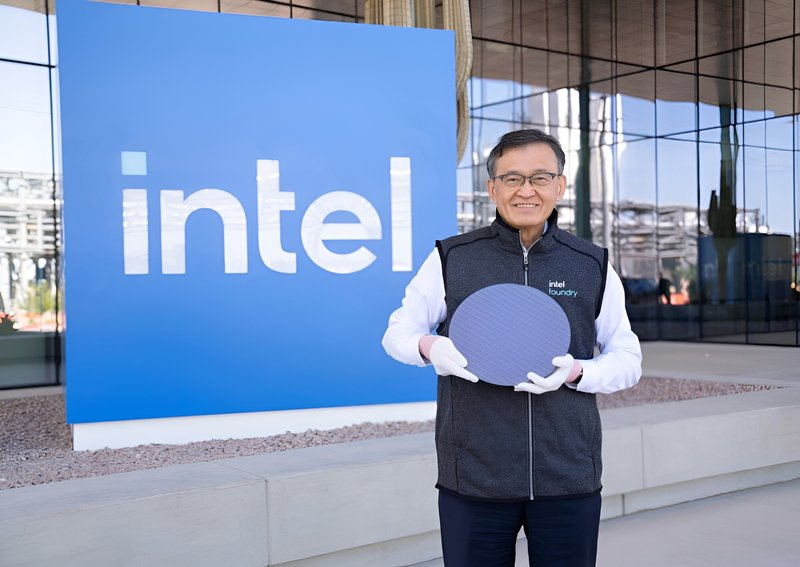
Hello techies, how are you all doing? Today I bring you news that left me with my jaw on the floor, and that’s that Intel has just landed one of the most important contracts in its history. The company has been selected as an official supplier of chips and advanced packaging services for the SHIELD program of the United States Department of Defense. We’re talking about an initiative with a budget ceiling of up to 151 billion dollars aimed at developing critical defense and national security capabilities. Yes, you read that right: one hundred and fifty-one billion dollars. It’s a figure that makes your head spin just thinking about it, and it marks one of the biggest recent milestones for the Intel Foundry division.
The interesting thing about this contract is that it consolidates the historic relationship between Intel and the US government, which had already included the company in sensitive projects such as the Secure Enclave contract, valued at 3.5 billion dollars. But in the case of SHIELD, the strategic relevance is even greater. The program seeks to build a resilient technological infrastructure for next-generation defense systems, where technological sovereignty and local manufacturing are absolutely decisive factors. In a world where geopolitical tensions are the order of the day, having total control over the semiconductor supply chain is vital for national security.
Intel has stressed that its competitive advantage lies in being the only American company that combines research and development in advanced logic with cutting-edge semiconductor manufacturing within the country. It also has mature advanced packaging capabilities and a robust supply chain. These strengths position the company as a key partner for critical defense missions that require reliability, traceability and total control over production. It’s not just about manufacturing chips, but about ensuring that every component can be tracked and verified from its origin to its final deployment.
Although the specific nodes to be used within the program have not been revealed, it is expected that a significant part of the contract will use mature technologies optimized for military applications, such as Intel 16, widely used in analog and radiofrequency components. At the same time, Intel continues to push its most advanced nodes, such as Intel 18A, which promises up to 25% more frequency at the same power consumption and 36% less power consumption at the same frequency compared to Intel 3. This is not only impressive from a technical point of view, but also positions Intel as an attractive platform for commercial customers seeking energy efficiency and performance.
This move comes amid a strategic reconfiguration for Intel Foundry, which seeks not only to strengthen its role within the United States, but also to attract large-scale external customers. Companies like Apple and Qualcomm have been mentioned in preliminary conversations about future nodes such as 18A-P and 14A, although there are still no definitive public commitments. What is clear is that Intel is betting big on recovering its leadership position in the semiconductor industry, and this contract with the Pentagon is a key piece of that strategy.
Best regards, Marta
Automatically published on 22/01/2026 at 12:05