
When people talk about power interconnectors between countries, the conversation usually stays on politics: how much energy is bought, what it costs and who depends on whom. But underneath sits an engineering problem that decides everything else: the electricity that leaves a submarine cable is not the same as the electricity that enters it. Not out of caprice, but because alternating current, the form in which energy has travelled on land for a century, behaves awkwardly when the conductor runs underwater.
The links that cross the sea over long distances — Viking Link between Denmark and the United Kingdom, NordLink between Norway and Germany, or the one planned in the Bay of Biscay between Spain and France — carry around 1,400 to 2,000 megawatts as direct current at ±525 kilovolts. The interesting detail is not the size: it is that those cables could not work on AC even if we wanted them to.
Why AC drowns in water
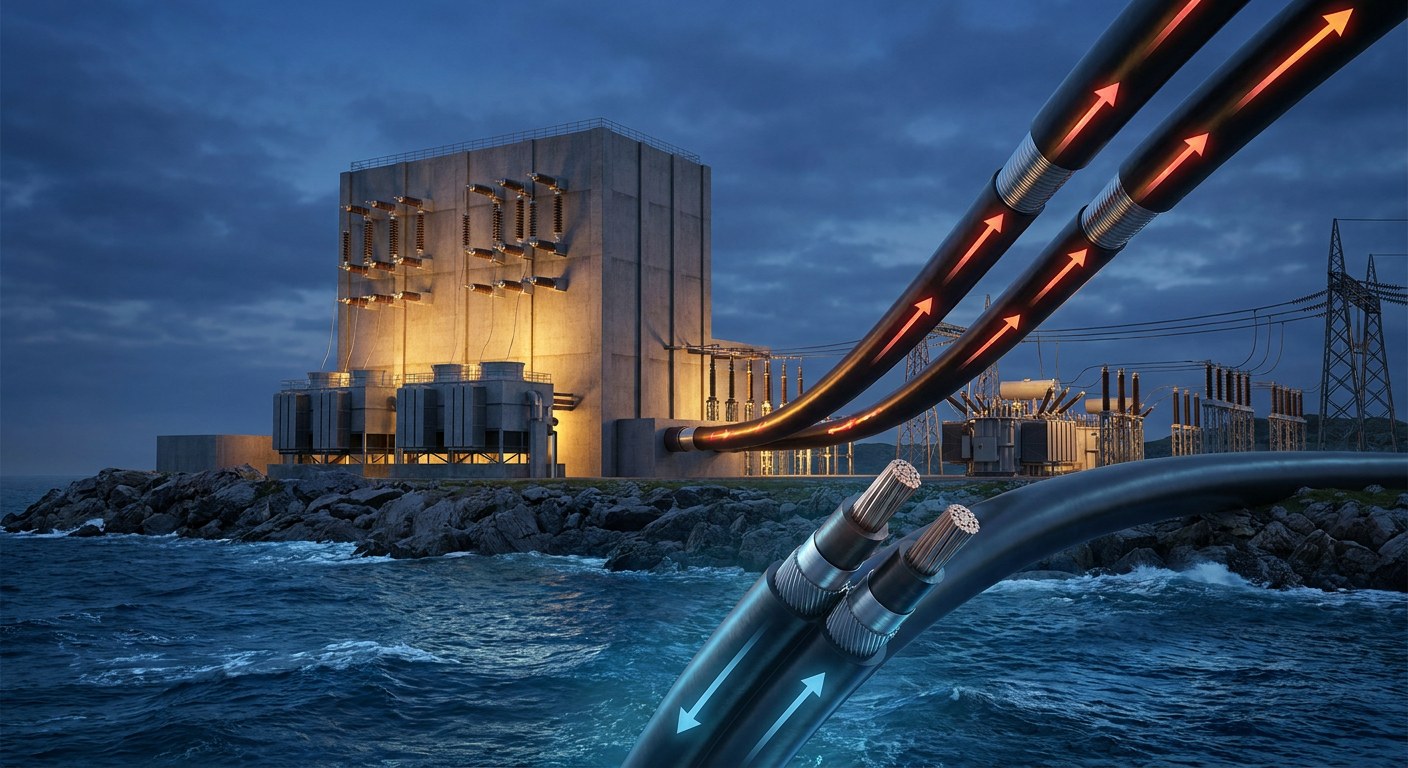
A submarine cable is, electrically, a capacitor. It has a central conductor, an extruded polymer insulation and a metallic screen or outer armour tied to earth; between conductor and screen a capacitance appears, spread along kilometres. In alternating current that capacitance charges and discharges eighty times a second, and doing so requires a current that delivers no useful power to anyone: the capacitive, or charging, current. The longer the cable and the higher the voltage, the more current is spent charging and discharging the insulation itself. In a 400 kV cable at 50 Hz the practical limit sits around 60 to 80 kilometres: beyond that, charging current eats the transfer capacity. That is why no long interconnector is built on AC.
On DC the cable is charged once, when it is energised, and afterwards the voltage is constant. Capacitance stops being a problem and only conductor resistance remains, which at ±525 kV is small because the current needed is modest: two gigawatts at 525 kV is about 1,900 amps per pole, a figure a 1,500 or 2,500 square millimetre cable handles without excessive heating.
Two converters and a border in between
The price of that advantage is having to convert twice. At each end of the cable stands a converter station: transformer, valve hall, cooling, DC yard and protection. The scheme most widely deployed today is the modular multilevel converter, or MMC, which replaced the old line-commutated converters. Each arm of an MMC is a series chain of submodules, each with a capacitor, two IGBTs (insulated-gate bipolar transistors) and their diodes. A modern link may have two or three hundred submodules per arm, each switching around two or three kilovolts.
The trick of the MMC is how it builds the wave. Instead of chopping the voltage at a very high switching frequency, the converter inserts and bypasses submodules in the chain, so the output voltage rises and falls in steps. With hundreds of steps the wave resembles a sine so closely that it barely needs filters: harmonics stay far below what classic converters demanded. Arm inductors limit the rate of current change and share the stress among modules. The result is equipment that switches little per transistor — fewer losses — and can even keep running with a failed submodule, because the system bypasses it and redistributes the voltage.
From ±320 to ±525 kV
The link voltage is not chosen at random. Raising it lowers the current for the same power and, with it, resistive losses and the copper required; but it makes insulation, cables and valves more expensive. Early commercial links ran at ±320 kV; today’s high-capacity ones run at ±525 kV with cross-linked polyethylene insulation, and higher levels are already being tested. As a loss reference: a modern converter station stays around 1% of the power it handles, and the cable, at ±525 kV, loses on the order of 0.5 to 0.6% per thousand kilometres. Adding two converters and several hundred kilometres of sea, a complete link can deliver more than 95% of what it receives.
One detail that is rarely mentioned: the return path. Links can be monopolar with sea return — two electrodes on the seabed, one at each shore, injecting current into the water — or bipolar with a metallic return conductor. The former saves a cable and works, but the electrode corrodes and the electric field on the seabed raises environmental concerns; that is why new projects lean towards the bipolar scheme or monopolar with metallic return.
Cutting two gigawatts is not like flipping a switch
On AC, a breaker opens at the instant the wave crosses zero; the arc extinguishes by itself. On DC there is no zero crossing, so an arc of thousands of amps does not go out: it has to be forced. That is why DC grids have not been meshed the way AC ones have. High-voltage DC breakers have existed for a few years — they combine fast switching with a circuit that injects an opposing current to cancel the arc within milliseconds — and some converters with full-bridge submodules can block fault current from the valves themselves. With both pieces, the industry has started talking about multiterminal grids rather than point-to-point links only.
Two grids that stop dancing together
There is a consequence as important as capacity: DC decouples the two systems. An MMC converter actively controls the power it injects and does so on millisecond scales, independent of the frequency on the other side. The link does not carry the mechanical inertia of the neighbour’s generators, and that forces each grid to manage its own stability, with synchronous condensers, batteries or converter control. In exchange you get fine regulation: the link can provide reserve, support the voltage of a weak grid, black-start a collapsed area and even keep operating with one of the two shores dark.
That is, in the end, the real business of 525,000 volts under the sea: not just moving electrons from one country to another, but being able to decide, at every instant, how many and in which direction, with a precision that synchronised AC never allowed.