

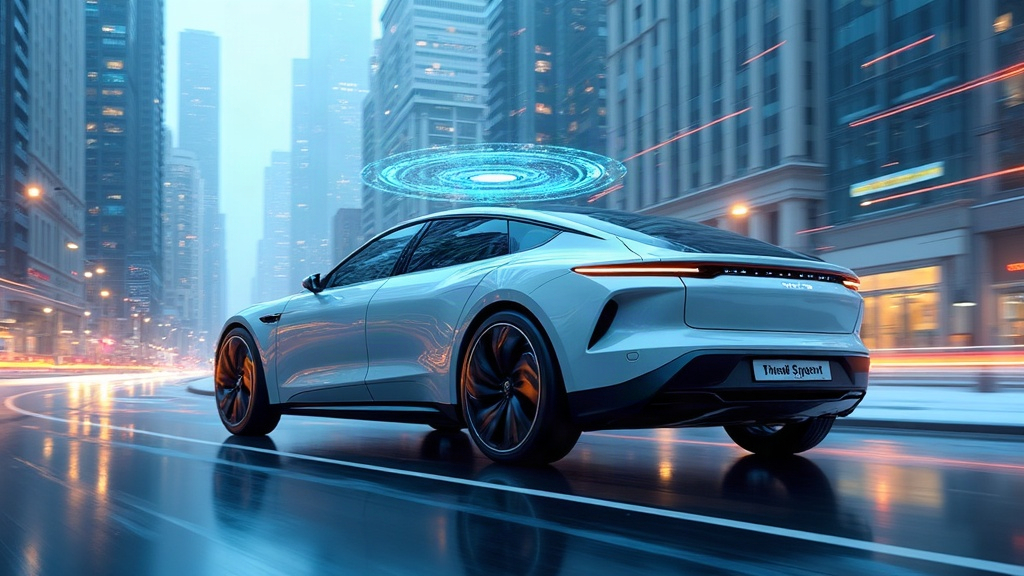
Imagine a car that drives itself. Without anyone touching the wheel, the vehicle decides when to brake, when to turn and how to dodge a pedestrian crossing unexpectedly. This is no longer science fiction: autonomous cars have been circulating in tests on the streets of the United States, China and some European cities for years. But how do they manage to do it?
A car that “sees” for you
The key is that the autonomous car does not drive with eyes, but with sensors. On its roof it usually carries a spinning device called LIDAR, which fires thousands of light pulses per second and measures how long each one takes to bounce back. In this way it builds a three-dimensional map of everything around it, with centimetre precision.
But the LIDAR does not work alone. The cameras recognize traffic signs, traffic lights and road lines. The radars measure the speed of the cars ahead. And all of that, combined, allows the vehicle to know where it is and what is happening around it at all times.
The brain: artificial intelligence
Having eyes is useless without a brain to interpret what they see. That brain is a set of artificial intelligence algorithms trained with millions of kilometres of real and simulated driving. Thanks to that learning, the system learns to distinguish, for example, the difference between a shadow on the road and a real obstacle, or between a stationary pedestrian and one about to cross.
When it detects danger, it decides in milliseconds. It is faster than any human driver, and it does not get distracted by looking at its phone nor does it get tired after hours at the wheel.
Levels of autonomy: from assistance to full autopilot
Not all autonomous cars are the same. Experts speak of levels from 0 to 5. At levels 1 and 2, the car only assists: for example, it keeps the distance from the vehicle ahead or stays in its lane, but the driver remains responsible. At level 3, the car can drive on its own in certain situations, such as on the motorway, although it must be ready to hand back control if asked.
Level 4 already allows the car to drive without intervention in specific areas and under defined conditions. And at level 5, the highest, the car would drive on its own anywhere and in any circumstance, without a steering wheel or pedals. Today, most vehicles on the road are at levels 1 and 2; the autonomous taxis already operating in some cities are at level 4.
Is it safe?
This is the big question. Supporters point out that most road accidents are caused by human errors, and that a machine that does not get distracted could save thousands of lives. Sceptics, on the other hand, recall that the technology still has flaws and that there are situations that are very hard to foresee, such as a traffic officer making hand signals or an unsignalled roadworks site.
That is why manufacturers are cautious and tests are carried out in stages. Even so, data from pilot programmes show that autonomous cars already travel millions of kilometres with a very low incident rate.
A future that is already here
Autonomous cars are not going to suddenly replace all the cars we see on the street. But little by little we will see more vehicles that help us park, that keep the speed on the motorway by themselves or that take us from one point to another in controlled urban areas.
The day the steering wheel becomes a museum piece is still far off, but the technology that will make it possible is already underway. And the most surprising thing is that, in large part, it works thanks to principles anyone can understand: light that bounces, cameras that observe and an artificial intelligence that has learned to drive by practising, just like us.