

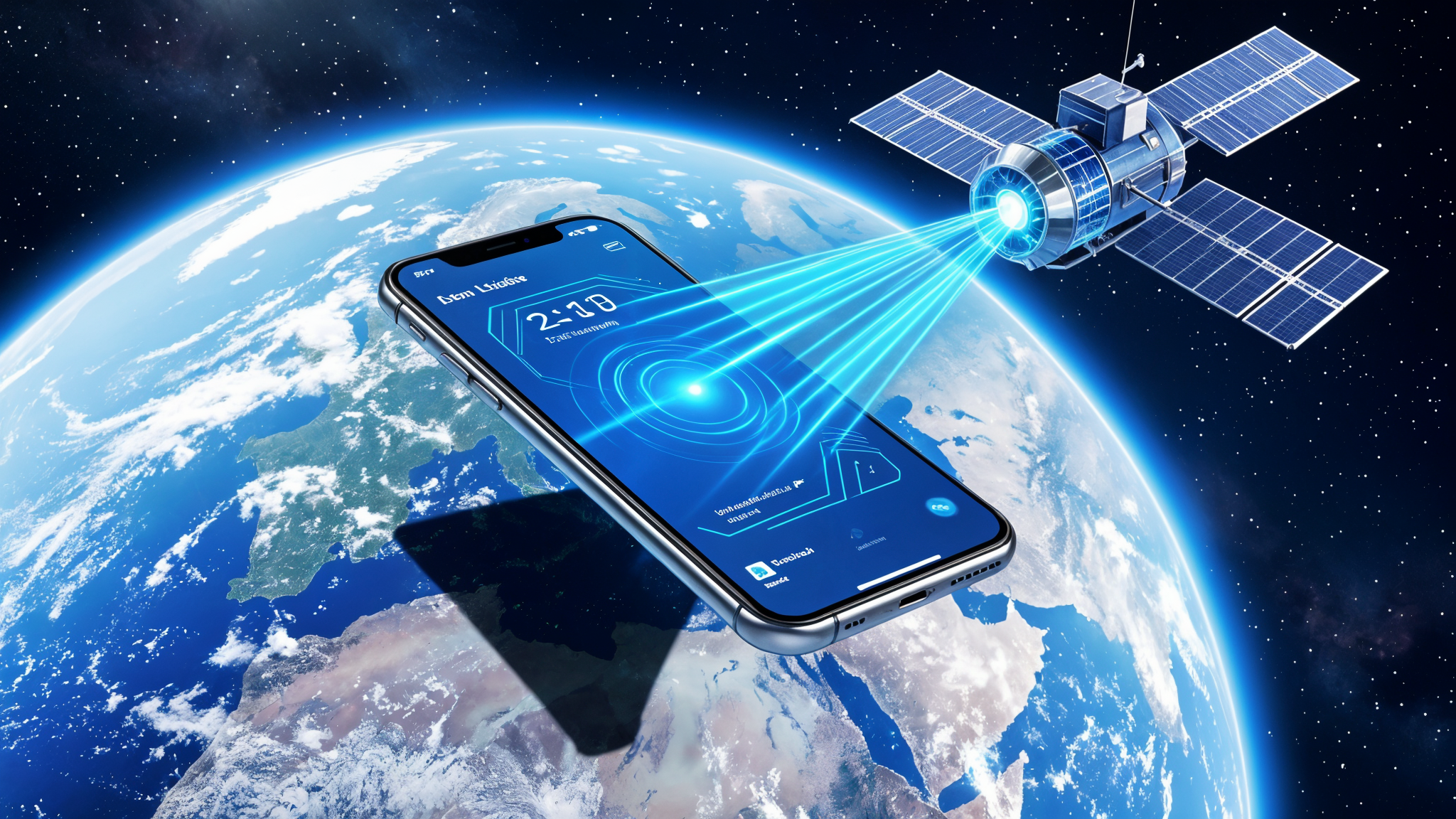
Your phone no longer needs a nearby cell tower to have coverage. In recent months, several companies have begun offering internet connection directly from space, using satellites that speak the same language as your phone. It is a change that promises to put an end to dead zones —those places where the signal does not reach— without you having to change your device or install a satellite dish on the roof.
What direct-to-phone satellite connection is
Until now, if you wanted satellite internet you needed specific equipment: an antenna pointed at the sky, a router and, often, a professional installation. The new generation of services —led by Starlink with its Direct to Cell technology, but also with proposals from AST SpaceMobile, Lynk and others— eliminates that extra hardware. The satellites broadcast on the same frequency bands used by terrestrial 4G and 5G networks, so your current smartphone can connect to them as if they were just another antenna.
The difference is that this “antenna” flies hundreds of kilometres high and covers a huge area. Where there is no tower, the satellite does the job. And since the phone cannot tell one from the other, the experience for the user is seamless: you see coverage, you make calls, you send messages and you browse.
How it works without changing your phone
The secret lies in standardization. The satellites use the NB-IoT protocol (a 4G variant designed for low-power, long-range devices) and, in the most recent versions, native 5G NR. Your phone already carries the compatible modem; it just needs the network —in this case, the space network— to answer it in the same language.
When you lose terrestrial coverage, the phone automatically looks for the satellite signal. If one is in view, it registers on its network just as it would with Movistar, Orange or Vodafone. Latency is higher than on fibre or urban 5G, but enough for messaging, email, light browsing and, in the most advanced rollouts, basic voice and video calls.
What services are already operational
Starlink Direct to Cell (SpaceX) is the most visible. After launching its first satellites with this capability in early 2024, it has struck deals with T-Mobile in the US, Rogers in Canada, Optus in Australia, One NZ in New Zealand, KDDI in Japan, Salt in Switzerland and Entel in Chile and Peru. In Spain, the regulation is still to be defined, but the orbital infrastructure already flies over the country.
AST SpaceMobile has demonstrated voice and 4G/5G data calls with standard smartphones using its BlueWalker 3 satellite and the BlueBird constellation. It has agreements with AT&T, Verizon, Vodafone Group, Rakuten and Telefónica, among others.
Lynk Global already operates in several countries offering SMS and basic messaging via satellite with local operators, and plans to expand into voice and data.
What changes for the everyday user
The immediate thing is universal coverage. Mountain hiking, sailing on the high seas, rural areas without fibre, secondary roads, building interiors with poor penetration: in all those cases, the satellite fills the gap. You do not need to buy an expensive satellite phone or a separate plan; your terrestrial operator sells you access as an extension of your current tariff (or as a cheap extra).
In emergencies, the difference is vital. Already today, iPhone 14 and later and several high-end Android phones allow you to send an SOS via satellite without mobile coverage. Direct-to-phone connection generalizes that capability: anyone with a reasonably modern phone will be able to call for help from anywhere.
Challenges still to be solved
Capacity is the big limit. A satellite has much less bandwidth than a dense terrestrial network; it is good for messaging and light browsing, not for watching 4K streaming or downloading heavy games. Latency —the delay of the signal travelling to space and back— is around 25-50 milliseconds in low orbit, acceptable for almost everything except competitive gaming.
Spectrum regulation is another front. Each country decides which frequencies a satellite can use and under what conditions. In Europe, the European Conference of Postal and Telecommunications Administrations (CEPT) and national regulators are defining the framework; until it is ready, operators cannot switch the service on commercially.
And then there is the battery. Keeping a connection with a satellite consumes more energy than with a nearby tower; manufacturers are optimizing firmware so the impact is minimal, but in areas without terrestrial coverage the phone will use more power.
The future: the invisible hybrid network
The trend is not to choose between satellite and ground, but to merge them. The 3GPP Release 17 and 18 standard already envisages the “non-terrestrial network” (NTN) as an integral part of 5G. Within a few years, your phone will jump from the 5G tower to the satellite and to Wi-Fi without you noticing, always choosing the best option. Coverage will stop being a map of antennas and become a continuous mesh covering 100% of the territory.
For the user, the promise is simple: wherever you are, there is signal. And that, in a world where being connected is no longer a luxury but a necessity, changes the rules of the game.