
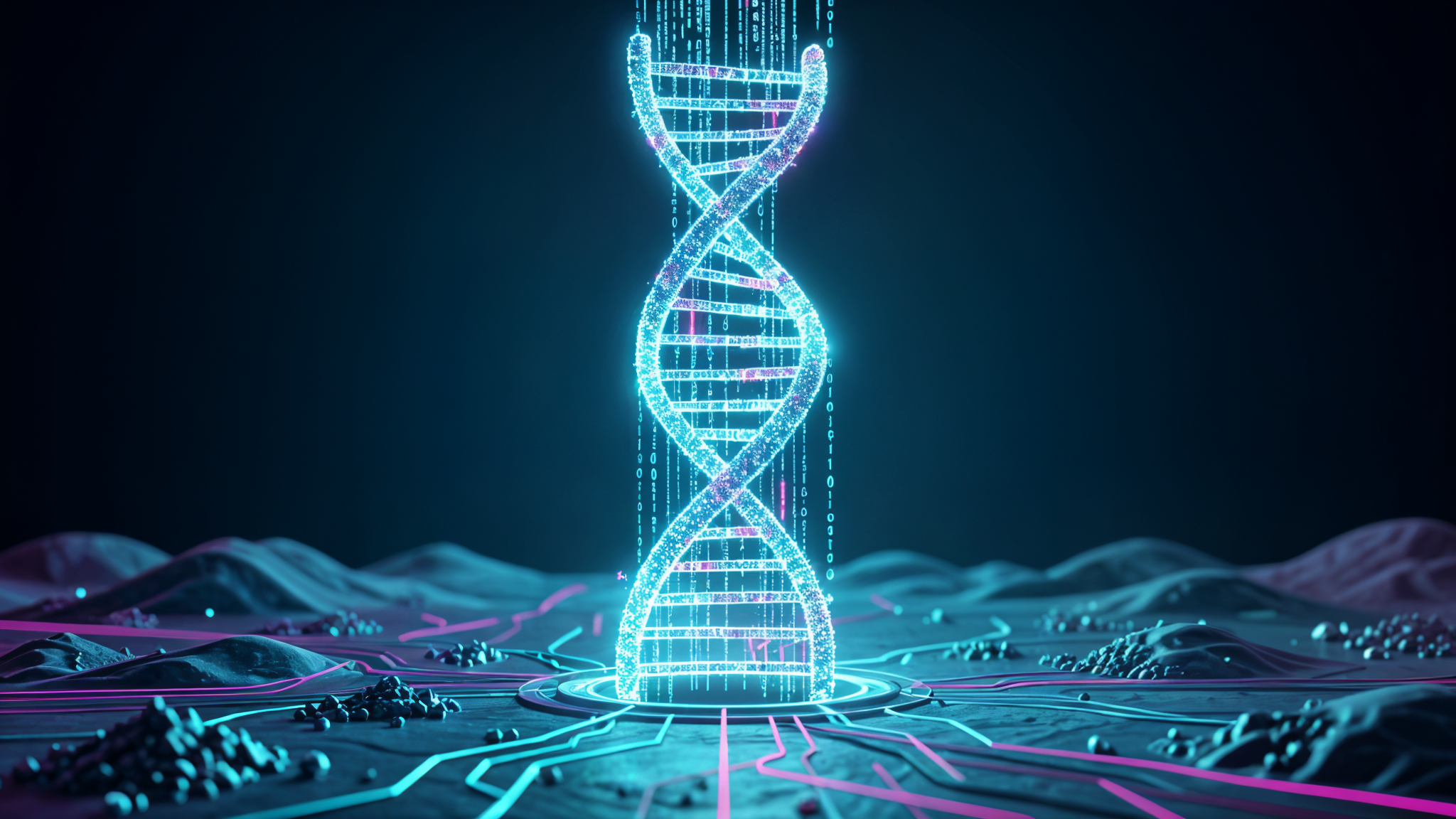
All of your digital life fits in the palm of your hand. But within a few years, the information of all of humanity could fit in something much smaller: a few grams of DNA. The same molecule that stores the instructions of life has become the great promise for the data storage of the future.
Why DNA?
Current hard drives and clouds have a problem: they take up space and need constant energy. A large data centre can fill several football fields and use as much electricity as a small city. And yet, the amount of information we generate keeps growing.
DNA solves both things. It is incredibly dense: a single gram can store more than 200 million gigabytes. And it is very stable: DNA thousands of years old has been recovered in good condition. A DNA archive could survive for centuries without needing electricity or maintenance.
This is how a piece of data is stored in DNA
Our computers work with zeros and ones. DNA works with four chemical letters: A, C, G and T. The idea is simple: translate the zeros and ones into those four letters, and then manufacture small DNA strands that contain them. To read the file, you only need to sequence those strands and translate the letters back into zeros and ones.
It sounds like science fiction, but it has already really been tested. Books, videos, songs and even a copy of the entire Wikipedia have been stored in DNA. It is not a theoretical idea: it is a technology that works.
The challenges still to be overcome
The main obstacle is cost. Manufacturing and reading DNA is still expensive and slow. Writing a file can take hours and require very specialized equipment. For that reason, today it is not for saving your phone photos, but for preserving valuable information that must last a very long time.
Errors also have to be avoided. Nature makes small mistakes when copying DNA, so researchers include “correction codes” so that a failure in one letter does not ruin the whole file. It is like adding extra words to a message so you can reconstruct it even if part is lost.
When will it reach your life?
Experts believe DNA will not replace hard drives, but will join them. It will be used for what really matters: historical archives, patents, the genetic material of species, legal documents or backups of museums and libraries.
Technology companies and laboratories around the world are already researching how to make the process cheaper. When the cost drops enough, DNA will become humanity’s definitive filing cabinet: the place where we keep, for centuries, everything we do not want to forget.