
You bring your card close to the terminal, it beeps, and the payment is done. Between one gesture and the other, 300 to 800 milliseconds go by in which three systems you never see are involved: a 13.56 MHz radio link that powers the card, a chip with cryptographic keys that signs the operation, and an authorisation network that asks your bank whether there is money available. None of the three is new, but how they fit together is one of the finest pieces of engineering we use every day without thinking about it.
The terminal supplies the power and the card replies by modulating the field
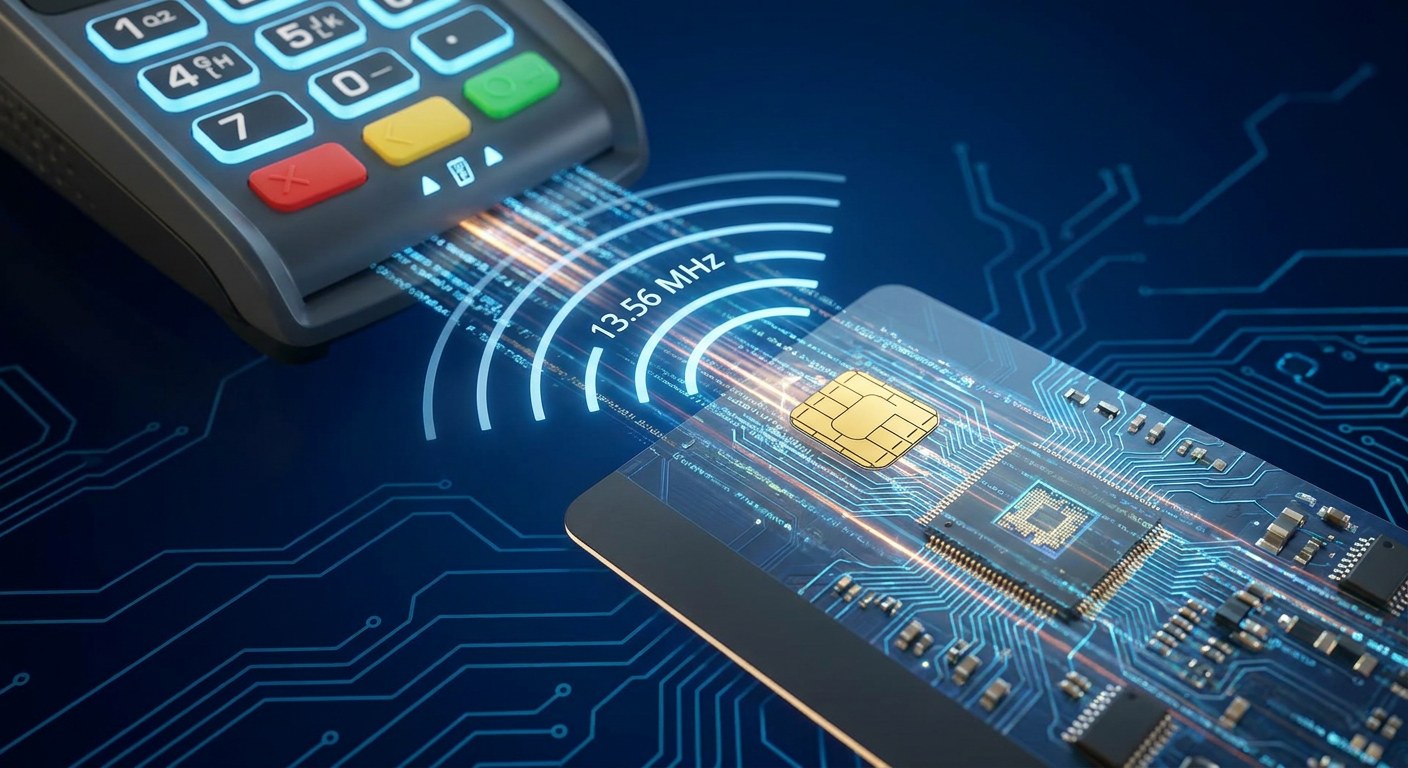
A contactless card has no battery: replacing one every few years without opening the card would be impossible. The reader supplies the energy. The terminal generates an alternating magnetic field at 13.56 MHz through a flat coil printed on the circuit board; when the card enters that field, its own antenna — also a loop etched into the plastic — induces a current that powers the chip. This is plain inductive coupling, the same principle as a transformer, except that here the secondary is a microcontroller of a few square millimetres that boots on the little voltage it receives.
To send data back, no transmitter is needed: the card sends it by loading the field. It switches a resistor in parallel with its antenna, which slightly changes the amplitude of the field the reader is generating; the terminal detects that variation and decodes it. This is load modulation from the ISO/IEC 14443 standard, and it explains why the useful range is about four centimetres: field strength falls with the cube of distance and, beyond a few centimetres, there is not enough energy for the chip to start. The initial link speed is 106 kbit/s, the subcarrier sits at 847.5 kHz, and a frame with parity and a CRC is enough for an exchange that needs no more bandwidth.
First the protocols are negotiated: PPSE, AID and a file list
The terminal does not know what is inside the card. The first thing it does is ask for the PPSE (Proximity Payment System Environment), a directory listing the available payment applications. A normal card usually has one: Visa, Mastercard or the local network. The answer includes the AID, an application identifier (for example A0000000031010 for Visa) that the terminal uses in the next command, SELECT. From there it runs GPO (Get Processing Options), which returns two structures: the AIP, with the card’s capabilities (authentication, limits, cipher types), and the AFL, a list of the data files the terminal must read with READ RECORD. Those records carry the card number, expiry date, issuing country and the cardholder verification rules.
That whole dialogue consists of APDU commands, the same data units contact chips have used since the 1990s; contactless only changes the transport, not the meaning. The terminal therefore holds the card’s public data in about 30 milliseconds.
The signature: a cryptogram only that chip can produce
Here is the heart of the system. The chip keeps a set of keys in secure memory that never leave it, not even when the terminal asks for them. For each transaction the card computes a cryptogram: a message authentication code (MAC) over a block of data that combines the amount, the currency, the date and, crucially, a four-byte unpredictable number generated by the terminal’s random generator. The card applies a 3DES or AES algorithm with a key derived from an internal counter — the ATC, incremented on every operation — and returns the result along with that counter.
The result is called ARQC (Authorization Request Cryptogram) when the card asks for online authorisation, TC (Transaction Certificate) when it approves the operation on its own and AAC when it declines it. The ARQC is what travels to the network: a bank can verify in milliseconds that only the genuine chip, with the right key and the right counter, could have produced it. An attacker who copies the conversation cannot replay it, because the unpredictable number changes on every attempt and the ATC will have moved on. That is why cloning a chip card is a far harder problem than copying the magnetic stripe, which has none of this and is read in the clear.
From the till to the bank over ISO 8583 messages
The terminal does not talk to the customer’s bank but to its own acquirer (the institution providing the merchant service). The message it sends is an ISO 8583 frame: a structure of numbered fields where 2 is the card number, 3 the transaction type, 4 the amount, 11 the terminal’s trace number and 55 — the interesting one — the EMV data, including the ARQC, encoded in TLV. The acquirer routes it to the scheme (Visa, Mastercard), the scheme to the issuer (your bank), and the response comes back the same way: an 0110 message with a two-digit response code where “00” means approved.
That round trip takes hundreds of milliseconds, and at peak times a single issuer handles thousands per second. When the issuer does not answer in time, stand-in authorisation applies: the scheme itself approves up to a pre-agreed risk limit so the supermarket queue does not stall because of a slow server. It is also why a payment can be approved and then, in that night’s clearing, corrected.
Tokenisation: the card that is no longer your card
When you pay with your phone or watch, the number that travels is not your card number. The issuer creates a token (DPAN, Device PAN) tied to that specific device, and the cryptogram is computed with keys from the phone’s secure element, not from the plastic card. If you lose the phone tomorrow, the bank disables the token and your physical card keeps working. The merchant never sees the real number, and the token only works in the scope it was issued for — one merchant, one country, one device — which sharply reduces the value of a point-of-sale data breach.
Why it sometimes asks for your PIN and sometimes does not
Contactless is not “payment without verification”: it is payment with deferred verification. The card keeps a transaction counter and an accumulated amount; below a threshold — in Spain, 50 euros per transaction and a cumulative total around 150 — the terminal accepts the chip’s signature without a PIN. Above it, the AIP signals that cardholder verification is required and the terminal asks for the PIN, which is validated against the chip rather than the bank in the offline case. Mobile wallets skip that threshold because they have already verified the user biometrically on the device itself (CDCVM): the phone certifies it was you, and that counts as a PIN.
The security is not in the distance, which is only a physical consequence, but in that chain: a chip that cannot be copied, a counter that prevents replay, one cryptogram per transaction and a token that decouples the device from the real number. All of it happens, literally, in the time it takes you to hear the beep.