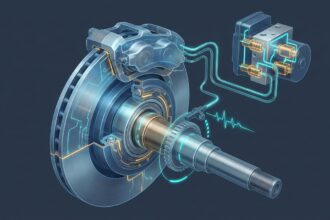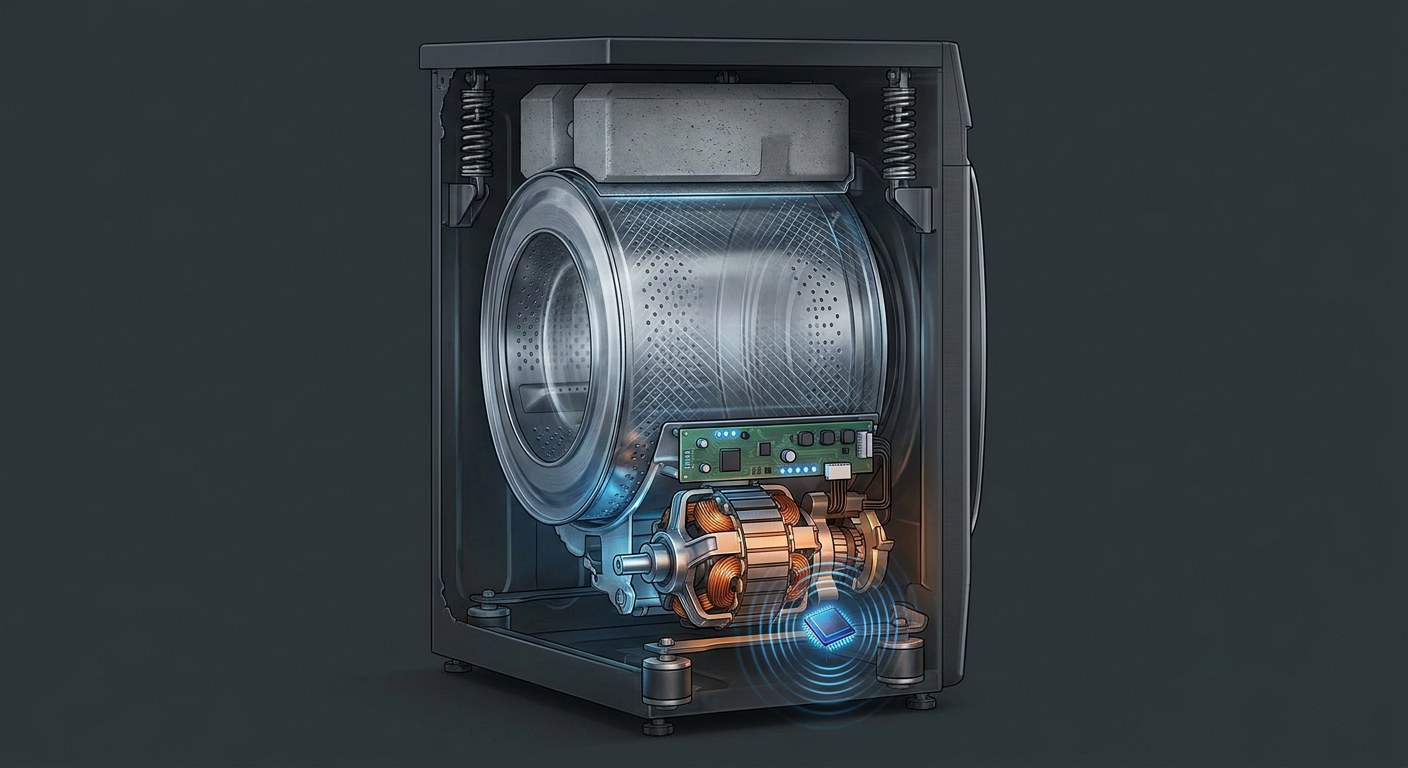
You press start and the washing machine does something that looks like a fault: the drum turns a quarter turn, stops, turns the other way, stops again, and repeats the manoeuvre three or four times. For those twenty seconds it is not washing or wetting anything. It is weighing the laundry. And it does so with no scale at all, using only the motor and a handful of sensors that cost cents.
The motor is not what it used to be
Washing machines thirty years ago used a brushed universal motor, the same type as a workshop drill: it spins on direct or alternating current, delivers plenty of torque at low speed and is regulated by a triac that chops the 230 V wave. It was cheap and noisy, and it forced a fixed-speed programme: wash, rinse, spin.
Today’s machine carries a permanent-magnet synchronous motor (PMSM) or a brushless one (BLDC), three-phase, driven by an inverter. The electronics rectify the mains into a DC bus of about 325 V, smooth it with capacitors and chop it with six IGBTs or MOSFETs in a three-phase bridge at a switching frequency of 10 to 20 kHz. By varying the pulse width (PWM) it synthesises a wave of arbitrary frequency and amplitude: from 40 rpm for washing to 1,400 for spinning, with no steps.
Control is done with FOC (field-oriented control): the three phase currents are measured, transformed into the rotor reference frame and split into two components, one that creates magnetic flux and one that creates torque. Torque is proportional to that second component, so the electronics know exactly how much effort they are applying at any instant. And since there is no encoder, the rotor angle is estimated from the back-EMF the magnet induces in the coils, or from how inductance changes with rotor position. That estimator is what allows a start from zero without the drum jerking.
Weighing with Newton’s law
The rotation equation is the same as the one for a cart: applied torque equals moment of inertia times angular acceleration, plus friction losses. T = J·α + B·ω. The electronics know T, because they control the current, and measure α by differentiating the speed their observer estimates. Solving for J gives the moment of inertia of drum plus laundry.
The empty drum contributes a known value, between 0.4 and 0.6 kg·m² depending on diameter and steel mass. A few kilos of dry laundry add considerably more, and the difference is the weight. The estimate does not come out on the first try: laundry is not a rigid disc glued to the wall but a mass that falls, rolls and clumps in a different spot on every turn. That is why the machine makes several short passes in both directions and averages them. In the end it has a figure with an error of a few hundred grams, enough to decide the water level.
Because weight alone is not enough: the programme needs to know how much water it will absorb. Cotton, towels and sheets hold far more water per kilo than polyester or silk. The machine estimates it by crossing the weight with the selected programme and then corrects on the fly with the level sensor: a pressure transducer connected to an air chamber at the bottom of the tub, which measures the water column and outputs a frequency signal. Ten centimetres of water is about 980 pascals, and the electronics turn that into litres inside the tub.
The enemy is not weight, it is imbalance
A drum with six kilos evenly spread spins without trouble. The same weight concentrated on one side becomes an eccentric mass that, as it turns, generates a force growing with the square of speed: F = m·e·ω². A single kilo stuck five centimetres from the axis at 1,400 rpm (about 147 radians per second) produces more than a thousand newtons, the equivalent of hanging a hundred kilos off the shaft. At 1,000 rpm the force drops by half, because it goes with the square.
There are three defences against that. The first is mass: the concrete block bolted to the tub, between 8 and 12 kilos, raises the inertia of the assembly and damps it. The second are the springs that hang the tub from the chassis and the friction dampers, two or three of them, which are not hydraulic like a car’s but dry-friction: a rod rubbing inside a tube against washers. They are chosen that way because little damping is wanted when the drum spins above its critical frequency and a lot when it crosses it. The third is the electronics, and that is what really keeps the machine from walking across the kitchen.
A three-axis MEMS accelerometer, in the ±2 or ±4 g range, is mounted on the tub or the chassis. It measures vibration, and from its amplitude and phase the system works out which side the excess mass is on. If the imbalance exceeds the threshold before spinning, the machine redistributes: it adds water, turns slowly one way and then the other so the laundry unrolls, and measures again. If it fails, it lowers the top speed: from 1,400 to 1,000 or 800 rpm. That is not a fault, it is a calculated decision.
The drum crosses a dangerous zone, and crosses it running
The tub hanging on its springs is an oscillator: it has a natural frequency, typically between 150 and 300 rpm. If the drum turned exactly at that speed it would hit resonance and the amplitude would grow until it struck the chassis. But the spin range, 1,000 to 1,600 rpm, sits well above that critical frequency, in what engineers call the supercritical zone. There the system self-centres: the eccentric mass tends to settle on the opposite side and the shaft stabilises by itself.
The problem is the crossing. On startup the machine has to pass through resonance, which is why it accelerates quickly through that band instead of lingering. It knows where the band is because it detects it: vibration amplitude spikes exactly on arrival.
Where the electricity goes
The motor is not the big consumer. A washing machine inverter draws 200 to 500 watts, and only during the spin. What runs up the bill is the 1,700 to 2,000 watt heating element. Heating 60 litres from 15 to 40 degrees takes m·c·ΔT: about 6.3 megajoules, that is 1.7 kWh. That is where the programme comes in: lower the temperature and make up for it with more time and more turns.
And spinning saves energy outside the machine. Laundry comes out with less water, and every kilo of water that does not have to be evaporated in the dryer is several hundred watt-hours. That is why the eco programme washes at 30 degrees for three hours and then spins flat out: the overall balance is better.
The remaining sensors are more modest but just as useful. An LED and a photodiode measure water turbidity to decide whether another rinse is needed; a conductivity sensor estimates hardness and adjusts the water softener; an inlet valve with aquastop cuts the supply if it detects a leak; and the door lock is a PTC resistor that heats a bimetallic strip and releases the latch only once the tub has cooled down. None of that weighs the laundry. That is still done by the motor, measuring how much it costs to accelerate.