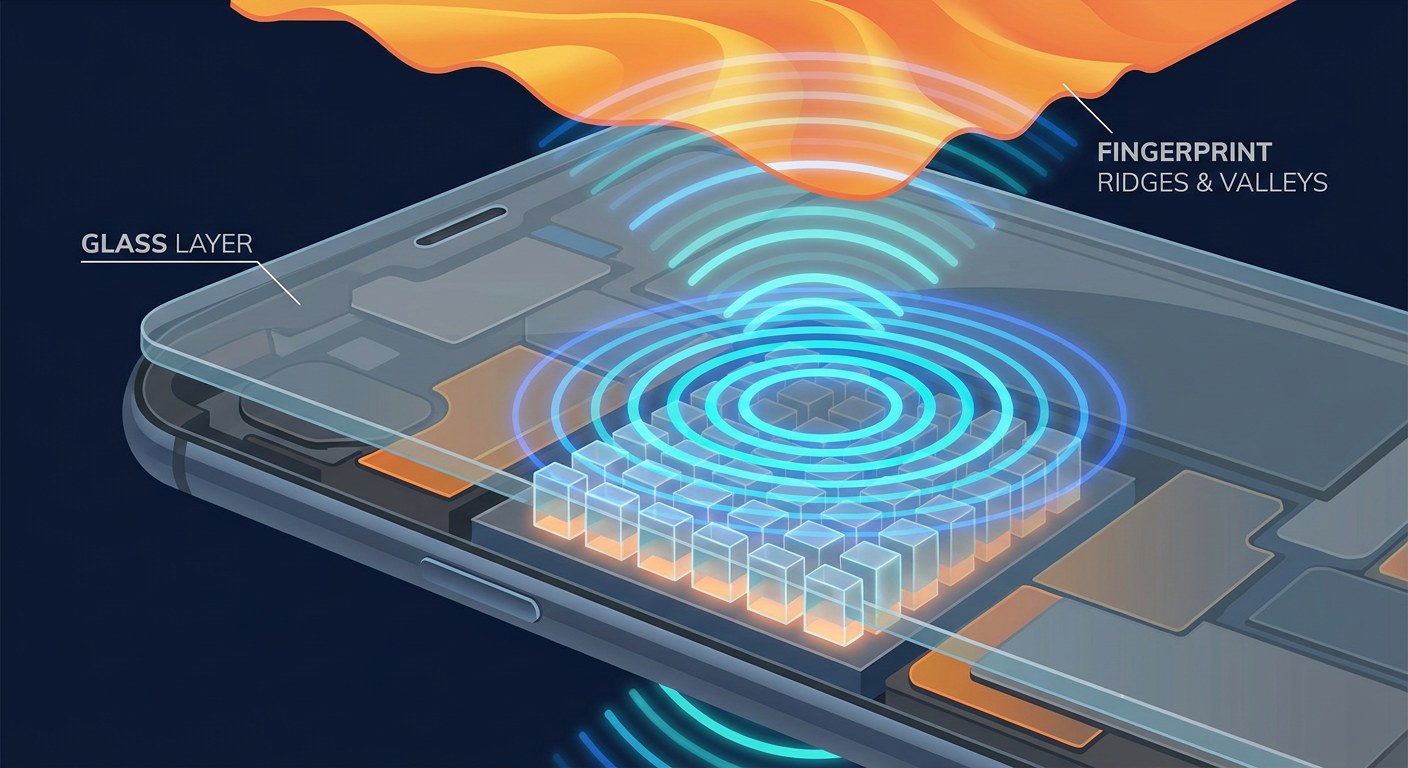
You place your finger on the screen, a circle appears, the phone buzzes and unlocks. In that half-second gesture there is no camera looking at your finger: there is an array of tiny silicon drums that emit sound far above what the human ear can hear and then listen to their own echo. That is the principle behind ultrasonic fingerprint sensors, the ones hidden underneath the display, with no physical button and no visible cut-out in the glass.
Sound tells a ridge from a valley without seeing either
A fingerprint is not a stain: it is a relief of ridges and valleys a few tenths of a millimetre deep. To work out what is at each point, the sensor relies on a physical quantity that rarely comes up in conversations about screens: acoustic impedance, the resistance a medium offers to the passage of a sound wave.
When a sound pulse reaches the underside of the glass, part of it passes into whatever lies beyond and part bounces back. The split depends on the impedance jump between the two materials. Glass sits around 12 million rayls (the unit of acoustic impedance) and air barely 400, so wherever the glass only touches air almost all the energy returns: the echo comes back strong. Where a skin ridge rests on it, the impedances are far closer, a fraction of the sound crosses into the skin and dissipates in the tissue, and the echo returns weaker. From that amplitude difference, point by point, the sensor rebuilds the relief without needing light or lenses.
Pulse, wait, echo: how the map is built
The core of the system is a matrix of piezo-electric micromachined transducers, known as PMUTs. Each element is a silicon membrane a few microns thick carrying a thin layer of piezo-electric material — aluminium nitride or PZT — that deforms when a voltage is applied and, conversely, produces a voltage when deformation arrives from outside. It is the same property used by pressure sensors and medical ultrasound probes, shrunk down and built with silicon-wafer processes, which allows hundreds or thousands of elements to fit in an area the size of a fingernail.
The measurement cycle is always the same. The elements fire a short pulse, on the order of nanoseconds, in a band of tens of megahertz; the system switches to listening and samples the echo during a very brief time window. For each element it gets one trace of amplitude against time, and time of flight becomes depth once you multiply by the speed of sound in glass, around 5,000 metres per second. Depth resolution depends on wavelength: the higher the frequency, the finer the detail, but also the greater the attenuation through the panel and the tougher the job for the receiving electronics.
Because a single shot yields a weak, noisy signal, the sensor averages several emissions and combines the responses of groups of elements using beamforming: by summing signals from several transducers with the right delays, sensitivity is focused on a particular region of the finger. The output is a three-dimensional height map, not a two-dimensional picture.
From echoes to a template that is not a photograph
That map goes through processing that locates the characteristic points of the fingerprint: ridge endings, bifurcations, pores and the distances between them. What matters is what does not happen: the sensor does not store a photo of your finger. It extracts a mathematical template, encrypts it and compares it with the one held in a secure enclave inside the phone itself, a trusted execution environment separated from the operating system. The comparison happens there and the answer comes out as a plain yes or no; the template cannot be turned back into an image and never travels through the rest of the system.
What light cannot do
An optical sensor under the screen lights up the fingerprint and captures the reflection with an image sensor: it works very well with a dry, clean finger and only so-so when there is water, lotion or sweat, because liquid fills the valleys and wipes out the contrast between what reflects and what does not. With ultrasound the opposite happens: water couples sound better than air and the echo becomes sharper, so a wet finger is often read better than a dry one.
The other strength is resistance to spoofing. A print on paper, a photo or a gelatine finger can reproduce the surface pattern, but not the depth or the acoustic properties of tissue: attenuation, scattering and propagation speed all depend on the material. A sensor that measures time of flight and amplitude therefore has two independent signals for deciding whether what is touching it is skin.
When it fails
The Achilles heel is distance. The echo has to cross the glass, the touch layer and the optical adhesive, and every interface takes energy away. That is why thick screen protectors, cases with multi-layer tempered glass or an air bubble between layers degrade the reading to the point of uselessness. Callused, scarred or very dry fingers also hurt, as do low temperatures — which change the speed of sound and the behaviour of the piezo-electric layer — and quick, off-centre taps. The phone’s own settings compensate by raising power, averaging more shots or asking the user to enrol the same finger in several positions.
The trade-off you pay for every day
Every biometric system lives with a compromise between two errors: the false acceptance rate (letting in someone who is not you) and the false rejection rate (turning you away). Lowering the threshold makes the phone more convenient and less secure; raising it does the reverse. That is why fingerprints are combined with a PIN, a pattern or face recognition, and why phones cap failed attempts: after a set number, the fingerprint stops counting and the code has to be typed.
Next time the phone unlocks before you lift your finger, keep in mind what happened in those milliseconds: hundreds of silicon membranes fired sound pulses, listened to how they bounced off the glass, measured the difference between ridge and valley and compared the result with an encrypted template that never leaves the chip. No light, no camera and no copy of your fingerprint stored anywhere.