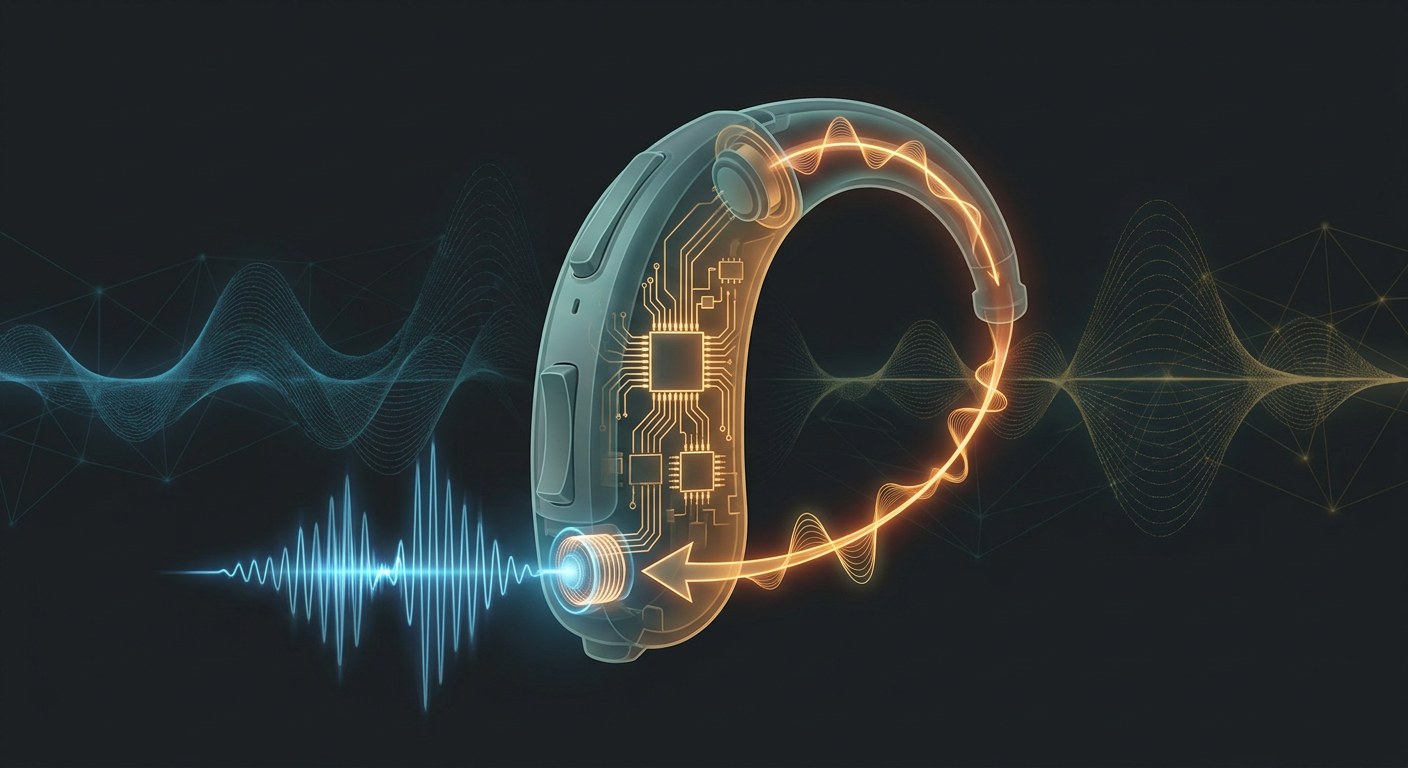
There is a whistle that anyone who has worn a hearing aid recognises instantly. It shows up when you raise a hand to your ear, when you sit with your back against a wall, or when someone leans in for a hug. It is high, metallic, unbearable, and it is not a defect in the device: it is the device hearing itself.
The phenomenon is called acoustic feedback, and in audiology it is known simply as feedback or howling. Behind that whistle sits a control problem that has driven much of the engineering of these devices for thirty years, and understanding it is the best way to understand what a modern hearing aid actually does.
Four parts and a loop
A hearing aid is a short chain: microphone, analogue-to-digital converter, digital signal processor (DSP) and receiver, a miniature loudspeaker. In between, a 1.45-volt zinc-air battery or a rechargeable lithium cell, plus a 2.4 GHz radio link to talk to the aid in the other ear and to the phone.
The signal covers that path in a few milliseconds: the microphone turns sound pressure into voltage, the converter samples it typically at 16 or 24 kHz, the DSP applies gain band by band, and the receiver moves air again. Up to that point it is an amplifier on steroids. The problem is the air around the device: some of the sound leaving the receiver comes back to the microphone. And it comes back already amplified.
Why the loop closes so easily
The condition for a feedback system to oscillate has been known since the days of valve amplifiers: the loop gain must exceed unity and the phase must come back closed, with nothing opposing it. In a concert hall that happens when the microphone stands in front of the speaker. In a hearing aid the distance between receiver and microphone is measured in centimetres, so the acoustic delay is a fraction of a millisecond and the loop closes at whatever frequency the shell, the tube or the vent lets sound escape.
The complication is that a hearing aid exists precisely to amplify: 30, 40 or 50 decibels in the frequencies where the ear has lost sensitivity. Any leak, however small, returns to the microphone with that gain on top. On top of that, the damaged ear usually loses high frequencies first, so the largest gain lands exactly where feedback is most likely.
Hence the classic trade-off of the custom earmould: the tighter it seals, the less leakage and the less whistling, but the worse the occlusion effect, that cavernous feel of your own voice. Modern moulds carry calibrated vents, from 0.6 to 3 millimetres, hunting for the point where your voice sounds natural and the loop still loses too much to oscillate.
Subtracting its own voice from the world
The digital answer is adaptive feedback cancellation. The DSP does not wait for the whistle and try to guess it: it builds a parallel model of the acoustic path from receiver to microphone, convolves that model with the signal it is sending to the speaker, and subtracts the result from what enters the microphone. In other words, it estimates its own echo and removes it before processing anything else.
That model is an adaptive FIR filter, tens of coefficients long, recalibrated with every sample: thousands of updates per second. The usual algorithm is a variant of normalised least mean squares (NLMS), which nudges the coefficients in whichever direction reduces the estimation error. When the wearer raises a hand to the ear, the acoustic path changes in milliseconds, and the filter has to chase it without falling apart.
Here lies the subtle trap: the filter only has the microphone signal, which contains both the feedback and the voice of whoever is speaking in front of you. If the algorithm mistakes voice for echo, it subtracts voice, and the result sounds hollow or metallic. Engineers call it adaptive filter bias, and they fight it with decorrelation tricks: small delays, frequency shifts, or freezing adaptation the moment speech is detected.
Shifting phase, shifting frequency
When the model is not enough, two blunter but effective tools remain. The first is a frequency shift of just 5 to 10 hertz across the whole signal: enough to break the phase coherence oscillation needs, and imperceptible to the ear in speech and music. The second is selective phase inversion: detect the frequency that is growing and apply a narrow attenuation, a dynamic notch, before it becomes an audible whistle.
Neither is free. The notch cuts real information in that band; the frequency shift slightly alters the timbre of music. The fine balance between the two, and its coordination with the physical mould, is today more the art of the hearing professional than a closed formula.
Compress, do not just amplify
Amplifying every frequency equally would be a disaster, because sensorineural hearing loss is neither linear nor flat. The typical pattern is a high-frequency drop with recruitment: loud sounds become annoying sooner than normal, because the outer hair cells that used to compress the dynamic range are gone. The aid compensates with wide dynamic range compression (WDRC), splitting the spectrum into channels, from 4 to 24, and applying a different gain to each according to input level.
Each channel has its own timing: attack of 5 to 20 milliseconds so a cymbal strike is not squashed, release of 50 to 200 milliseconds so background noise does not rise and fall like a swell. The parameters are not chosen by eye: they come from a prescription rule (NAL-NL2 or DSL v5) fed by the audiogram, and are verified by measuring the real sound inside the ear canal with a probe, the so-called in-situ measurement or REM.
The millisecond and milliamp budgets
All of the above lives inside two brutal budgets. The first is latency: if processing delays sound by more than about 10 milliseconds relative to the direct sound entering the canal, the brain starts to notice a comb filter as the two mix, and your own voice sounds like it is inside a pipe. Current designs run between 3 and 8 milliseconds, with converter and filter squeezed into that margin.
The second is power. A 312 zinc-air cell holds about 150 milliamp-hours and the device draws one or two milliamps: enough for a few million operations per second, not for a phone processor. That is why hearing aids use small filter banks and small FFTs, fixed-point arithmetic and a purpose-built DSP, with the radio integrated on the same chip to avoid doubling consumption.
Listening with two ears, and with the phone
High-end aids carry a binaural 2.4 GHz link: the two devices exchange gain parameters, noise level and filter state dozens of times per second, so the listening beam is steered in a coordinated way towards the source. With two microphones 8 or 12 millimetres apart, the arrival-time difference, on the order of 20 to 30 microseconds, allows a directional pattern and buys 3 to 5 decibels of signal-to-noise ratio in diffuse noise, which is exactly what separates following a conversation in a bar from guessing at gestures.
The same link carries audio from the phone. With Bluetooth LE Audio and the Auracast profile, a hearing aid stops being a device paired to a handset and starts tuning into broadcasts: a television, an airport or a conference hall can transmit straight to any compatible receiver, with no phone in between. It is the deepest change the category has seen in years, and it explains why the radio has gone from optional extra to part of the chip design.
What the whistle still tells you
Feedback has been greatly reduced, but it has not vanished, and its presence remains informative: an aid that whistles when you raise your hand, that whistles in only one ear, or that whistles when you chew usually points to a mould that has given way, a tube blocked with earwax or an ear that has changed. It is not a software failure; it is the system reporting that the acoustic path is no longer the one the filter had memorised.
And the uncomfortable fact remains: most people who would benefit from a hearing aid do not wear one. The technical part, cancelling your own echo, compressing without distorting, fitting inside a milliamp, has been solved with remarkable elegance. The part still missing is not engineering.