

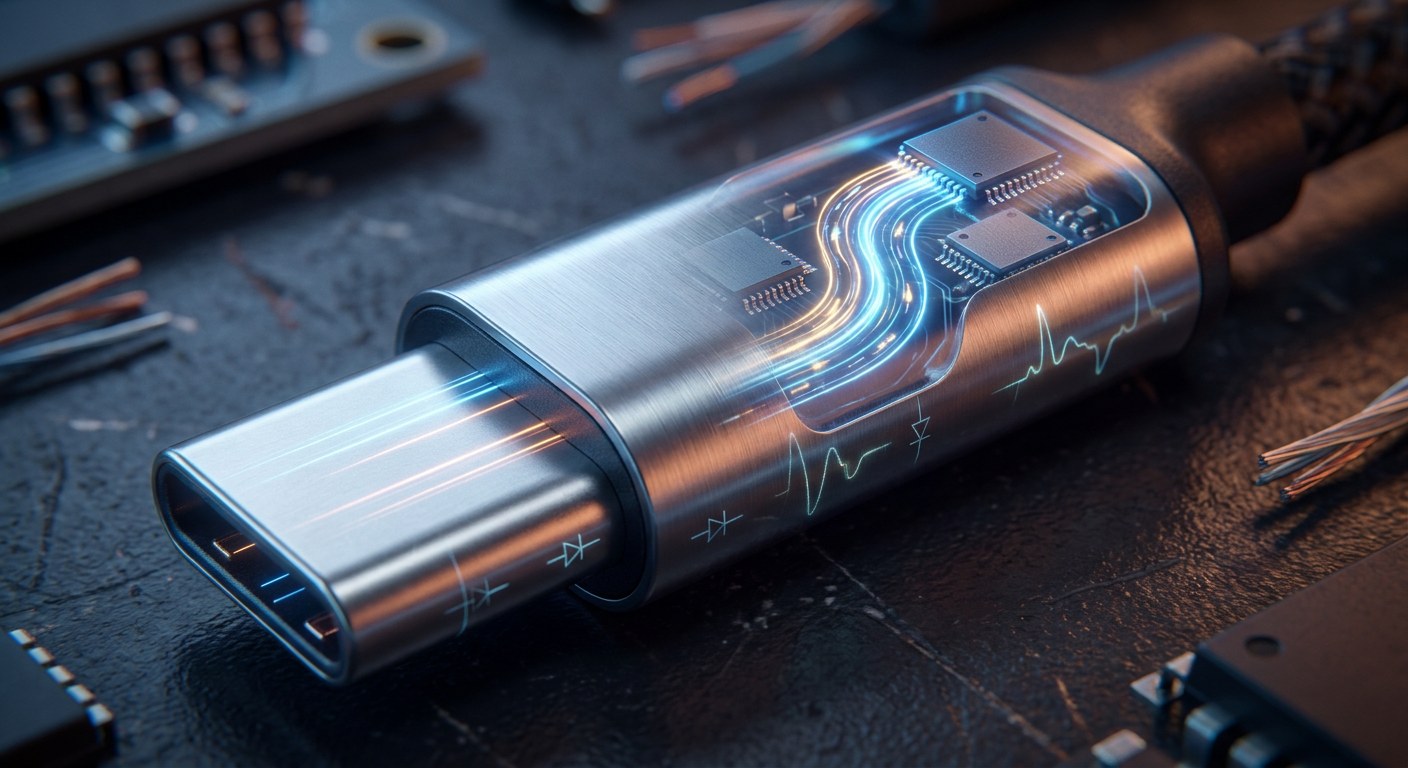
You plug the laptop’s 240-watt charger into your phone and the phone charges at 18. You swap the cable for an apparently identical one and the laptop stops fast-charging. It is neither a fault nor a manufacturer’s whim: a conversation runs along the USB-C connector in which three chips — charger, cable and device — agree on terms before a single amp flows.
A connector is not a standard
The first thing to dismantle is the idea that “USB-C” means anything specific. USB-C is a physical shape: 24 contacts, twelve per side, symmetrical, so the plug goes in either way round. That symmetry is resolved electronically, not with springs. Behind it sit four power contacts (VBUS), four grounds, two differential lines for USB 2.0, two sideband lines (SBU) and four pairs for high-speed data.
That is all the connector guarantees. A USB-C speaker may carry no data line at all; a 15-watt charger uses the same socket. Real capability is defined by what sits behind the connector, and what declares it is the USB Power Delivery (PD) protocol, the rulebook for how the power is shared out.
Two cables in one
In the middle of everything is the CC (Configuration Channel) line, a pair of hair-thin wires that carries no power. Its first job is casting: the charger presents a pull-up resistor (Rp) and the device a pull-down (Rd, 5.1 kilo-ohms). That tells the charger something is plugged in, in which orientation, and how much current it may offer by default before any negotiation. Its second job is talking: CC carries a signal encoded in BMC (biphase mark coding) at 300 kilobits per second, robust and self-clocking.
PD messages are short 32-bit packets with a header, up to seven data objects, a 32-bit CRC and a mandatory acknowledgement (GoodCRC). If the CRC does not match, the message is dropped and retried. There are three possible interlocutors depending on packet direction: SOP for the device, SOP prime for the cable’s connector and double-prime SOP for the second connector in active cables.
The chip hidden in the cable
Here lies the key to most surprises. Good cables carry an e-marker: a tiny chip inside the connector itself, powered over VCONN, which states in writing how many amps it can take, what speed it can carry and whether it is active. If the cable does not answer, the system applies the conservative 3-amp limit: 60 watts at most at 20 volts, even with a 240-watt charger.
That is why two visually identical cables behave differently. Five-amp cables use thicker conductors and their e-marker says so. A cable with no chip, or with a counterfeit chip promising 5 amps it cannot deliver, does not merely cap charging: at full current it overheats, because voltage drop across a thin conductor turns into heat.
Nobody pushes watts: the device asks for them
The most useful mental model is the opposite of the usual one. The charger does not inject a fixed current; it publishes a menu of offers, the PDOs (Power Data Objects): 5 volts at 3 amps, 9, 15, 20, and under revision 3.1 also 28, 36 and 48 volts. The device picks one, answers with a request (RDO) that includes the current margin it needs, the charger accepts, adjusts its output and confirms with a PS_RDY. All of that takes a few tens of milliseconds, and it repeats whenever something changes: another device is plugged in, temperature rises, or the device decides it has enough.
That is why a phone on a 240-watt charger does not blow up: it only asks for what its charging circuit can take. The protection is not in the charger, it is in the protocol.
Why 240 watts forced the voltage up
Power is voltage times current, and current has a physical ceiling: the connector contacts and the cable gauge. At 20 volts and 5 amps the limit is 100 watts. To reach 240 there is no choice but to raise the voltage: the Extended Power Range (EPR) specification adds 48 volts at 5 amps, exactly 240 watts. In exchange it demands a cable with a 5-amp e-marker, connectors rated for 48 volts and stricter messaging, because an arc at that voltage in a wet or dirty connector is no longer a minor detail.
Inside the laptop, a buck converter steps those 48 volts down to what the battery asks for, typically between 8 and 17. Its efficiency sits around 95-97 %, and the remainder is heat: at 240 watts, between 8 and 12 watts dissipated in the conversion alone. That is where the warmth of big chargers and thin laptops comes from.
Real fast charging: PPS
Phones use another piece of the same protocol: PPS (Programmable Power Supply), a special offer in which the voltage can be tuned in 20-millivolt steps within a range. Instead of jumping between fixed rungs, the phone can ask for exactly what the cell needs at each moment. That avoids the efficiency loss of an internal converter forced to drop the voltage a long way, and it can follow the charging curve without excess heat: high current at first, less at the end, with temperature as the real limit.
Data and video in the same conversation
The same CC channel also negotiates alternate modes. Through structured messages called VDMs, device and cable agree to carry DisplayPort over the high-speed pairs or to tunnel PCI Express over USB4, which reaches 40 gigabits per second and, in version 2, 80. Power and data travel on separate paths but are agreed in the same dialogue: that is why a USB-C monitor can power the laptop, receive video and act as a hub for peripherals over one cable.
When the dialogue breaks down
The protocol has its safety nets. If the device does not answer in time, the charger withdraws power; if the cable is unplugged mid-transfer, a Hard Reset fires, cutting VBUS for a few milliseconds and starting over. Reliable chargers include overvoltage, overcurrent and temperature protection and check the cable’s state periodically. Cheap ones sometimes merely advertise capabilities they cannot sustain, and the result is an overheated cable or a damaged port.
The conclusion is less glamorous than an advert: there is no such thing as a “universal 240-watt charger”. There is a dialogue between three chips, a cable that must know what it can take, and a device that asks only for what it needs. When something refuses to fast-charge, the weak link is almost always the one that stays silent: the cable.