
You open the door, take the plate out, and it burns. The air that was inside the microwave, on the other hand, is still exactly at kitchen temperature. The scene is so ordinary that almost nobody frames it as a physics problem: for two minutes the appliance has been pumping energy into a closed box, yet the gas filling that box has not noticed. The explanation is not about power or time, but about how radiation interacts with matter: an electromagnetic field that reverses direction 2.45 billion times per second crosses the air almost without depositing anything, and yet dumps its energy violently into the asymmetric molecules of the food.
A magnetron emits a field, not heat
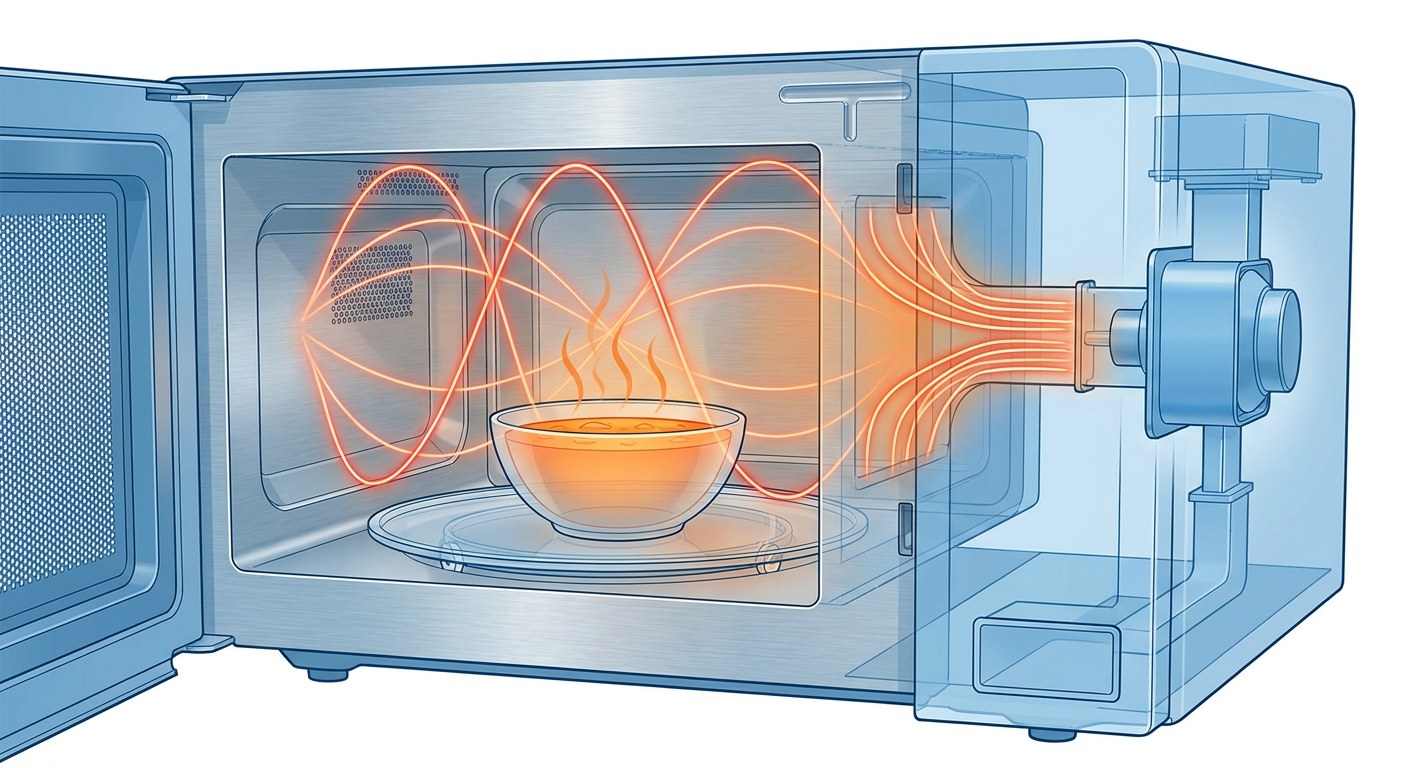
At the heart of the appliance is the magnetron, a vacuum tube with a ring-shaped resonant cavity. A central cathode emits electrons that spiral under a permanent magnetic field; as they pass the anode cavities, those electrons bunch into rotating spokes whose frequency is set by the geometry of the block. The result is a 2.45 GHz wave (about 12.2 cm long in air) that leaves through an antenna, travels down a waveguide and enters the oven cavity. That frequency is no accident: it belongs to the ISM band (industrial, scientific and medical), reserved internationally so it does not interfere with communications, and it is the same one used by the marine radars that first popularised the idea of cooking with radio waves.
The metal cavity is, in practice, a multimode resonant box: the wave bounces off the walls and superposes on itself, creating a pattern of peaks and nulls spaced half a wavelength apart, about 6 cm. There is the first detail many people notice without knowing why: the turntable is not a design whim. It makes the food travel through the antinodes and nodes of the field so it heats evenly. High-end models replace or complement the rotation with a mode stirrer, a metal fan that moves the wave pattern around the cavity.
How a material absorbs energy
A material heats up in a microwave if it has dielectric losses, and that happens when it contains molecules with a dipole moment or free charges that can move. Water is the textbook case: its molecule is a dipole, with the oxygen negatively charged and the hydrogens positive. When the field is applied, the dipoles try to align with it; when the field reverses, they have to turn again. In a liquid that rotation is not instant: the dipoles always lag one step behind the field, and that phase lag is precisely what turns electromagnetic energy into thermal agitation. It is described formally by the complex permittivity, ε = ε′ − jε″, and by the loss tangent, tan δ = ε″/ε′, which measures how much energy is dissipated per cycle. In water at room temperature and 2.45 GHz, that tangent is around 0.1.
There is a second mechanism, often forgotten: ionic conduction. Dissolved salts split into ions, and those ions are dragged by the alternating field, colliding with neighbouring molecules and handing them energy through Joule heating. That is why a salty broth heats faster than the same amount of pure water, and why sodium-rich foods tend to develop very hot spots.
This is a good place to dismantle a widespread myth: 2.45 GHz is not the “resonant frequency of water”. The dielectric relaxation of liquid water sits much higher, close to 20 GHz at room temperature. The choice of 2.45 GHz came from a mix of practical and physical reasons: the band was free, magnetrons were cheap and plentiful, and penetration into food is reasonable. At 20 GHz the wave would be absorbed in the first layer, so only the surface would cook.
Why the air stays cold
Nitrogen and oxygen are symmetric, non-polar molecules: they have no permanent dipole to orient. The field only induces a tiny polarisation in them, and their loss tangent is on the order of 10⁻⁴ or less. On top of that, air weighs very little: about 1.2 kg per cubic metre against the 1,000 kg in a cubic metre of water. Little absorption per unit mass and little total mass mean the gas is practically transparent to the radiation. The air heats up later, and not from the field but from contact with the hot food and the steam it gives off.
The same goes for most glass and ceramic plates and cups: they are low-loss dielectrics and let the wave through. If they feel hot when you take them out, it is usually by conduction from the food, or because their glaze or clay contains metal oxides that do absorb. Metals are a different story: their free electrons reflect the field within a surface layer a few microns thick, which is why the cavity walls stay cool and why the oven can confine the energy at all.
The grid on the door is the most elegant demonstration of all this. Its holes are two or three millimetres across, far less than half the wavelength (6.1 cm). For a 12 cm wave, such a small aperture behaves like a waveguide below its cut-off frequency: the field cannot propagate and decays exponentially on the other side. The door also carries a quarter-wave choke in the frame that reflects whatever tries to escape through the seal. The radiation that leaks out is so small that exposure limits are met with margin a few centimetres from the glass.
It heats from the inside, but only as far as it reaches
Penetration depth is the system’s Achilles’ heel. In a water-rich food at 2.45 GHz, power drops by half roughly every centimetre; after two or three centimetres, most of the energy has already been deposited. Heating is volumetric, yes, but limited to the outer layer. That is why a large roast cooks at the edge long before the centre, and why manufacturers recommend standing times: heat has to spread by conduction, a slow process, to even out the inside.
The same physics explains other oddities. Ice barely absorbs, because in the crystal the water molecules are locked into the lattice and cannot rotate; hence defrosting is slower than intuition suggests and defrost programmes run in pulses. Fats have fewer losses than water but heat quickly because their specific heat is lower. And concentrated sugar or salt can reach temperatures well above 100 °C, since they boil at higher ones.
Some safety consequences come from the same cause. A very smooth container and a liquid with no boiling nuclei can superheat above 100 °C without boiling; when you move it or add sugar, the water flashes to steam and splashes out. And the thin edges of aluminium foil or cutlery concentrate the field until they ionise the air: the sparks are not a fault in the appliance, they are dielectric breakdown of air caused by intense fields at sharp points.
So the next time you hear the fan and the hum of the transformer, remember what you are not seeing: a resonant box full of a 12-centimetre wave that crosses the air, the glass and the walls without touching them, and that only surrenders to the dipoles and ions of whatever you have put in to eat. A microwave does not heat the oven: it selectively heats whatever knows how to lose energy as heat.