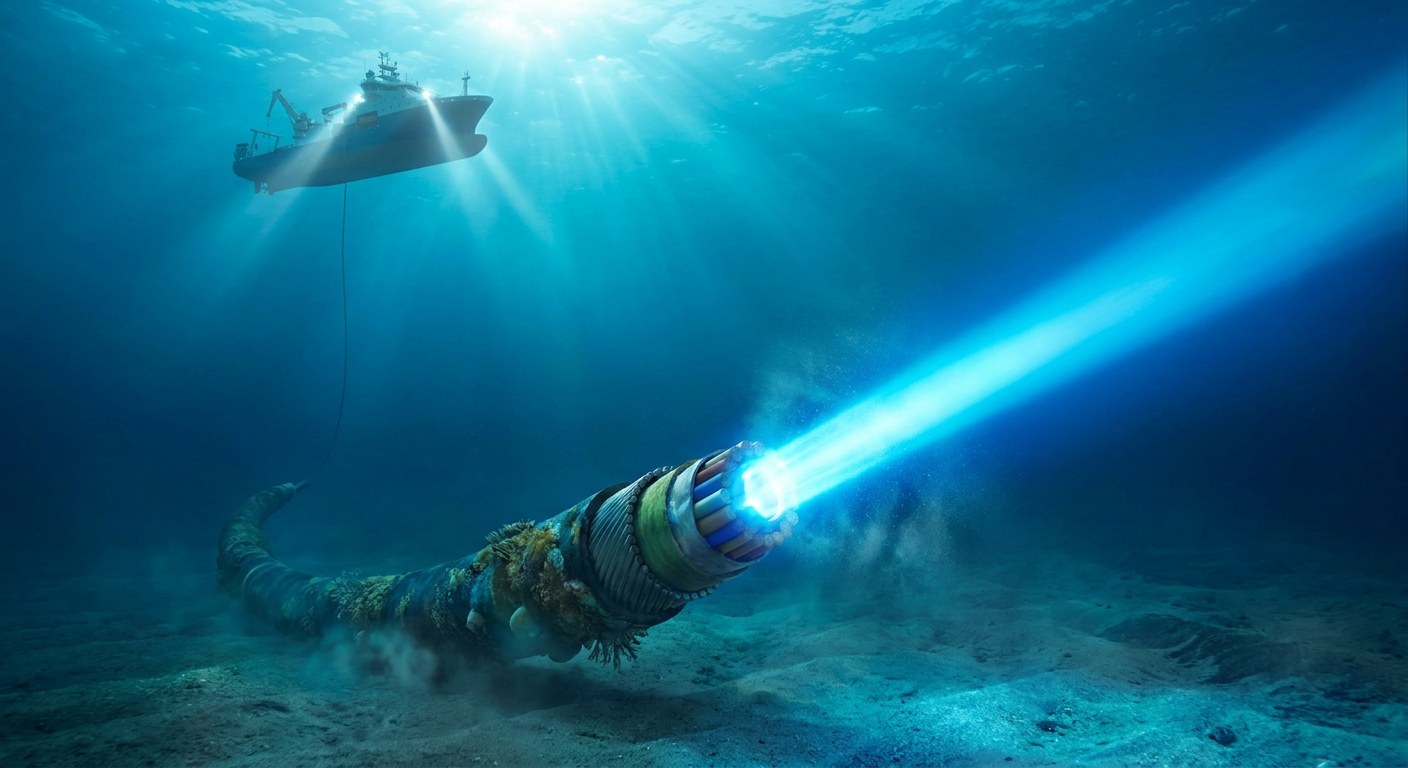
When you open a page hosted in the United States, the video starts in a fraction of a second and almost nobody thinks about the journey. That traffic does not come down from the sky: it travels along a fibre-optic cable laid on the ocean floor, roughly as thick overall as a garden hose, with a glass core thinner than a human hair. Around 99% of communication between continents goes through there; satellites, so visible in the news, carry a tiny fraction of the capacity.
A nine-micrometre core
The heart of the system is single-mode fibre: a silica strand with a core about 9 micrometres across, surrounded by a 125-micrometre cladding that confines light by total internal reflection. The work happens in the so-called C-band, between 1530 and 1565 nanometres, where glass attenuation reaches its minimum: 0.15 to 0.18 decibels per kilometre. The figure sounds harmless until you translate it: every 20 kilometres the signal has lost roughly half its power. Unaided, a cable would not even reach the next shore.
The aid is wavelength-division multiplexing (DWDM): instead of a single light, dozens of separate carriers are injected, typically 50 gigahertz apart, into the same fibre. Each carrier carries a coherent channel of 200, 400 or 600 gigabits per second. Coherent detection compares the phase and polarisation of the incoming light against a local oscillator, and a digital signal processor then corrects dispersion and noise; forward error correction (FEC) adds calculated redundancy to approach the theoretical limit of the channel. With 12 or 24 fibre pairs per cable, a modern transatlantic system moves hundreds of terabits per second in total.
Fifteen thousand volts under the sea
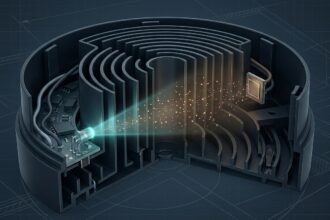
Light fades, so every 50 to 80 kilometres there is a repeater: a steel cylinder almost a metre long holding erbium-doped fibre amplifiers pumped by 980-nanometre lasers. Erbium hands energy to the signal and restores it, but does not regenerate it: noise accumulates, which is why the optical budget is calculated to a fraction of a decibel.
The detail that surprises almost everyone is that those amplifiers need electricity, and there are no batteries at the bottom of the sea. Power arrives from the landing stations ashore through feeding equipment that works as a constant-current source, around one ampere, at voltages that in long systems exceed 10,000 volts. Repeaters sit in series along the copper conductor inside the cable and each one taps its working voltage. If the circuit breaks — an anchor, for instance — the voltage jumps and the monitoring system notices instantly; a coherent reflectometry test then pinpoints the fault to within metres.
The cable itself is a layered materials-engineering feat: the fibres sit inside a stainless-steel tube, wrapped in steel wire that takes the tension, a copper conductor for power and high-density polyethylene insulation. In shallow water a double metal armour is added and the cable is buried one to three metres deep by a submarine plough or by vehicles that jet away the sediment under pressure. On abyssal plains a lightweight design is enough, because there are no anchors or trawl nets down there.
Branches, splices and ships that take weeks
When a cable forks towards several countries it uses branching units, and since 2019 many include wavelength-selective optical switches that can reassign spectrum between branches without lifting the cable out of the water. Laying is done by cable ships that pay out the cable at controlled speed, splicing on deck the sections delivered from the factory and testing each leg with reflectometry before sealing it.
Faults are routine: hundreds a year, most of them in shallow water from anchors, trawl nets or dredging. Repair is not immediate. The point must be located, a ship sent out with a remotely operated vehicle, the cable cut, both ends lifted with a grapnel, the fibres spliced — one by one, with an electric arc fusion splicer — and the joint lowered again. From detection to repair usually takes one to three weeks. The Red Sea incidents in 2024 and the cut that isolated Tonga in 2022 showed it bluntly.
Latency is not negotiable
In fibre, light travels at about 200,000 kilometres per second, that is, five microseconds per kilometre. Between New York and London there are some 5,600 kilometres of cable: the one-way trip is around 28 milliseconds and the round trip about 60. No protocol improvement removes that number, because it is physics, not software. That is why high-frequency trading desks rent space in buildings near cable landing points and pay premiums for straighter routes.
Satellites compete neither on capacity nor on latency: a geostationary orbit adds around 600 milliseconds round trip, and low-orbit constellations improve that figure but move a fraction of the traffic. They can rescue a specific crisis, not carry daily traffic.
What comes next: more glass in the same cable
The limit is no longer in the electronics at the ends, but in the optical power the glass can carry without distortion. The answer is space-division multiplexing: cables with more fibre pairs per unit of section, multicore fibre with several cores inside the same cladding, and expansion into the L-band, which doubles the available spectrum. Channels of 800 gigabits and 1.2 terabits, with probabilistic constellation shaping, squeeze every hertz. All of it travels underwater, invisible, in a system designed to last 25 years and that almost nobody looks at until it breaks.