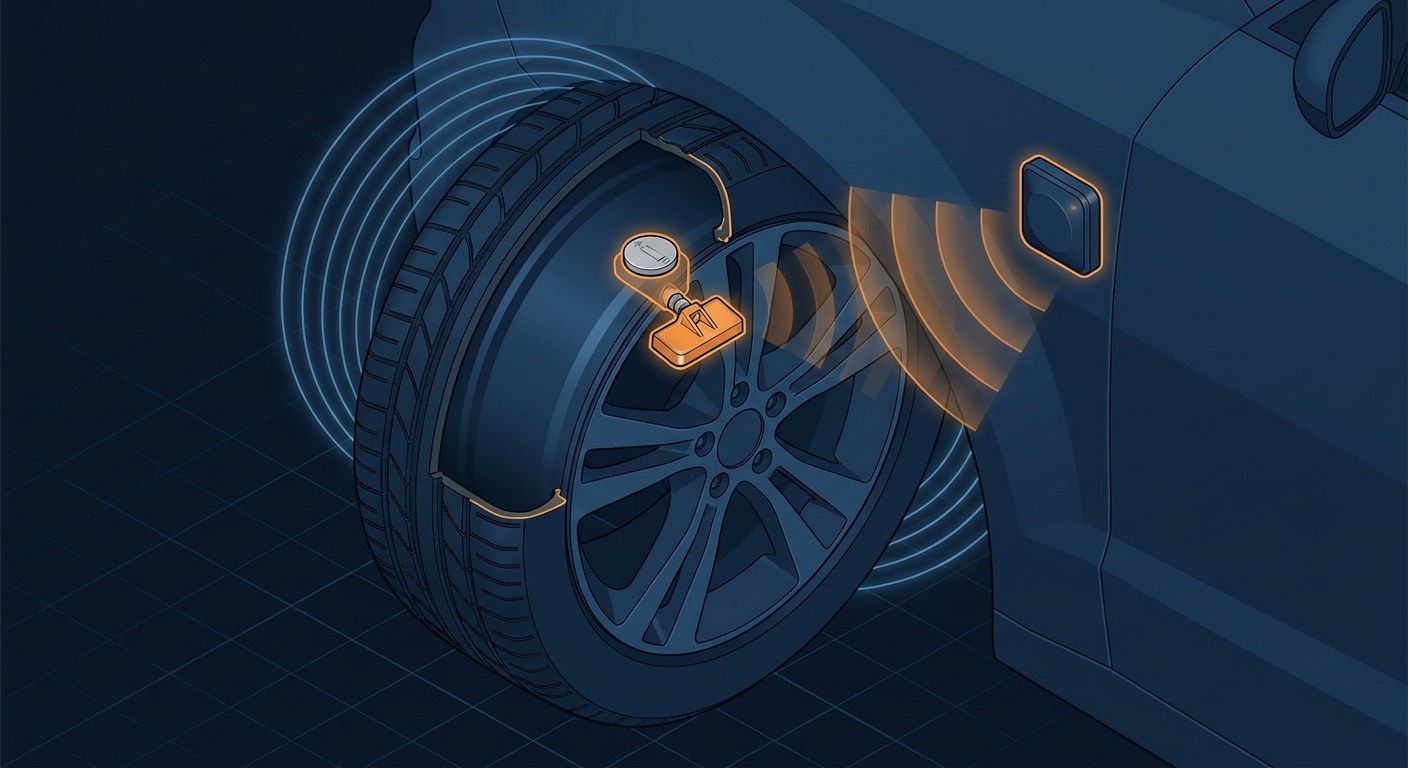
Since November 2012 no new passenger car type-approved in the European Union can leave the factory without a system that monitors tyre pressure. The rule —UNECE Regulation 64, implementing 661/2009— does not say how to do it, and that is where two very different families come from: indirect systems, which infer pressure by comparing how fast each wheel turns using the ABS sensors, and direct systems, which carry a device inside every tyre. This article is about the second kind, because that is where the interesting electronics live: a walnut-sized module bolted to the valve stem that measures pressure and temperature, transmits by radio and has to last a decade on a coin cell.
The MEMS: a membrane that unbalances a bridge
The core of the sensor is a piezoresistive MEMS chip. A cavity is etched into the back of a silicon wafer, leaving a membrane a few microns thick. On its edges, where strain is highest, four resistors are implanted by diffusion to form a Wheatstone bridge: when pressure flexes the membrane, two resistors stretch and two compress, the bridge goes out of balance and a differential voltage of a few millivolts appears, proportional to pressure. An instrumentation amplifier, a 12- to 14-bit analogue-to-digital converter and a thermal compensation loop turn that into a number.
Typical ranges run from 100 to 900 kPa, with resolutions of 1 to 3 kPa, that is, hundredths of a bar. The hard part is not measuring, it is measuring correctly when cold and when hot: the bridge resistors also drift with temperature, so every module carries an NTC thermistor next to the membrane and the firmware applies a factory-calibrated correction polynomial. Temperature does not travel in the radio packet by accident: air roughly obeys the gas law at constant volume, and pressure moves by about 0.8 kPa per degree. Without that data, the car would warn you every winter morning.
The accelerometer that decides when to speak
A lithium coin cell of the CR2450 type holds on the order of 600 mAh. That sounds like a lot until you spread it over ten years with a radio transmitter inside a tyre. The answer is to sleep almost all the time: the module draws a few hundred nanoamps at rest and only wakes when an internal accelerometer detects that the wheel is turning. The threshold sits around 20-25 km/h, the point where centrifugal acceleration exceeds a couple of times gravity.
From there the sensor enters drive mode and sends a packet every 30 to 60 seconds. A burst of about 10 milliseconds at 10-15 mA costs roughly 0.03 microamp-hours; at one packet per minute and some 1,000 driving hours a year that is about 60,000 packets, or some 2 mAh annually. Add standby current and transmissions while parked and the arithmetic works out: a 600 mAh cell lasts between seven and ten years, about as long as a set of tyres and a little longer. That is why the sensor warns of a low battery months in advance, and why in many cars the battery cannot be replaced: the module is potted in resin and swapped whole.
125 kHz: the field that tells the car which corner it is
When a 433.92 MHz packet arrives, the car’s receiver knows which identifier signed it but not where the transmitter physically is. Four wheels transmitting at once in the same band, with a steel body in between, cannot be told apart by power. The answer is a second channel, this one very short range: each wheel arch carries an antenna that radiates a magnetic field at 125 kHz. The sensor contains a coil and a low-frequency receiver; when it picks up the field it measures its strength and can answer instantly. The receiver compares low-frequency signal strength at each antenna: the nearest one wins, and that is how front-left, rear-right and the rest get assigned.
The same link is used to force a transmission while the car is stationary (when inflating at a filling station, for instance), to learn new identifiers after a wheel change and for workshop diagnostics. It is a one-way link with a range of centimetres, which makes it convenient: it interferes with nothing and needs no licence.
The packet: ten bytes of Manchester and a CRC that does not authenticate
Over the air, almost every system uses FSK modulation with tens of kilohertz of deviation and a data rate of 4.8 to 19.2 kbit/s. Bits are Manchester-encoded, which guarantees enough transitions for the receiver to recover the clock even if the carrier drifts. A typical packet occupies 8 to 10 bytes: preamble, a 32-bit identifier unique to each sensor, pressure and temperature in 8-bit fields with scale and offset, a status byte (mode, low battery, fault) and an 8-bit CRC.
That CRC catches errors, not impostors. The protocol is proprietary and, in most implementations, carries no authentication: anyone who knows the identifier can broadcast a packet claiming whatever pressure they like. In 2010 a Rutgers University team demonstrated this with low-cost receivers, and replay and spoofing attacks have been published since. In practice the risk is limited, because the attacker must be close and the impact is a warning light, but it explains why some makers add a low-frequency challenge-response step before accepting a new identifier.
Four wheels at once without stepping on each other
The four sensors transmit without knowing about one another. So they do not always collide, each one adds random jitter to its transmission interval, and the receiver drops packets that fail the CRC and waits for the next one. Since the information is not urgent —tyre pressure does not change in half a second— losing one transmission in ten is irrelevant. If a sensor goes unheard for a set period, the car lights the system fault lamp, which is different from the low-pressure one.
From the sensor to the dashboard
The receiver is usually built into the body control module or a dedicated unit, and publishes values on the CAN bus. The regulatory warning threshold sits around 20-25 % below the pressure recommended by the manufacturer, and the lamp must come on within ten minutes of driving from the moment the loss is detected. Many cars go further and show each tyre’s pressure in real time. Indirect systems, by contrast, have no radios and no batteries: they compare each wheel’s angular speed with the others, because a soft tyre has a smaller effective radius and turns faster. It works, but it detects simultaneous losses poorly and measures nothing while the car is standing still.
Changing wheels: pairing
The identifiers of the four sensors are stored in the car’s memory. Fitting a new set means teaching them: with an OBD diagnostic tool, or with an ignition sequence and a low-frequency tool that pings each sensor so it answers with its identifier. For winter wheels, cloneable sensors are programmed with the identifiers of the original set, so nothing needs relearning when you swap them. And remember that the sensor does not measure tread wear or rubber temperature beyond what the thermistor gives: visual checks still exist for a reason.
Where it goes next
The next generation adds Bluetooth Low Energy in some models, which lets you read pressure from a phone without going through the car, and is beginning to explore energy harvesting: a small electromagnetic generator that uses wheel rotation to top up a supercapacitor and do away with the cell. Meanwhile the indirect system is creeping back in through the back door of cheap cars, because it needs no hardware in the wheel. Underneath it all sits a simple idea: the hardest part of this invention is not measuring pressure, it is doing so for ten years on the energy of a coin.