The cable that runs from your router to your computer costs two euros, has no firmware, never updates and almost never breaks. Yet inside those eight strands of copper things happen that in the 1990s would have needed a cabinet full of electronics: four simultaneous conversations in both directions, an echo that is measured and subtracted in real time, and electrical noise cancelled out by geometry. Understanding how that cable works is understanding why a washing machine can sit a metre away from it without ruining the connection.
Eight wires that are really four pairs
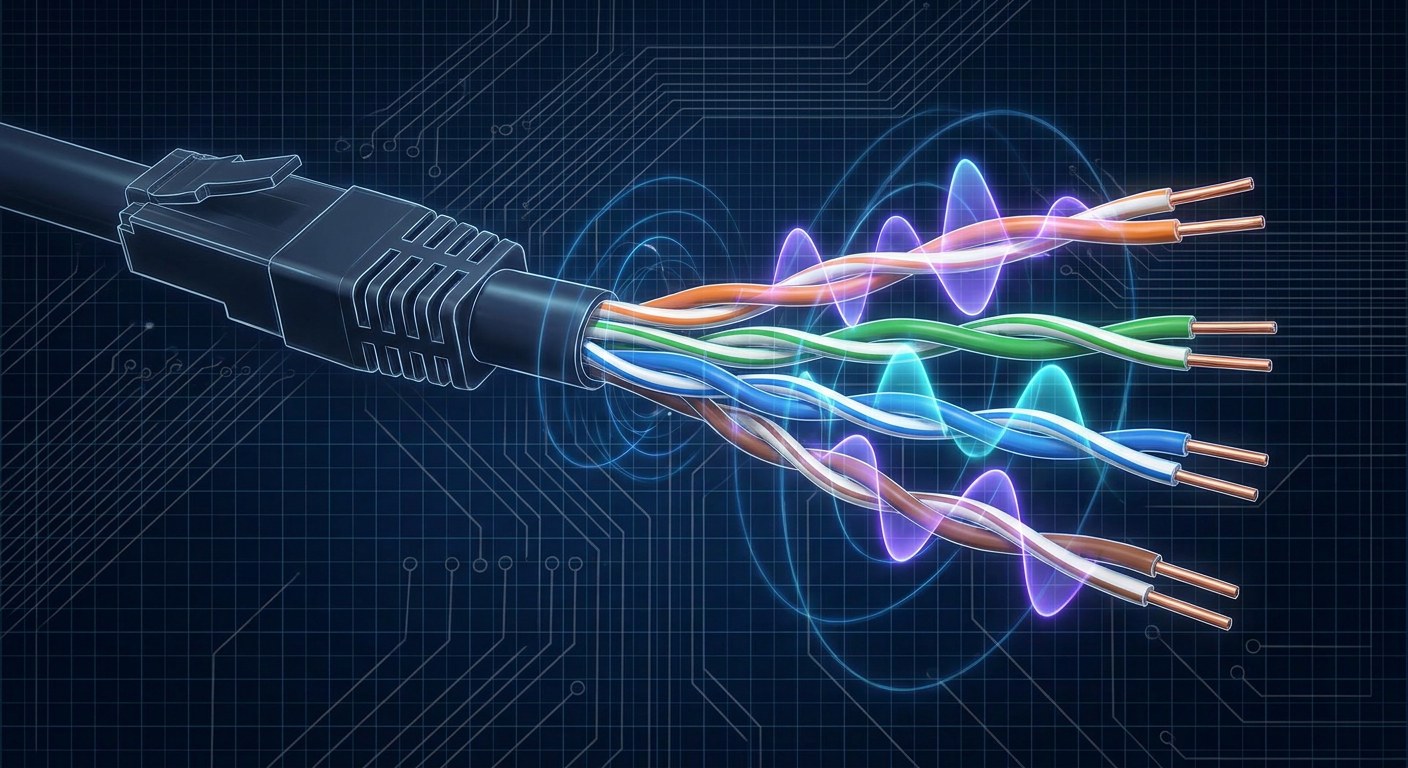
A modern network cable (Cat5e, Cat6, Cat6a) contains eight copper conductors arranged in four pairs. Each pair is twisted around itself, and not at the same rate: one pair may complete a full turn every 12 millimetres and another every 17. That detail is not cosmetic. Each pair carries a differential signal, meaning the same information sent twice with inverted polarity: if one wire rises to +1 V, the other falls to -1 V. The receiver does not read each wire’s voltage separately, but the difference between them.
Why? Because external electromagnetic noise — a motor, a transformer, a switched-mode charger — reaches both wires almost equally. Subtract one wire from the other and that common noise cancels, leaving only the useful difference. Twisting guarantees that the two conductors of a pair run through the same region of space, exposed to the same magnetic field, so the noise really is identical on both. Different twist rates between pairs stop one pair from coupling with another along the whole run: if two pairs twisted at the same rhythm, their fields would add coherently and interference would be far worse.
Crosstalk: the enemy that lives inside the cable
That coupling between pairs is called crosstalk, and it is measured in two forms. NEXT (Near-End Crosstalk) is the interference one pair injects into another at the transmitter end, where its own signal is strongest and the other has not yet been attenuated. FEXT (Far-End) appears at the far end, already weakened. Manufacturers certify cable using the ACR ratio, which compares how much signal arrives against how much crosstalk leaks in: if the margin narrows, the receiver starts confusing levels and errors appear.
How four pairs reach a billion bits
This is the leap that changed everything. The 100BASE-TX standard (Fast Ethernet) used two pairs: one to transmit, one to receive. Gigabit Ethernet (1000BASE-T) uses all four, and not by alternating them, but by transmitting and receiving simultaneously on each one. The maths of the link goes like this: each pair modulates at 125 megabaud, and every symbol encodes two net bits through PAM-5, a five-level voltage modulation (-2, -1, 0, +1, +2) combined with trellis coding to gain margin against noise. Four pairs times two bits per symbol times 125 million symbols per second gives exactly 1,000 Mbit/s. There is no magic: there is arithmetic and a very fast modulator.
The problem is that transmitting and receiving on the same pair at the same time means the receiver has to listen to its own voice. The signal it sends comes back hundreds or thousands of times stronger than the one from the other end. To separate them it first uses an analogue hybrid, a resistor bridge that subtracts a copy of the transmitted signal; then a digital echo canceller takes over, an adaptive filter that learns the response of that specific cable and keeps adjusting its coefficients with the LMS algorithm. In parallel, three NEXT cancellers remove crosstalk from the other pairs and an equaliser compensates for the distortion copper introduces on the edges of each symbol. All of that runs at more than a billion operations per second inside the PHY, the chip behind the RJ45 connector.
The transformer that doubles as a power socket
Before reaching the chip, the signal crosses isolation transformers (the magnetics) that galvanically separate the equipment from the network: if one device develops an electrical fault, the cable does not carry the problem along. The centre tap of those transformers also allows direct current to be injected onto the same pairs without interfering with the data, because the signal is differential and the power is common-mode. That is the principle of Power over Ethernet: 802.3af delivers 15.4 W at the source, 802.3at raises it to 30 W and 802.3bt reaches 60 or 90 W using all four pairs. The powered device identifies itself with a 25-kiloohm signature resistor before receiving full voltage, so an old laptop does not fry when plugged into a PoE switch.
This is also why Gigabit cannot afford to use only two pairs: it needs all four for data, so the power rides on top of them.
Why the limit is one hundred metres
The 100-metre ceiling (90 of fixed cable plus 10 of patch leads) is not tradition: it is the point where attenuation and crosstalk leave the margin too thin. On Cat5e, at 100 MHz, a 100-metre run loses roughly 22 to 24 decibels, and the receiver still has to tell five voltage levels apart with a fair amount of noise on top. Adding metres adds attenuation and also delay skew between pairs, which ruins cancellation. Cat6 raises bandwidth to 250 MHz with slightly thicker conductors and a physical separator between pairs; Cat6a reaches 500 MHz and adds shielding to control crosstalk between neighbouring cables inside the same conduit, known as alien crosstalk.
With 10GBASE-T things get harder: you must modulate 500 MHz with PAM-16 and a 128-point constellation (DSQ128), correct errors with LDPC and cancel a far more aggressive echo. That is why 10 gigabits over copper only holds for 55 metres on Cat6 and 100 on Cat6a. The intermediate 2.5G and 5G standards (802.3bz) exist precisely to stretch Cat5e and Cat6 to 100 and 200 MHz respectively, reusing the cabling already inside the walls.
What you are really buying
When someone pays double for a “higher category” cable, what they are really buying is margin: more copper, better symmetry in the pairs, connectors with precisely aligned contacts and, in some cases, a shielding foil. None of that adds intelligence; it just means the chip’s cancellers have less work to do. A badly crimped cable, with eight millimetres left untwisted before the connector, can ruin the crosstalk of the whole link even if the cable itself is excellent: in that final stretch the wires run parallel and coupling spikes. That is why diagnosing a home network that “feels slow” almost always starts by unplugging and re-crimping, not by replacing the router.