When you brake hard and the pedal starts to vibrate and hammer against the sole of your foot, almost nobody thinks about valves. People think about the disc, the pads or something broken. What is actually happening is that a small computer has taken charge of the braking and is opening and closing the flow of fluid to each wheel dozens of times a second. The judder is the physical proof that the system is working.
The problem it solves: a locked wheel brakes less
Intuition says a wheel that stops turning grips more, and it is exactly the opposite. A tyre only transmits force while there is controlled slip between the rubber and the asphalt. That slip is measured as the slip ratio: the difference between the vehicle’s speed and the wheel’s peripheral speed, divided by the vehicle’s speed. With the wheel rolling free the ratio is 0; with the wheel fully locked it is 1.
The grip curve —friction coefficient against slip— is not flat. It rises quickly from 0, peaks at around 10-20% slip and then drops. On dry asphalt the peak can sit at a coefficient of 0.9 or 1.0; with the wheel locked it falls to 0.7-0.8. On top of that, a locked wheel loses the ability to steer: a tyre sliding in a straight line generates no lateral force, so the car ploughs on even if you turn the wheel. ABS exists to keep the system at that peak and to let the driver keep steering.
Three sensors that see nothing: they only count teeth
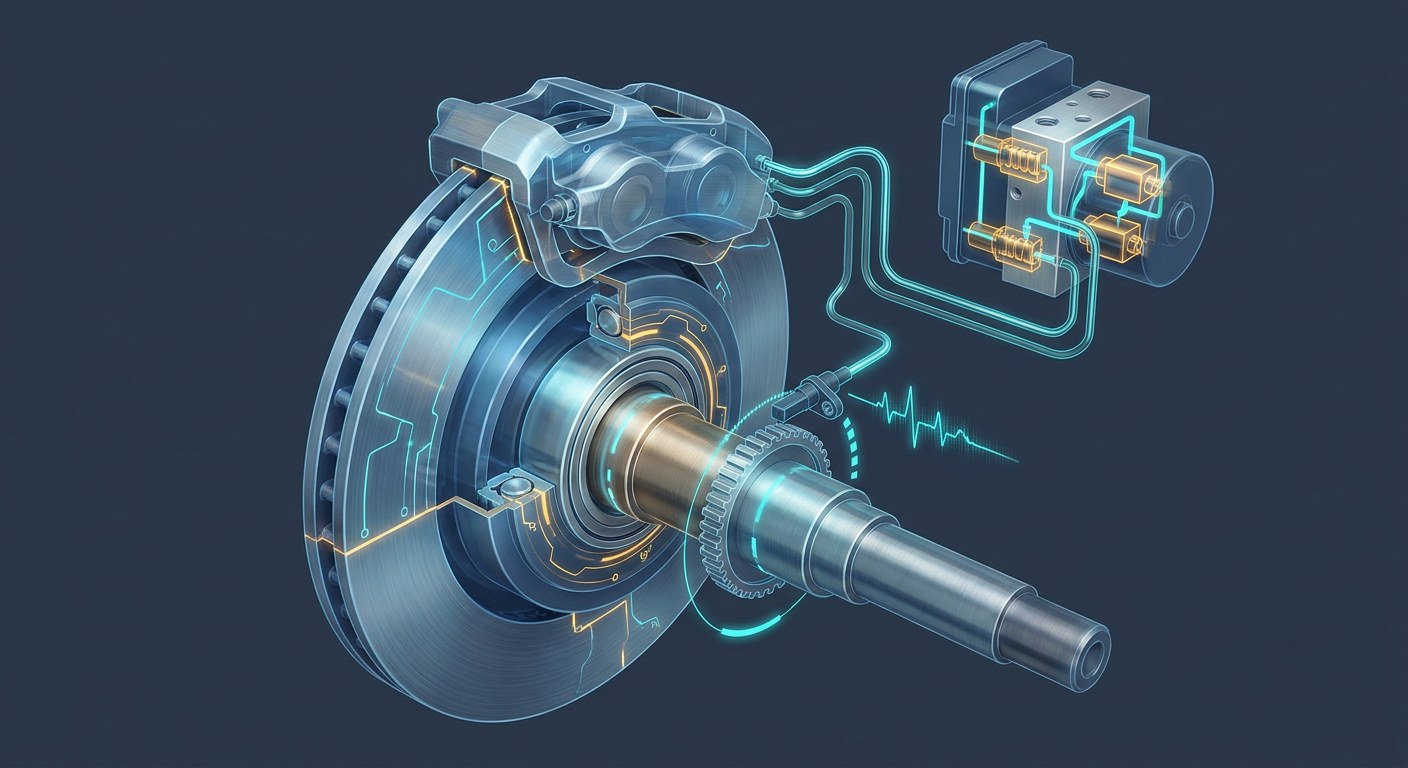
Everything starts at the wheel. Each hub carries a toothed ring —the tone ring— with 43, 48 or up to 96 teeth, turning with it. Facing that ring, a sensor measures how fast the teeth go past. There are two families:
- Inductive (variable reluctance): a coil with a permanent magnet. Each passing tooth disturbs the magnetic field and generates an alternating current pulse. They are passive, need no power supply and work from very low speed, but the signal amplitude drops almost to zero when pulling away.
- Active (Hall or magnetoresistive): they carry built-in electronics and return a clean square wave from 0 km/h, with two phase-shifted channels that also reveal the direction of rotation. These are the ones that enable features such as hill-start assist or parking aids.
The unit’s calculation is almost trivial: the pulse frequency divided by the number of teeth gives the wheel’s revolutions per second; multiplied by the rolling circumference you get the speed. With 48 teeth, at 100 km/h and a wheel with a 2-metre circumference, the sensor delivers about 667 pulses per second. The ECU compares the four wheels with each other and with an estimated vehicle reference speed: the wheel falling behind is the one about to lock.
The hydraulic block: three states per wheel
The actuator is an aluminium block with one solenoid valve per wheel on the pressure inlet and another on the outlet, plus a return pump and a low-pressure accumulator. The circuit pump also has an isolation valve that can cut the pedal off from the rest if needed.
Each wheel can be in one of three states, and the system hops between them several times per cycle:
- Build pressure: inlet valve open, outlet closed. Fluid from the pedal reaches the caliper cylinder and braking grows.
- Hold: both closed. Caliper pressure is frozen even if the driver keeps pushing.
- Release: inlet closed, outlet open. A volume of fluid escapes into the accumulator and pressure falls; the pump pushes it back into the pedal circuit, and that return flow is part of the noise and the tingle you feel.
The full cycle —detect slip, release, build again— repeats 5 to 15 times a second in classic systems and faster in current ones. There is the pedal judder: it is not a warped disc, it is valves opening and closing and a pump shoving fluid back.
From ABS to stability control
ABS shares its hardware with ESP or ESC. To know whether the car is turning more or less than the driver is asking, the system adds a yaw-rate sensor (a MEMS gyroscope in the vehicle plane), a steering-angle sensor and a lateral accelerometer. From that data it computes an intended trajectory and compares it with the real one; if the nose washes out, it brakes the rear inside wheel; if the tail steps out, it brakes the front outside one. It is the same hydraulics with more intelligence on top.
The current generation goes one step further: one-box systems combine the brake booster and the modulator in a single unit, and in many cars the pedal no longer pushes fluid directly —it acts on a travel sensor and an electric motor builds the pressure. That is brake by wire, with a pedal simulator that mimics the traditional feel. In an EV there is an extra layer: the car prefers to slow down with the motor to recover energy, and ABS has to coordinate that regenerative braking with the hydraulics, cutting motor torque when a wheel starts to slip. If the battery is cold or full, the available retardation changes and the blend must be recalculated in milliseconds.
What it cannot do
ABS does not create grip. It works with the tyre and the road surface it has, and its margin of improvement is the gap between the peak of the curve and the locking point: a few metres in a 100-to-0 stop on dry tarmac, considerably more in the wet. On loose surfaces such as gravel or deep snow it can even lengthen the distance, because a locked wheel piles material in front of it and digs in, which is why many cars let you switch it off partially in those conditions.
The system is no substitute for maintenance either: a dirty sensor, a broken tooth or old fluid with air in the circuit light the warning lamp and hand the car back to conventional braking. With one important difference from twenty years ago: when something fails, the vehicle keeps braking, because the valves are designed to stay open with no current and the safety case is certified under ISO 26262 at ASIL-D, the most demanding level, with internal monitoring and a clean shutdown.
Next time you feel that hammering under your foot, you know what you are feeling: four wheels reporting in milliseconds, a computer choosing which one can brake a little harder, and a block of valves dumping pressure just before the tyre stops gripping.