

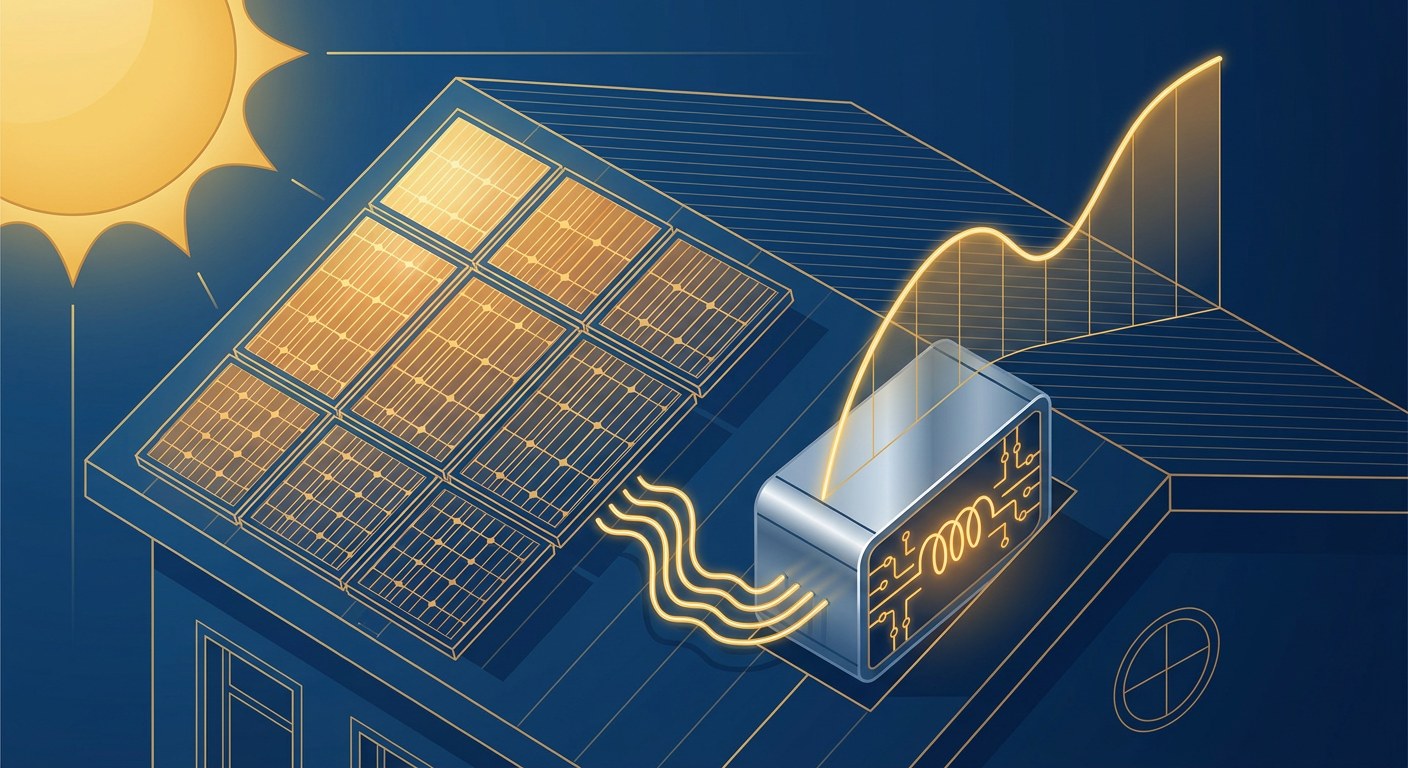
The datasheet for a 400 W solar panel shows a round number that is almost never met. On a real roof, that same panel spends much of the day delivering 300, 250 or even 120 watts. It is neither fraud nor a manufacturing defect: it follows from the fact that a photovoltaic cell is not a battery but a current source whose output curve keeps moving with light and temperature. And from the fact that squeezing it dry takes a circuit willing to chase it.
A cell does not store electrons: it prises them loose
Each silicon cell is a wafer about 15 centimetres square with two layers doped differently: one with phosphorus, which contributes free electrons (N-type), and one with boron, which leaves holes where an electron is missing (P-type). At the boundary between them a permanent electric field forms and separates the charges.
When a photon with enough energy strikes the silicon, it knocks an electron out of its bond. That electron becomes free and the junction field pushes it towards the metal contact on the N side; the hole it leaves drifts towards the P side. Connect an external circuit and the electrons flow through it: that is the current. Each cell produces between 0.6 and 0.7 volts, very little, so a domestic panel strings 60 or 72 of them together and adds up to 40 volts open-circuit.
The important detail is that current depends on how many photons arrive, that is, on irradiance, while voltage depends mainly on temperature. A hot panel loses voltage: roughly 0.3% for every degree above 25 °C. On an August afternoon, with the cell at 60 °C, the operating voltage can drop by 10%.
The I-V curve and the sweet spot
Sweep the load connected to the panel from zero to open circuit and you get the so-called I-V curve. At the left edge sits the short-circuit current (Isc), almost proportional to light. At the right edge, the open-circuit voltage (Voc), where no current flows any more. Between them is a knee: beyond a certain voltage the current collapses.
Power is voltage times current, and that product draws a hump. Its peak, the maximum power point (MPP), is the only place on the curve where the panel gives everything it can. In a typical 400 W module it sits around 34 volts and 11.6 amps. The ratio between that maximum power and the product Voc × Isc is called the fill factor, and in commercial silicon it usually lands between 0.75 and 0.82: the more rectangular the curve, the better the cell came out.
Why wiring it straight to a battery is a mistake
Connect the panel directly to a 12 V battery and the voltage is pinned at the battery’s, forcing the panel to work at a point on the curve that is almost never the MPP. With a 34 V module feeding a 12 V battery, the difference is burned as heat in the regulator. Worse, the curve moves: a cloud halves the current, heat lowers the voltage, and shade on a single cell drags down the whole string because they are in series.
That last point explains bypass diodes. Panels carry three, one per group of cells, so if a leaf covers a third of the module, that third is bridged instead of blocking the current from the other two. Even so, the curve stops having a single hump and several local maxima appear.
The converter that moves the operating point
This is where the maximum power point tracker, or MPPT, comes in. It is a switched-mode converter, usually a boost, placed between the panel and the rest of the system. A silicon switch opens and closes tens of thousands of times per second, charging and discharging an inductor. By varying how long the switch stays closed — the duty cycle — the converter changes the ratio between voltage and current on either side.
The interesting part is what the panel sees from its own bank: not a fixed load but an impedance the converter can reshape. The algorithm measures voltage and current, computes power, nudges the voltage by a small step and measures again. If power rises, it keeps going the same way; if it falls, it reverses. This is perturb and observe, and repeating it every few hundred milliseconds is enough.
Finer variants exist, such as incremental conductance, which compares the slope of the curve with the current-to-voltage ratio to know exactly where the peak lies. The trade-off is always the same: big steps find the MPP fast but oscillate around it and waste energy; small steps react slowly to a passing cloud. Good equipment reaches 99% tracking efficiency and states it on the datasheet next to conversion efficiency.
When the curve has several peaks
Under partial shade the classic algorithm can get stuck on a local maximum and fail to notice a higher one. That is why inverters sweep the whole curve at dawn and every so often, or whenever they detect an abrupt change in irradiance. Some compare the result with an internal model of the panel and decide whether moving is worth it.
The other answer is to change the architecture. Instead of one MPPT for the entire string, microinverters and optimisers put one per module. Then a dirty or shaded panel does not drag the others down. In exchange, electronics multiply on the roof, where heat is harsher, and communication between units has to be solved.
From the roof to the grid
In a grid-connected installation the inverter does more than track the MPP: it converts direct current into 230 V, 50 Hz alternating current, phase-locked to the grid through a phase-locked loop (PLL). It also watches that the grid is alive: if the voltage disappears, it must disconnect within milliseconds so as not to electrocute anyone repairing the line. That is anti-islanding protection, required by regulation.
That is why the production curve on a sunny day is a bell: it climbs with the sun, flattens at noon and falls in the afternoon. And why, when the array is larger than the inverter, the inverter clips the peaks: it would rather lose a few watts at 1 p.m. than oversize a unit it would only use flat out a few hours a year.
The panel does not decide
Next time the monitoring app shows power moving in sawteeth, it is worth remembering what is happening: a circuit is raising and lowering the panel voltage thousands of times a day, probing a curve that shifts with every cloud, hunting the one point where each photon pays off best. The panel only offers; the converter decides how much is taken.