
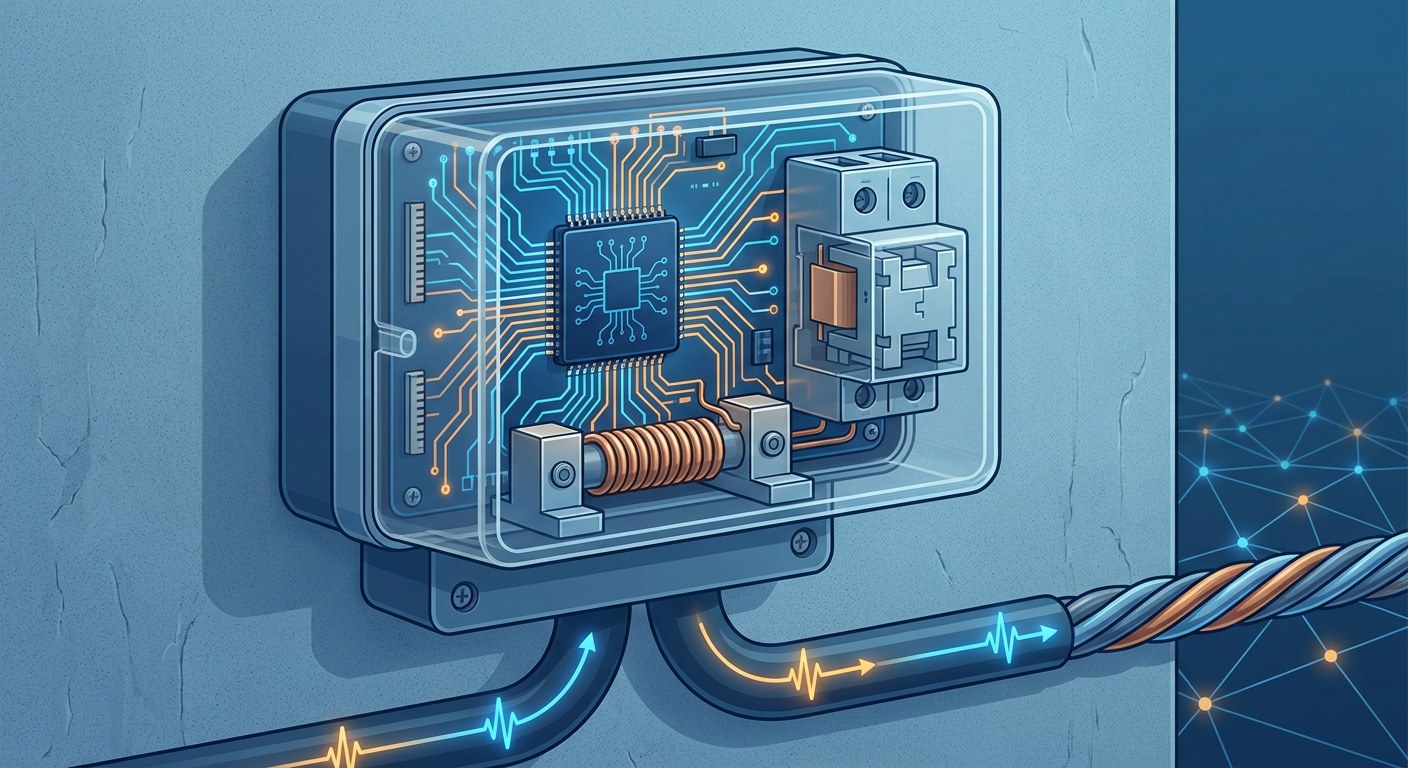
It sits in the hall cupboard or a niche on the landing, and almost nobody pays it any attention. But what is behind the clear cover of a modern electricity meter is no longer a spinning wheel: it is a small measuring computer that takes tens of thousands of samples every second, computes energy with laboratory precision and sends the result back down the very cable that brings the electricity in.
Sample, do not count turns
The classic electromechanical meter solved the problem with physics: an aluminium disc spun by currents induced in two coils. The more you consumed, the faster it turned, and a gear train moved the digits. The electronic meter does the same thing, but with arithmetic. An analogue-to-digital converter (ADC) reads voltage and current thousands of times a second; the processor multiplies each pair of instantaneous samples and averages the result. That product, voltage times current, is active power, and accumulating it over time gives the energy you are billed for.
Everything hinges on the sampling rate. To measure a 50 Hz sine wave properly you have to see it many times per cycle: domestic meters take between 4,000 and 8,000 samples per second, which is 80 to 160 points per full cycle. At that resolution they can compute RMS voltage and current, active and reactive power, power factor and even harmonic content, all with no moving parts and nothing to wear out.
A shunt of a few hundred micro-ohms and a voltage divider
The most common current sensor in domestic meters is a shunt resistor: a manganese-alloy part, from tenths of a micro-ohm up to a few hundred micro-ohms, through which the whole household current flows. A 200 µΩ shunt carrying 60 amps drops just 12 millivolts, a tiny signal that the metering chip amplifies and digitises with a very low-noise amplifier. The alternative is a current transformer or a Rogowski coil, which does not sit in series with the load and provides galvanic isolation, but costs more and is only justified in three-phase or high-power installations.
Voltage is measured with a high-stability resistive divider. The metrology chip — parts such as the ADE7953 or STPM34 — combines both channels, applies phase and thermal-drift compensation and outputs the energy registers directly. The assembly is calibrated in the factory against reference standards and certified to class 1 or class 2 under IEC 62053-21 (and its European equivalents under the MID directive), which in practice means a maximum error of 1 % or 2 % across the measuring range. Meters for large customers go down to class 0.5S.
Eight registers, a load curve and a clock
The meter does not store a single number. It keeps separate registers: active energy imported, active energy exported to the grid (relevant if you have solar panels), reactive energy in all four quadrants and, on some models, energy per tariff and per time band. On top of that comes the load curve: consumption accumulated in each fifteen-minute slot and kept for months in non-volatile memory. That curve is what makes time-of-use billing possible and what suppliers use to analyse consumption habits.
For tariff periods to add up, the meter needs its clock in step. It synchronises over the mains or with the concentrator and corrects the drift of its internal oscillator; a few minutes of offset between meters would produce different bills for identical consumption. The clock also handles daylight saving, which in Spain forces a review of how the bands fall.
The relay that cuts you off (and the sensor that spots fraud)
Inside the housing there is a power relay, usually bistable and latching, that can cut the supply on remote command: unpaid bills, a new contract not yet activated, or exceeding the contracted maximum power — the job the old ICP breaker used to do. It is driven by a current pulse into a coil and stays put without drawing power, which avoids heating the device for years.
The same unit watches its own integrity. A switch detects the cover being opened, a magnetic sensor flags a strong magnet brought close by, and the firmware checks the consistency between phase and neutral voltages to detect a bridged neutral or reversed current. Any of these events is logged with date and time and reported to the distribution company.
Talking over the power cable
What makes the meter “smart” is communication. There is no fibre to the cupboard: meters use PLC (Power Line Communication), modulating high-frequency data onto the low-voltage cable itself. The two most widespread standards are PRIME and G3-PLC, both OFDM-based: they split the available spectrum into dozens of subcarriers — in the CENELEC A band, between 35 and 91 kHz — and adapt the modulation of each one, from BPSK up to 1024-QAM, to the noise on that stretch. The result is a mesh network between meters that ends at a concentrator in the transformer substation, the node that gathers every customer on that transformer and links onward to the utility over 4G or fibre.
The application protocol is DLMS/COSEM, a standardised object model in which every quantity has its OBIS identifier: 1-0:1.8.0, for instance, is total imported active energy. Messages are encrypted with AES-GCM and keys are managed per meter, so tapping the cable is not enough to read or forge readings. Firmware is updated remotely and signed.
What it means for you
Beyond the bill, the smart meter changes the granularity of the information: instead of one monthly reading there are 96 daily consumption records per household. That enables time-band tariffs, excessive-consumption alerts and, eventually, automated demand management. It also raises a privacy question: a load curve every fifteen minutes reveals when you get up, when you run the washing machine and whether you are on holiday.
And it is worth remembering its limits. The meter measures and reports; it does not decide. The real intelligence sits in the concentrator, in the utility’s systems and in the appliances at home. The credit of the box on the landing is another one: doing laboratory-grade metrology, for twenty years and without a fan, inside a plastic case next to the door.