
There is a material capable of conducting electricity without losing a single fraction of energy along the way. Without heating up, without wasting anything. It sounds like science fiction, but it has existed for more than a century and already works silently in hospitals, accelerators and, increasingly, in our cities. These are superconductors, and they could be on the verge of their great revolution.
To understand it, a comparison is enough. A normal copper cable loses part of the electricity as heat: that is why the cables of streetlights, homes or trains get hot. In a superconductor that resistance disappears completely. A current introduced once can circulate for years without losing intensity. It is the most “electrically perfect” material we know.
One enormous drawback: the cold
The problem is that this magical behavior only appears at extremely low temperatures, near absolute zero (about -269 °C). Keeping these materials cold requires liquid helium and expensive equipment, which for decades limited their use to laboratories and big-budget infrastructure.
That is why the great goal of physics is to find a superconductor that works at room temperature. Every advance in that direction makes headlines, and in fact there have been announcements that later turned out to be measurement errors. The search continues, but scientists are getting closer and closer.
Where they already work today
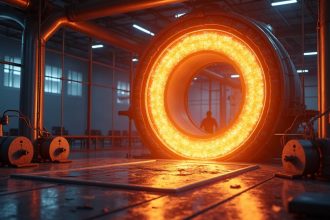
Although it may not seem so, superconductors have been saving lives for years. The MRI machines in hospitals use them to create extremely powerful magnetic fields without consuming a fortune in electricity. Thanks to them, soft tissues, tumors and injuries that were once invisible can be seen.
They are also the heart of the Large Hadron Collider in Geneva, where thousands of superconducting magnets guide particles at speeds close to that of light. And they are in the maglev trains of Japan or China, which float over the tracks without friction: the world record for rail speed (603 km/h) is held by one such train.
The revolution to come: lossless energy
The most promising leap is in the power grid. Today, when transmitting electricity over hundreds of kilometers, a significant part of what is generated is lost along the way. With superconducting cables, that loss would disappear. There are already pilot projects in cities such as Munich, Seoul or New York, where cooled sections of superconducting cable connect substations with record efficiencies.
If one day we manage to achieve superconductors at temperatures reachable with cheap methods, the effect would be enormous: more efficient power grids, much more practical quantum computers, smaller and more powerful motors, and a far more viable nuclear fusion, which is the clean energy that is so eagerly pursued.
When will we see them at home?
With caution. Although the advances are real and constant, room-temperature superconductors remain an unsolved challenge. The most realistic path is a gradual transition: first we will see stretches of power grid and cables in critical zones, then in industries, and only much later, perhaps, in home appliances.
Meanwhile, superconductivity is already one of those technologies that work without us seeing them: discreet, cold and surprisingly powerful. Every MRI, every levitating train and every accelerator that unveils the secrets of the universe depends on a phenomenon that still amazes physicists more than a century after its discovery.