

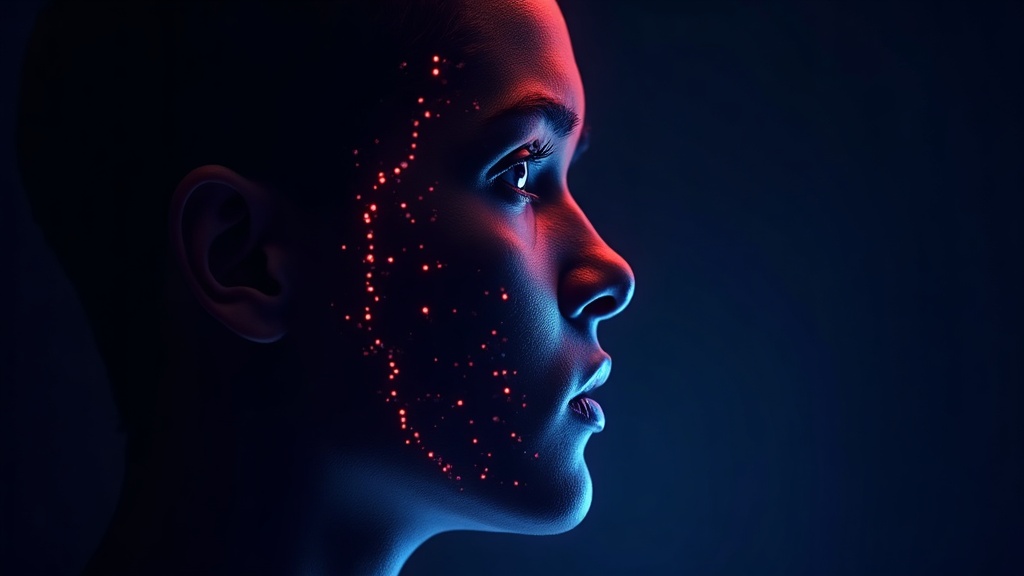
Your face is already one of your most used passwords. Your phone’s camera turns on, looks at you for half a second and lets you in: without typing anything, without remembering anything. Facial recognition has stopped being science fiction and become an everyday tool. But how does your phone know that you are you?
From the phone to the airport
We use it to unlock the phone, to pay with the front camera and to open banking apps. But its reach goes much further. Airports validate your identity by comparing your face with the one on your passport, companies use it to control access to their offices and more and more shops are trying it at their checkouts. What a few years ago seemed like a movie trick is now routine.
How does it work inside?
The key is turning your face into numbers. The camera captures your image and a programme, trained with millions of faces, looks for specific points: the distance between the eyes, the shape of the nose, the outline of the jaw or the curve of the lips. With that data it builds a kind of “mathematical signature” of your face.
When you stand in front of the phone again, the system repeats the operation and compares: if that signature matches the one it stored on the first day, it opens the door for you. It is like a key, but a key you always carry on you.
It is not a photo: it is a measurement
An important detail: the system does not compare one photo with another photo. It compares measurements. That is why, normally, a paper photo of you does not fool the most modern systems, which also detect depth and realise that the image is flat. Many phones project thousands of invisible dots onto your face to build a three-dimensional map, so a simple photo is not enough.
The advantages: speed and convenience
Its great triumph is convenience. There is no password to steal or pattern to forget: you just look. In addition, in many cases it is faster and safer than other methods, especially when the technology is accompanied by good protection systems. For a person with reduced mobility, unlocking a device with their face can also be far more accessible than typing a code.
The risks: privacy at the centre
But not everything is advantages. The big question is what happens to your data: where is that “signature” of your face stored and who can consult it? If a phone stores your facial map internally, it is relatively safe. If that information travels to a company database, the risk of it leaking or being used without your permission increases.
There is also concern about use without consent in public spaces, and the so-called “biases”: some systems make more mistakes with certain skin tones or features, which can lead to unfair errors. That is why more and more countries are regulating its use and requiring that people be clearly informed before being scanned.
A balance we are still learning
Facial recognition is one of those technologies that change everything: incredibly useful and, at the same time, delicate. It unlocks our phone in an instant and lets us cross borders without papers, but it also forces us to decide how much of our identity we want to hand over to machines.
As almost always in technology, the key is not to reject it, but to understand it and demand that it be used with clear rules. Because your face is, after all, the most personal identification you have: you can neither change it nor hide it. And that deserves to be treated with care.