
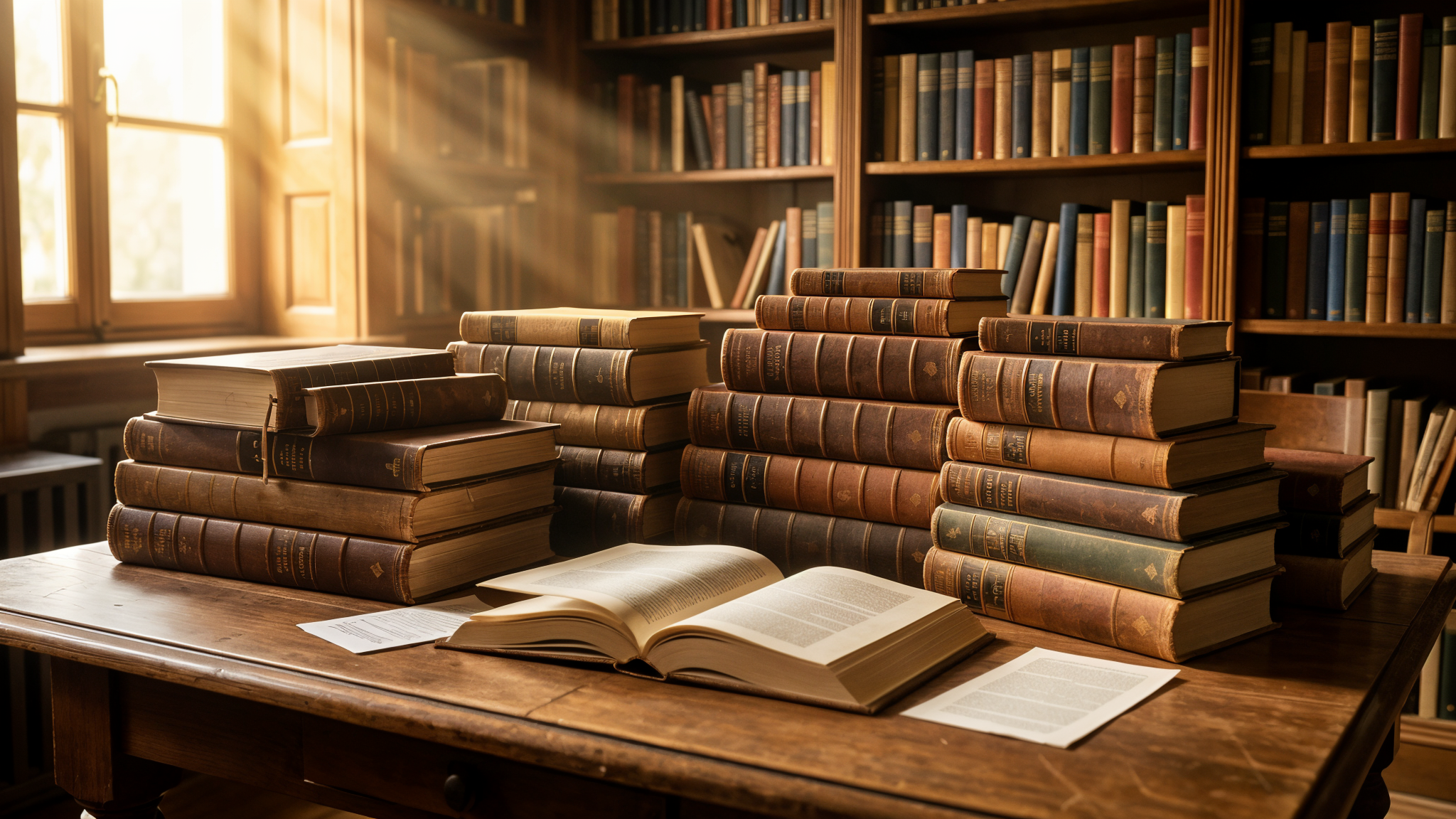
The “Project Panama”: artificial intelligence companies are buying old books to destroy them
An investigation has revealed that several companies that build artificial intelligence buy thousands of old books to scan them and then throw them away. It is a fast and cheap method, but it is making unique copies that can never be recovered disappear.
It all started with a strange order. Marçal Font has been selling old books for twenty years in Badalona, Catalonia. One day, in spring, he received several emails from a Canadian company asking for a huge number of books at once. And the strangest thing: they paid three times the shipping cost without batting an eye.
It was not a fraud, or at least not the kind he feared. That client was behind something called “Project Panama”. A plan to digitise (put into a computer) and destroy books with the aim of training artificial intelligence. The story has been told by the BBC.
What the “Project Panama” is
Artificial intelligence (AI) learns by reading an enormous amount of text. It is like a child who learns to speak by listening to thousands of conversations: the more it listens, the better it speaks. Well, the computer, the more text it reads, the better it responds.
At first, AI companies used everything there was on the internet: web pages, newspapers, notes. But that source ran out. So they started looking in old books, those no longer found in ordinary bookshops, and which only exist in second-hand or antiquarian stores.
According to documents that were leaked in a lawsuit, the “Project Panama” is an effort to “destructively scan all the books in the world”. The plan’s own notes asked that nobody know they were working on it.
What happens to the books
There are two ways to put a book into a computer. One is careful: it is scanned page by page and the book stays whole on the shelf. It is slow and expensive.
The other is fast and cheap. The spine of the book is cut, the pages are separated and put into a machine that scans them at high speed. When it finishes, the book can no longer be reassembled. The remains are sent to be recycled.
Companies almost always choose this second option because it allows them to process millions of copies in much less time and spending less money.
Why it is worrying
The problem is that many of those books do not exist anywhere else. They are limited editions, unique copies, works few people keep. If the physical copy is destroyed, that information is lost forever for people, even if the company that scanned it has it.
Booksellers around the world are alarmed. A bookseller from the Netherlands said someone asked him for “a couple of hundred” of his books, something almost impossible to imagine in his trade, where people normally buy one or two. Booksellers in Australia and New Zealand received similar orders.
The association that groups Spain’s antiquarian booksellers believes that scarce or unique works should not end up destroyed. As traders who preserve heritage, their opinion is that the final use of a very special book should not be destruction.
A dilemma without an easy answer
Here two interests clash. On one hand, artificial intelligence needs a huge amount of text to improve, and old books are a mine of content that is not on the internet. On the other hand, that same content is cultural heritage that belongs to all humanity.
There is also the matter of permission. A few months ago, an AI company called Anthropic agreed to pay $1.5 billion to settle a lawsuit by authors who said their works had been used without permission. A judge even ruled that, if the company bought the copy, it could use it to train AI.
And that is where the mass orders to second-hand bookshops come in, which is exactly what the Badalona bookseller detected that spring.
What we can expect
This is not going to stop all at once. As long as artificial intelligence keeps needing more text to learn, and as long as it is cheaper to destroy a book than to scan it carefully, there will be companies willing to do it.
The question is more fundamental: is it worth losing part of our cultural heritage so that a program answers our questions better? It is a debate that is barely beginning, and which will probably shape the next few years of technology.
Sources: BBC News Mundo (investigation into the “Project Panama”), The Telegraph and The Guardian.