
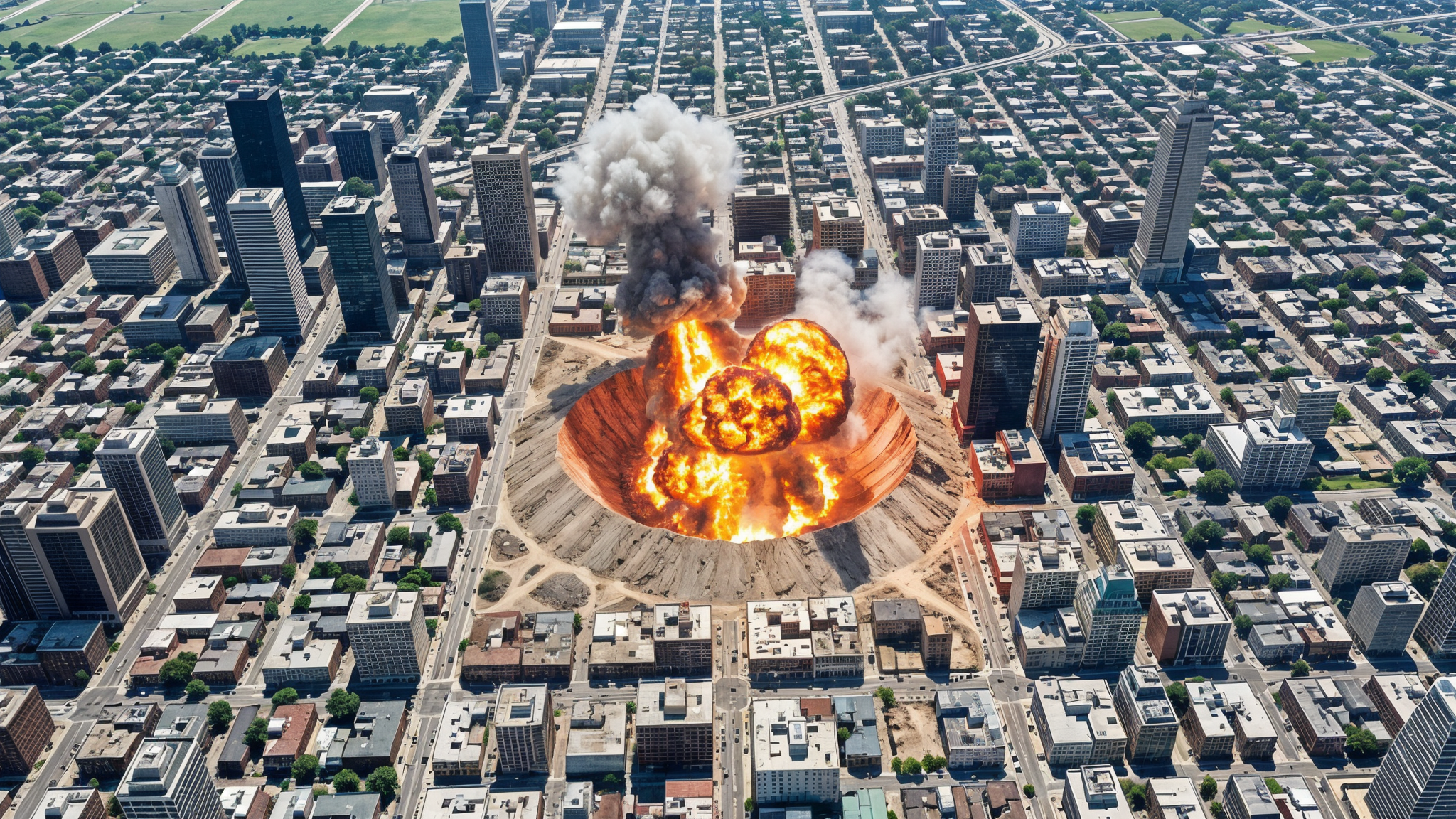
Google launched a novelty within its most famous maps program, Google Earth, on Thursday 30 July. But it withdrew it the next day, barely 24 hours later. What happened? The tool allowed anyone to create fake images of any place in the world and place them over the planet’s real photos. And there was the problem. We will tell you about it in simple words, without jargon.
What was it that Google had added?
Imagine you are looking at a photo of your city from the sky, as if you were a bird. Now imagine you can ask the computer: «put a smoke cloud over that square» or «change that stadium for a crater». That is exactly what the new feature did. You just had to write what you wanted to see (a text called a “request” or, in its technical language, a prompt) and the program drew an invented image on top that nevertheless looked real.
This ability to create images that mimic a photograph belongs to a type of technology called artificial intelligence (AI). AI is, very simply put, a system that learns from a huge amount of data to do things that only people could do before, like writing or drawing. Here it was used to manufacture fake satellite images.
Why is Google Earth special?
To understand the scale of the problem, you need to know what Google Earth is. Above all, it is a tool of trust. Journalists, researchers and citizens use it to check whether an image circulating on the internet is true or false. For example, if someone spreads the news that a city is on fire, Google Earth is checked to see the real sky and confirm or debunk it.
The problem was that Google put the lie factory directly inside the tool people use precisely to catch lies. An expert summed it up very well: «The fake image is manufactured inside the same application people use to check whether images are true». It is as if they sold you a magnifying glass to examine a document and, in reality, that magnifying glass was the one crossing out the lines.
What was created in those 24 hours?
In a very short time, journalists had already generated a lot of disturbing scenes. For example: an explosion crater in Los Angeles, protests in front of Google’s headquarters, a city hit by bombings, flooding around a United States government building or a military base as if it were damaged.
The most worrying thing is that you did not need to know anything about computers to do it. Anyone, just by writing what they wanted to see, could create an image that looked like a real photo of an authentic place. Practically impossible for an ordinary person to tell apart.
The withdrawal in 24 hours
Google explained, when removing it, that it saw people using it for things that go against its rules, and that it was going to strengthen the safety brakes before offering it again. That is positive: they reacted quickly. What many people ask is why they did not notice the danger before launching it. Before showing it to the public, it went through several departments of the company and nobody asked what would happen if someone invented a war scene in a real city.
Besides, Google said the images carried an invisible watermark to detect that they are fake. But that is not enough: when an image is shared over and over on social networks, that mark is lost. And even if there is a way to check whether an image came from a machine, not everyone knows how to do it or has the tools.
Why does it affect you?
Because today anyone can create a fake image of your city, your neighbourhood or a place you want to go, and share it as if it were real. Before, seeing a ¬satellite» photo was almost a guarantee that it was true. Now we can no longer trust it completely.
The recommendation is simple: if you see a shocking image claiming something serious happened, be distrustful and check it against serious sources before sharing it. Images on their own no longer prove anything.
Google has said the feature will return, but with more brakes. Hopefully so. Because trust is something very hard to recover once you manage to deceive someone with something so easy.