

You turn the phone and the screen straightens itself. You run and a watch counts your steps. You open a map and the arrow points where you are looking. None of that is known by a single component: it ...
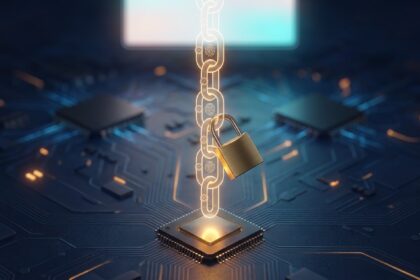
You press the power button and two seconds later the desktop appears. Between those two moments, without you seeing any of it, four things have happened: the firmware verified the signature of the boo...

You glance at your phone, it flashes for an instant and the screen unlocks. The comfortable explanation is that the handset “recognises your face”, as if it compared one photograph with an...
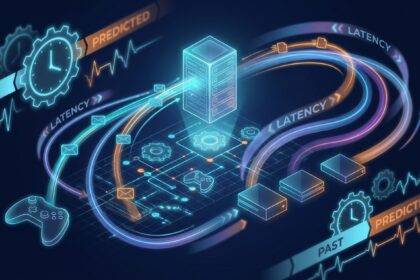
You pull the trigger and, on your screen, the shot leaves instantly. Yet the server that referees the match is living 20 to 80 milliseconds behind you. Decisions, bullets and deaths fit inside that ga...
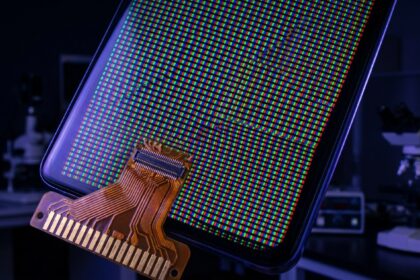
Pick up your phone, turn the brightness all the way down and look at a black area of the screen in a dark room. There is no light bleed, no murky grey: real black. That is the first clue that the disp...

A one-megabyte text file is about 8.4 million bits. That same text, dropped into a ZIP, shrinks to a quarter of its size without losing a single comma. The interesting question is not how it shrinks, ...
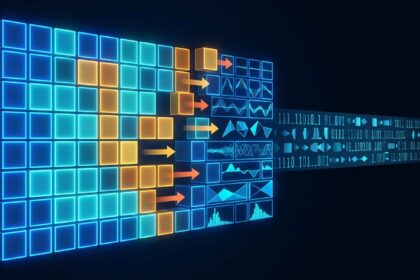
A 4K frame at 8 bits per colour channel is 3840 × 2160 pixels, roughly 8.3 million points. If we stored each one with its three colour components, that single frame would weigh almost 25 MB; at 60 fra...
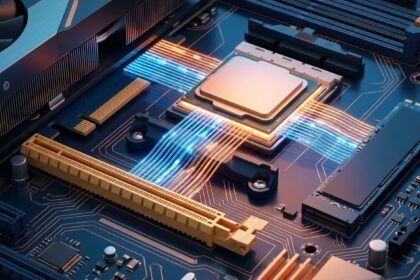
You install an M.2 SSD and you see seven gigabytes per second. The mouse sitting next to it has been working just as well for twenty years while moving at one and a half megabits per second. Both hang...
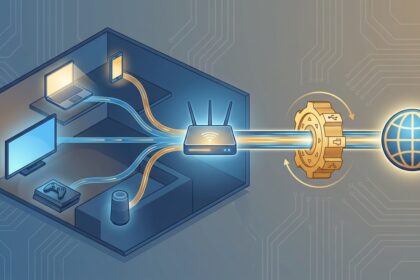
A normal home now holds more IP addresses than people. Every phone, every laptop, the television, the console, the speaker and even the light bulb has one. And yet, seen from the outside, the whole ho...

When you talk to a language model, the answer is cooked up in a few seconds inside a machine with very little magic in it: memory, bandwidth and millions of multiplications. What is striking is the ar...
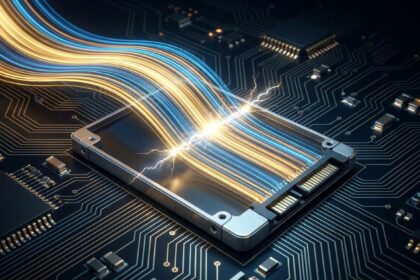
The scene lasts milliseconds. A transaction has just modified three rows, the engine has updated its indexes, the application is about to receive the confirmed commit… and the breaker trips. The...

When your browser opens https://, before a single letter is sent it negotiates a set of keys with the server. That opening greeting, the TLS 1.3 handshake, includes an ECDHE key exchange (ephemeral Di...

The battery percentage in the corner of your screen looks like a measurement, but it is an estimate. Nobody actually knows how much energy is left inside a lithium cell: there is no dipstick in the ta...

You open a laptop, kick off a build and for two minutes everything flies. Then, with nothing broken and no application closed, the fan roars and the machine seems to be driving with the handbrake on. ...
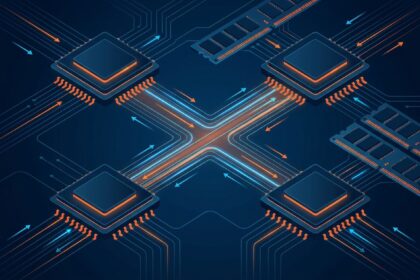
In a processor from twenty years ago, two cores touching the same variable fought over the memory bus and the hardware settled the tie by taking turns. Today a single chip can hold 96 or 128 cores, an...

More than 99% of traffic between continents does not travel by satellite: it runs through submarine fibre-optic cables. This is how light is multiplexed, amplified every 60 kilometres and repaired whe...
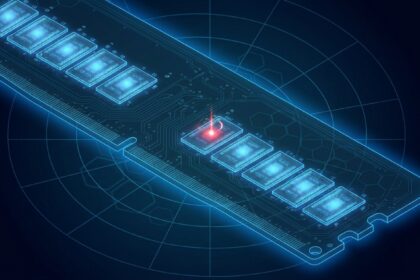
A computer’s memory is not a filing cabinet: it is a bank of microscopic capacitors that drain by themselves in milliseconds and have to be topped up constantly. In that back-and-forth of electr...

For forty years, choosing a processor has meant choosing a side: x86 if you wanted a PC or a server, ARM if you wanted a phone that did not run hot. Both architectures are proprietary, and to build a ...
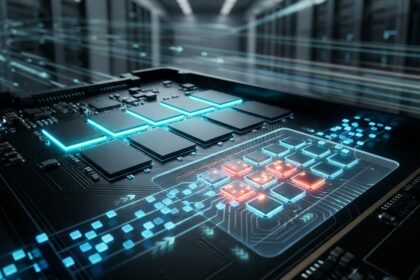
When you delete a file on an SSD, the operating system does something rather modest: it removes the directory entry and marks those filesystem blocks as free. The drive itself does not touch anything....

For nearly thirty years, changing carriers meant the same ritual: find a pin, open the tray and swap a piece of plastic with gold contacts. That piece was a SIM card (Subscriber Identity Module), and ...

Every time your phone draws the blue dot on the map, there is no satellite looking at you. What exists is four atomic clocks in orbit keeping their own account of time and a receiver in your pocket th...

Wi-Fi 7 arrives with a promise we have heard before Every generation of Wi-Fi promises the same thing: more speed. And every generation delivers, though almost never under the conditions in which you ...

The problem is not when, but since when The public-key cryptography that holds up the Internet —RSA and elliptic curves (ECC)— rests on two problems a classical computer cannot solve in reasonable tim...

A touch does not press anything: it disturbs an electric field The first consumer touchscreens worked by pressure. They were resistive: two transparent conductive layers separated by a few micrometres...

The problem: to compute, you have to open the box When you upload your payslip to a cloud service so it can work out your income tax withholding, the server needs to see the numbers. It does not matte...

Email was designed in 1982 for a world built on trust: anyone could connect to a server and say “hello, I am writing from your-bank.com“. Four decades later, that sentence is still free to...

On 4 October 2021, Facebook, Instagram and WhatsApp vanished from the internet for nearly six hours. There was no attack, no power failure, no fire in a data centre. Their servers stayed up and their ...

There is an object that is manufactured by drawing with light and that costs more per unit of weight than gold: the chip in your pocket. Each of its transistors — now counted in the tens of billions —...

You plug in the cable, the phone starts charging and the screen says “fast charging, 67 W”. Nothing visible has happened, but in that instant a strictly rule-bound negotiation has taken pl...
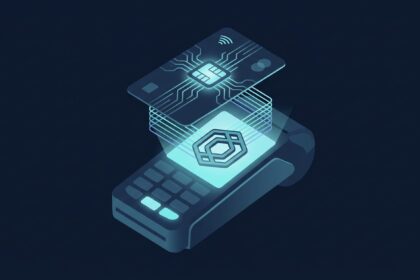
You tap the card, the terminal beeps, and in under half a second it already knows whether that piece of plastic deserves its trust. No PIN, no signature and, in many cases, not even a call to the bank...