
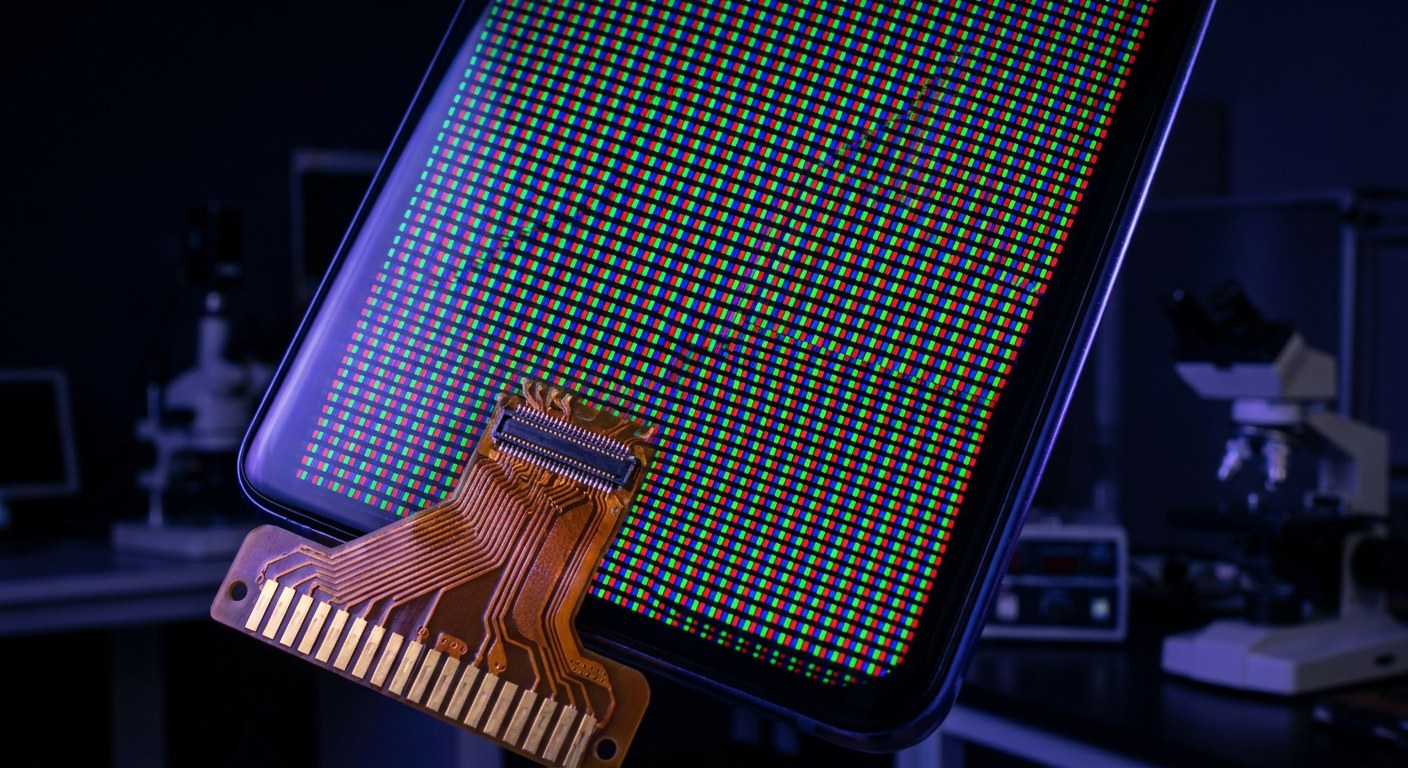
Pick up your phone, turn the brightness all the way down and look at a black area of the screen in a dark room. There is no light bleed, no murky grey: real black. That is the first clue that the display does not behave like a window lit from behind, but like a mosaic of lamps that switch on individually. On an LCD panel the light always comes from a layer of white LEDs placed behind it, and each pixel is a liquid-crystal shutter that lets more or less of that light through; even black is a nearly closed shutter. On an OLED panel there is no backlight: every subpixel is an organic diode that emits its own light when current flows through it, and black is simply the absence of current.
That change of architecture drags everything else with it: contrast, viewing angles, panel thickness, flexibility and also the problems. Because a component that emits light and is used all day long ends up wearing out, and it wears out unevenly.
What is inside a subpixel
An OLED subpixel is a sandwich of organic layers about 100 nanometres thick between two electrodes: a transparent indium tin oxide (ITO) anode and a metallic cathode that usually includes a thin semi-reflective layer. In between lie a hole transport layer, the emissive layer and an electron transport layer. The anode injects holes and the cathode injects electrons; when they meet, they form an exciton, and that recombining pair releases a photon. By changing the molecules in the emissive layer you choose the colour: red, green or blue.
Efficiency depends on how spin is exploited. Fluorescent emitters use only 25 % of the excitons, the singlet ones; phosphorescent emitters, based on iridium complexes, also harvest triplets and get close to 100 %, but a triplet lives a long time and is far more likely to break the molecule. Blue is the cursed colour: it needs the highest energy to emit (photons around 450 nm), its materials age much faster, and only recently have commercial phosphorescent blues started to appear.
The transistor that decides how much light comes out
An OLED is a current device: its brightness depends on current density, not on voltage, so something has to turn the signal into a stable current. That something is a thin-film transistor (TFT) built into the substrate itself, in what is called the backplane. The typical pixel circuit is 2T1C: a switching transistor that charges a storage capacitor and a driving transistor that delivers the current for the whole frame.
The TFT material makes the difference. Low-temperature polysilicon (LTPS) is made with a laser that crystallises the deposited silicon; it has high mobility and allows small transistors (high-density displays), but its threshold voltage drifts over time and with temperature. IGZO, an oxide of indium, gallium and zinc, is far more uniform and leaks very little current, ideal for large panels and low refresh rates. In both cases the panel has to compensate: either with internal circuits of six or seven transistors that sense and correct each pixel’s drift, or with external compensation, periodically measuring the panel’s real currents and adjusting the voltage values that are sent to it.
Brightness is regulated with current, and that is where flicker appears
Dimming is not as trivial as it looks. The clean way is to reduce the current (DC dimming), but at very low currents the colour shifts and some panel generations show blotches. The most widely used alternative is PWM: switching the pixel fully on and off many times per second so that the eye integrates an average luminosity. If that frequency is high, it is imperceptible; if it drops to 240 Hz or less and brightness is very low, some people notice eye strain, or see banding when filming the screen with another camera. It is exactly the same principle as PWM speed control in a motor, applied to light.
Subpixels are not equal, and not only because of colour
A 6.1-inch QHD screen holds around four million pixels and some twelve million subpixels. Manufacturing twelve million reliable blue emitters is expensive and risky, so many panels use layouts such as PenTile: fewer blue and green subpixels, shared between neighbouring pixels. The result is an effective colour resolution somewhat below the nominal one and slightly fringed edges on small text; this is offset with subpixel rendering, which is what an operating system does when it draws letters with that geometry in mind.
Wear: why a screen can get “burned”
Here is the price of being emissive. The lifetime of an OLED material is measured as T95: the time it takes for its luminance to fall 5 % while working at a fixed current. Because blue decays first, a pixel that has spent many hours showing a white status bar or a keyboard will end up emitting less than its neighbours: that is burn-in or image retention, and it is not a one-off fault, it is differential ageing happening in plain sight.
Panels have defended themselves for years with several layers of countermeasures: shifting the image slightly to spread wear, dimming static interface elements, measuring each pixel’s degradation and raising its voltage to compensate, and running compensation cycles while the device is off and plugged in, a process in which the panel heats up and is fully re-measured. On the materials side, blue has been improving with deuterated molecules (replacing hydrogen with deuterium extends life) and with tandem structures, where two blue cells are stacked so the current is shared between them: the same light with half the current density in each.
QD-OLED and MicroLED: two different answers
One of the most interesting commercial solutions is QD-OLED. A blue OLED emitter is manufactured and, above it, a layer of quantum dots converts part of that blue light into red and green. That way only one emissive material has to be perfected, blue, and the red and green primaries inherit the purity and narrow spectrum of quantum dots; on top of that, viewing angles and luminous efficiency improve.
The other route gives up on organic material: MicroLED uses tiny inorganic gallium nitride LEDs with no appreciable degradation. The problem is not making them, it is placing them: millions of chips a few tens of microns across have to be transferred onto a substrate with micron precision and a negligible failure rate, and then the bad ones repaired. That is why it exists in very expensive televisions and not yet in cheap phones.
The result is a trade-off any display engineer knows by heart: more brightness demands more current, and more current shortens the material’s life. That is why HDR on an emissive screen, with its thousand-nit peaks, does not just drain the battery: it takes a toll in longevity. The screen in your pocket is not a glass that lights up, it is a chip that emits light and wears out, slowly and unevenly, from the first day you switch it on.