

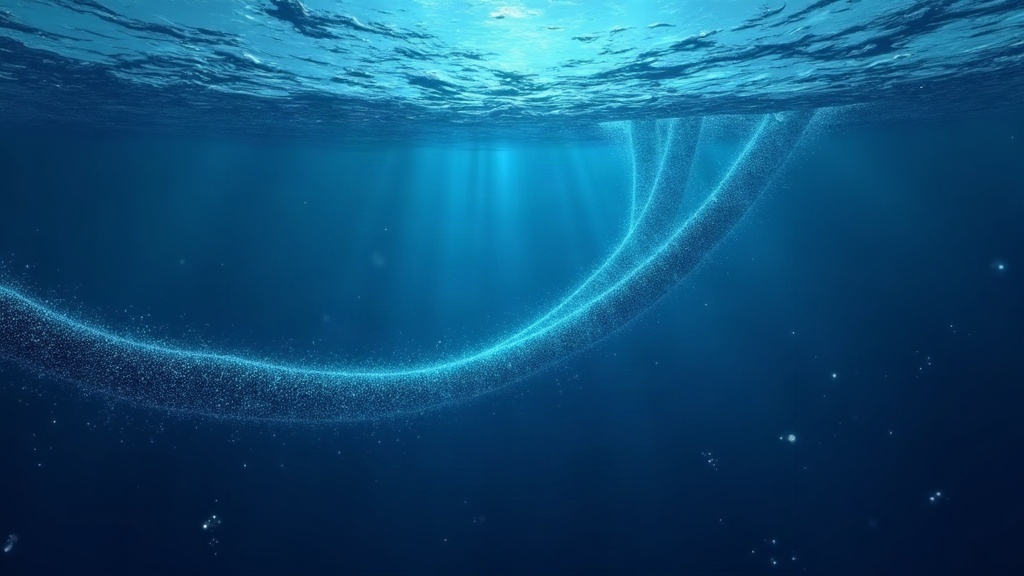
Every time you send a message, watch a video or make a video call, your data does not travel through the air or by satellite. It travels along the seabed. Behind almost all the internet you use there is a network of submarine fibre-optic cables that cross the oceans like invisible motorways. They are the most important infrastructure of the digital age, and almost nobody sees them.
It is estimated that more than 95% of international data traffic passes through those cables. Satellites, which seem more futuristic, only move a small part: the rest. For most connections between continents, submarine fibre remains the fastest, cheapest and most reliable route that exists.
One cable, many layers
A submarine cable is not a simple thread. It is a piece of engineering designed to survive the pressure of the seabed, the currents and years of use. In the centre are the strands of optical fibre, the thickness of a human hair. Through them travel pulses of light that carry the data at the speed of light.
Around them there are layers of protection: plastic, steel and, in some stretches, reinforced armour for the shallow areas where there is more risk of an anchor or a fishing boat damaging it. In total, the cable can be several centimetres thick. Even so, on the seabed, surrounded by darkness, it is easy to forget that it is there.
The repeaters, the filling stations of light
The light that travels through the fibre gradually weakens with distance. That is why, every stretch of about 60 to 100 kilometres, the cable carries a repeater: a small device that amplifies the signal so that it can continue its way. These repeaters are also on the seabed, thousands of metres deep.
If one fails, it is not a matter of going to change it like a light bulb at home. It takes specialised ships, cranes capable of pulling the cable off the bottom and technicians who work in extreme conditions. That is why they are designed to last decades with hardly any maintenance. They are very robust parts, because replacing them is expensive and complicated.
How they are laid and how they are repaired
Laying a submarine cable is a large-scale operation. A specialised ship sets out with kilometres and kilometres of coiled cable and releases it little by little while sailing along a studied route. In shallow areas, it is buried under the seabed with a plough to protect it. In deep waters, it is simply deposited on the bottom.
When a cable is damaged, the monitoring systems detect exactly where the fault is by measuring the round-trip times of the signals. Then a repair ship moves to the point, drops a hook to catch the cable and brings it to the surface to splice it. It is a delicate job that can take weeks.
A map that draws the connected world
If you looked at a map of submarine cables, you would see that the routes are not straight. They follow the most stable seabeds, avoid volcanic and earthquake zones, and connect the great data exchange points. The planet’s main centres are linked by a dense network of digital motorways.
The capacity of these cables keeps growing. Modern technologies make it possible to transmit huge amounts of data over each pair of fibres. And as the world becomes even more digital, with video, the cloud or artificial intelligence, demand keeps rising. In fact, new cables are already being planned and laid to expand that network.
A discreet and essential infrastructure
Few technologies are so decisive and so little visible. The submarine cable is not advertised, does not appear in shop windows and you do not carry it in your pocket, but without it there would be no international messaging, no global social networks, no video calls with someone on the other side of the ocean.
The next time your connection runs at full speed, remember that, most likely, your data is crossing an ocean inside a few-centimetre cable resting on the seabed. The modern internet is not in the sky: it is submerged, working in silence to keep you connected.