
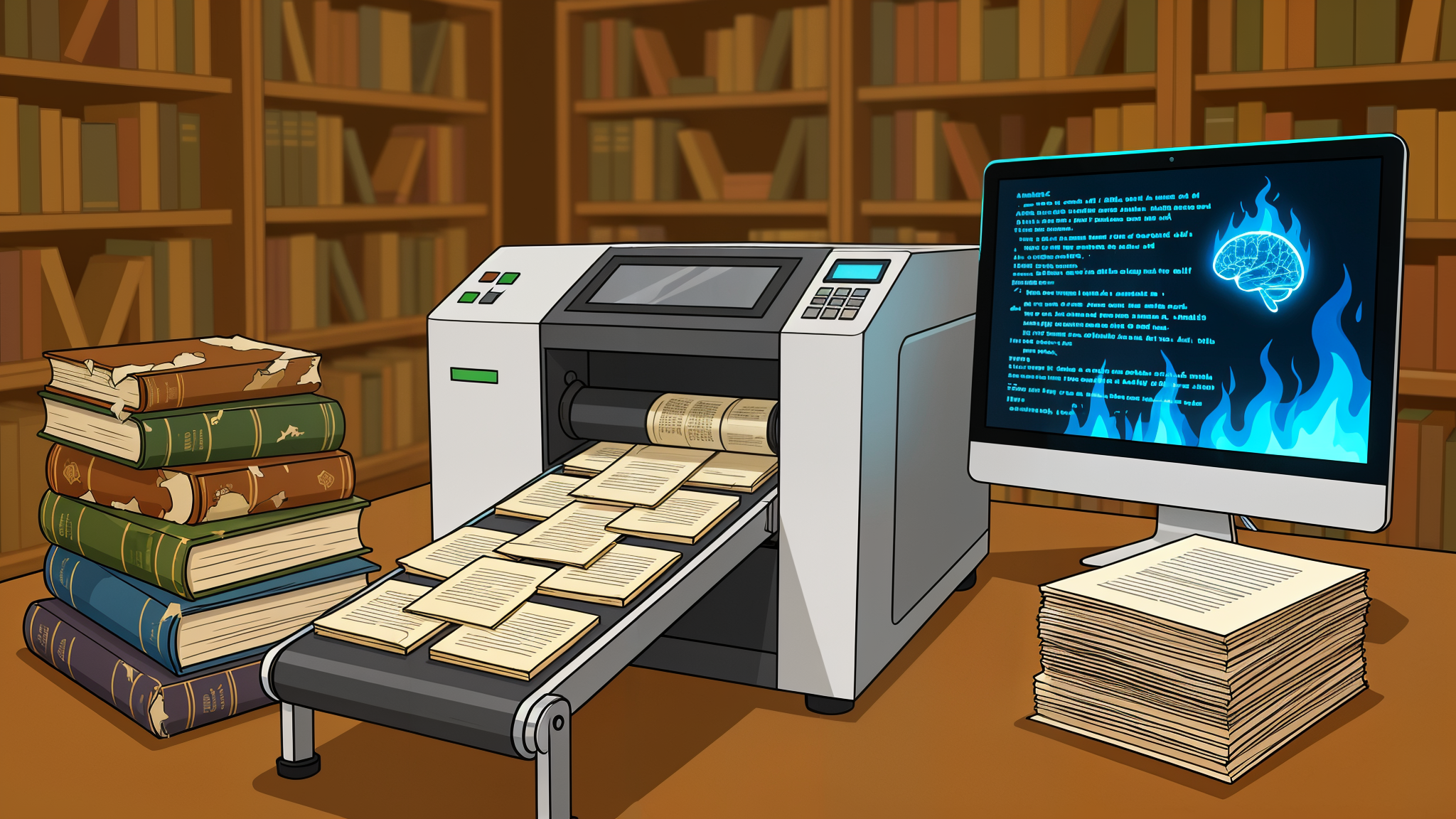
A bookshop in Badalona received a very strange order: the customer bought old books without looking at the price, paid three times for shipping and wanted dozens at a time. The bookseller, Marçal Font, thought it was a scam. When he investigated, he discovered something making headlines around the world: the big artificial intelligence companies are buying millions of used books to cut them apart, scan them and feed their programs.
The mystery of the strange purchases
It all started on 30 April at the Librería Fénix, a benchmark for old books. A strange order arrived: it came from Canada and the pattern was odd. They asked for many books in a very short time, sometimes in an hour, and the shipping costs were exorbitant. Nobody takes two hundred used books at once.
Font talked to his friend Xavier Vinaixa, an expert in artificial intelligence. Together they find other booksellers with the same story in Germany, New Zealand and Australia: the same customers, nobody haggled over the price. It was not a fraud. It was much more.
What is the “Panama Project”?
In September 2025, an artificial intelligence company called Anthropic reached an agreement to pay 1.5 billion dollars to a group of authors who were suing it for using their books without permission to train its programs.
Four months later, a newspaper uncovered an internal document. In it, what they call the “Panama Project” was mentioned. Its objective was devastating: to scan all the books in the world. The text said literally: “We do not want anyone to know we are working on this”.
How does that artificial intelligence work? Think of your phone’s keyboard. When you type “hi, I’m on my way”, the phone suggests the next word because it has read many of your texts. Well, that same idea, multiplied millions of times, is behind the programs that write on their own, such as the well-known ChatGPT.
To learn, these programs need enormous amounts of text. First they ate up all the information on the internet: Wikipedia, blogs, forums. Then the newspapers and even the subtitles of videos. Now it is the books’ turn. When they have read all the commercial ones, they look in second-hand bookshops for the rare ones that nobody has digitized.
The problem: cutting the book forever
There are two ways to get a book into a computer. The first uses scanners that read the pages without breaking it; it is slow and expensive. The second is destructive: the spine is cut, the sheets come loose, they go through a machine at full speed and the book can no longer be put back together. Its remains go to recycling.
The companies choose the second because of the money: it is faster, cheaper and allows millions of copies to be digitized. And the law allows them to use a purchased book to train artificial intelligence.
Why does it matter to you?
Here is the delicate part. When you cut a book to scan it, you lose things that the text alone does not tell: the binding, the handwritten notes, the illustrations, the dedications, the history of that particular copy. Digitizing is not the same as preserving.
And there is something else. Everything written outside the big publishers, such as the pamphlets of social struggles or self-published books, often does not have an official identification number, the so-called ISBN. That material is at risk and can be lost.
In addition, digital files usually end up stored in private databases, out of reach of libraries, teachers and researchers. Knowledge goes from a public book to a company’s private archive.
Not everything is bad
There are also those who see it with good eyes. Marçal Font recalls that in the 15th and 16th centuries, with the printing press, data was also lost when books changed format, and it was resolved by noting down what surrounded the text.
His fear is not breaking a book to digitize it, but that that digitization stays private and that they forget to note where each copy comes from, who signed it, what characteristics it has. A book is not just a pile of words; it is a piece of history.
What you can do
You do not need to be a technology expert to understand this news. Just ask yourself: who decides what is worth keeping? A private company or society?
And a practical recommendation: if you love books, support libraries and old-book dealers. They are the ones who keep the memory. As Font says, there is no one who destroys more books than the person dedicated to saving them.
Artificial intelligence is changing the world. This story reminds us that, as it advances, we must decide carefully what we leave behind. The knowledge of all humanity cannot end up locked in a company’s safe.