

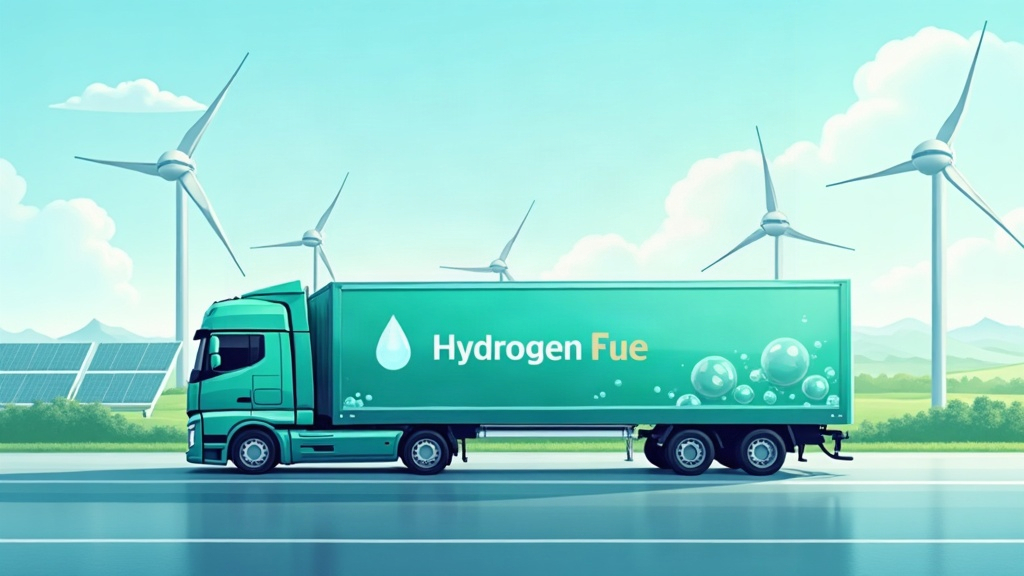
When we talk about renewable energy, we almost always think of the sun and the wind. But there is another candidate that has been making a strong case for years and promises to solve one of the great challenges of the energy transition: green hydrogen. It is not a fad or a science-fiction promise: it is a real fuel already being tested in trucks, ships and factories around the world.
To understand it, just recall two simple facts. The first: hydrogen is the most abundant element in the universe. The second: when it is burned to generate energy, its only waste product is water vapour. Zero smoke, zero carbon dioxide. That makes it a perfect ally for decarbonising activities that a simple plug cannot cover.
What makes it «green»?
Hydrogen is not found free in nature, but combined with other molecules, above all with water. It has to be «extracted», and there lies the heart of the matter. Depending on how it is obtained, hydrogen is classified by colours.
Grey hydrogen is produced from natural gas and releases CO₂ into the atmosphere. Blue does the same but captures part of that CO₂. And green is the holy grail: it is obtained through a process called electrolysis, which uses renewable electricity to split water into oxygen and hydrogen. Since the electricity comes from the sun or the wind, the emissions balance is virtually nil.
Why don’t we already use it in every car?
The most common question. The answer has two parts: cost and infrastructure. Producing green hydrogen is still expensive, because electrolysis consumes a lot of energy and is not yet manufactured at scale. In addition, you need a network of refuelling stations that today is almost non-existent outside a few cities.
That is why hydrogen is not fighting for the small car — where the battery electric car has the advantage — but for territory where the battery falls short: long-haul trucks, ships, aircraft or heavy industry such as steel and cement. These are sectors that need a lot of concentrated energy that is quick to refuel, something hydrogen can offer.
A tank, not a battery
It is worth clarifying a nuance. When we talk about hydrogen cars, most do not burn the gas directly: they feed it into a fuel cell, a device that combines it with oxygen from the air and generates electricity to drive the motor, emitting only water. In other words, it works like a small power plant on board, silent and clean.
It can also be used to store energy. One of the problems with the sun and the wind is that they do not always blow or shine when needed. Hydrogen makes it possible to «store» that surplus electricity to use it days or weeks later, something batteries find harder to do when we are talking about large quantities.
What is needed for it to take off
The path is laid out, but there are still slopes to climb. More electrolysis plants are needed, prices must come down with large-scale production, and a transport and refuelling network must be built. Many countries, including Spain, have already announced plans and millions in funding to boost the so-called «hydrogen valley», with the idea of turning southern Europe into an exporter of clean energy.
Nobody says it will be easy or immediate. But green hydrogen has something no other fuel offers: the ability to move heavy transport and industry without leaving a footprint. And that, in the race to slow climate change, is a piece the planet cannot afford to leave off the board.