
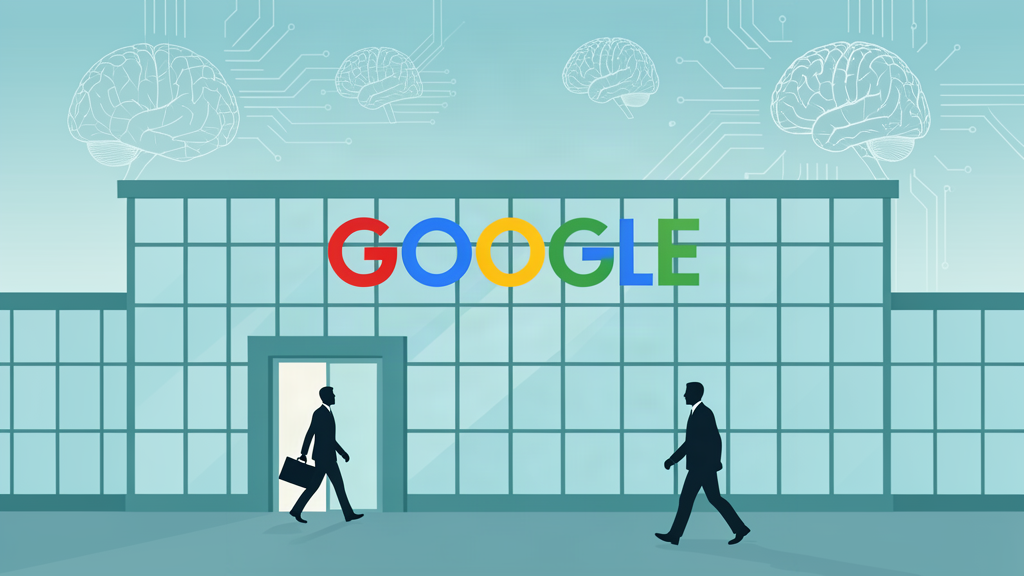
Google has moved the pieces of its artificial intelligence (AI) team. The most striking change is the departure of Jeff Dean, one of the company’s most important scientists, after 27 years working there. He’s leaving to found his own company, and Google is going to invest in it. The changes were announced on Wednesday 5 August.
Who is Jeff Dean and why does he matter so much?
Jeff Dean isn’t just another employee. He’s one of the people who helped build Google from the inside: when the company was small, he took part in creating the systems that made the search engine work, that tool we use every day to find things on the internet.
But his most famous role came later, when he helped drive what are called “neural networks”. It sounds complicated, but the idea is simple: they’re programs that learn from examples, just as a child learns to tell a cat from a dog after seeing many. That way of teaching computers is the basis of modern artificial intelligence, the one we use today so a phone can understand what we dictate to it or so a program can write texts. Pichai, Google’s chief executive, said Dean helped create “some of the most important technological transitions” in the company.
What will Jeff Dean do now?
Dean isn’t retiring. He’s leaving to set up a new company called Discovery Loop. He’s joined by other heavyweight researchers, such as his long-time partner Sanjay Ghemawat and veterans Oriol Vinyals and Quoc Le.
The new company will have a special legal form: it’s called a “public benefit corporation”. It’s like a restaurant that, besides seeking to make money, commits in writing not to serve food that’s bad for your health. In their case, the commitment is to put science ahead of financial interests. Dean himself said it: “We could make decisions that aren’t the best for the company’s pure interests.”
His goal is to use artificial intelligence to accelerate discoveries in science and engineering: finding new medicines, new materials or more efficient ways of producing energy. Google, far from being upset, is going to invest in the new venture and will even rent it the computing power it needs.
Who takes over?
The role of chief scientist of Alphabet, the company that owns Google, goes to Demis Hassabis. Hassabis isn’t a newcomer: he founded DeepMind, the world’s most famous artificial intelligence laboratory, which Google bought in 2014. In 2024 he received the Nobel Prize in Chemistry for his work with an AI capable of predicting the shape of proteins, something that helps research diseases.
Hassabis is leaving the day-to-day leadership of DeepMind to focus on long-term strategy, including what’s called “artificial general intelligence”. Don’t be scared by the name: it’s an AI capable of doing almost any intellectual task a person can do, like an all-round assistant. He will also remain at the head of Isomorphic Labs, a company that uses AI to discover medicines.
Taking charge of DeepMind is Koray Kavukcuoglu, until now the lab’s chief technology officer. He will oversee Gemini, Google’s family of AI assistants that millions of people already use in the search engine and on Android phones. According to Google, the Gemini app exceeds 950 million monthly users.
Why are they doing this now?
Google is in the thick of the race for artificial intelligence against rivals like OpenAI, the creators of ChatGPT, or the company Anthropic. It’s an extremely expensive race: Google plans to spend between 175,000 and 205,000 million dollars this year on giant computers, data centres and other AI infrastructure. It’s so much money that, for the first time in its history, the company spent more in one quarter than it earned. After the announcement, its shares fell around 4%.
This move seeks to go faster. Pichai summed it up like this: he wants to “accelerate” AI work and keep Google “at the frontier” of the sector.
And what’s it to me?
More than it seems. The AI you use every day, even if you don’t know it, is directed by the people who have just changed roles. Mobile assistants, automatic translators or the email that auto-completes depend on these decisions. When the chief scientist of the world’s biggest company in this field leaves to set up his own, it’s a sign that the technology we use is changing hands and that competition is fierce.
In the end, it’s good news: more bright minds working on the same thing usually means better and cheaper products. Like when a great chef leaves a famous restaurant to open his own: customers gain variety.