
Can you imagine that, before opening a new hospital, an entire building, or even a whole factory, there were already an exact copy of it where you could test everything without risking anything? That is, in essence, what the technology that today headlines industrial and urban innovation does: the digital twin.
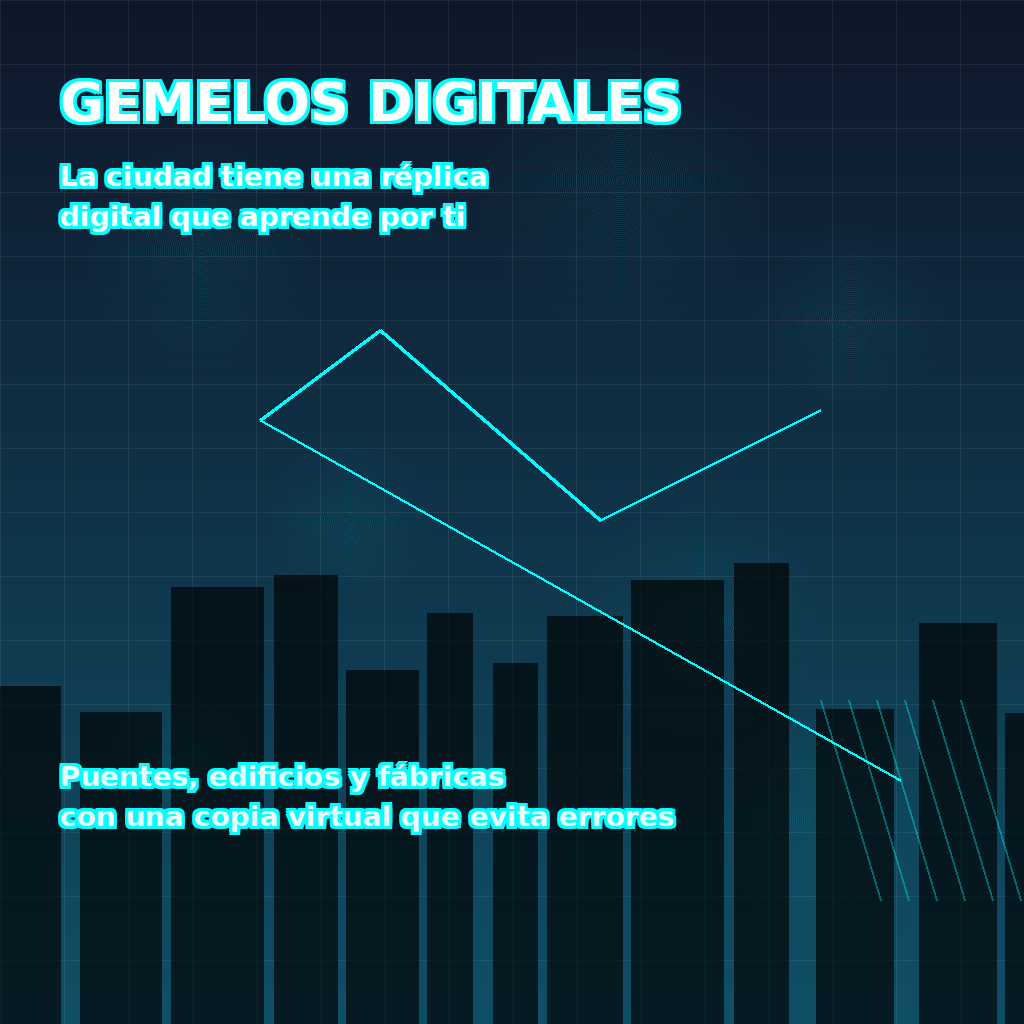
A digital twin isn’t a three-dimensional drawing or a pretty video. It’s a virtual replica of something real —a bridge, a city, a company, even a person— that stays alive and up to date thanks to the data that arrives from sensors, cameras and connected devices.
The copy that never sleeps
Imagine a real bridge fitted with sensors that measure vibrations, cracks or the traffic it supports. That information travels to a computer model that repeats, on the screen, what is happening to the real bridge. If the model detects a weak point, there’s no need to wait for the real bridge to fail: the warning comes earlier.
The key is in that word: earlier. While a static blueprint only shows what something was like on the day it was designed, the digital twin shows what it’s like right now and, thanks to the accumulated data, helps imagine what it will be like tomorrow.
Testing it on the computer before real life
This approach allows experimenting without fear. A city can simulate with its twin what would happen if it opened a new metro line, a huge traffic jam or a day of torrential rain, and see the effects before spending a single euro on works.
The same happens in factories. Before reorganising an assembly line or testing a new robot, engineers rehearse the manoeuvre in the digital replica. If something goes wrong, it’s fixed in the simulator, not on the real line, avoiding costly stoppages and accidents.
A hospital tested before it exists
A good example came from the world of healthcare. Before building a hospital, its digital twin was created to simulate patient routes, the lighting of each operating room and the flow of the emergency department. The result was facilities designed to work, not just to look good.
In fact, the concept also applies to people. Doctors already use so-called “digital twins of the body” to anticipate how a heart or a particular joint will evolve, practising interventions on a replica of the organ before touching it for real.
The map and the territory
The most fascinating part is that the relationship between the copy and the original isn’t one-way. Not only does the twin learn from reality: reality can learn from the twin. If the digital model discovers a more efficient way to ventilate a building, those lessons are transferred to the real building.
It is, ultimately, a constant dialogue in which the replica helps the original work better, consume less and live longer.
And the risks?
Like all technology, it has limits. A digital twin is only as useful as the data it receives: if data is missing or incorrect, its predictions waver. There’s also the question of privacy, especially when the replica is of a person. And, of course, you need a good connection and storage capacity to support so much data in motion.
A mirror with a memory of the future
Digital twins don’t herald the “smart cities” of science fiction. Quite the opposite: they’re a tool of common sense: rehearse before building, warn before breaking and save before spending.
As sensors get cheaper and networks faster, having a twin of almost anything —of your neighbourhood, your office, your ship or your plane— will become as normal as having a blueprint or a photograph. The difference is that this blueprint doesn’t stay still: it breathes, it learns and, above all, it lets us look to the future before taking a step.