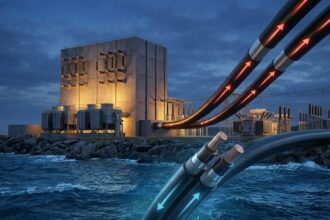

On the Alicante coast, the Torrevieja desalination plant produces close to 80 cubic hectometres a year, roughly the consumption of 700,000 people. There is no chemical magic in that process: there is pressure. Mediterranean water comes in with about 35 grams of salt per litre and leaves with less than half a gram, and the difference is paid for with an energy bill the plant has learned to charge twice.
Salt is not filtered out: it is pushed back
Water does not separate from salt on its own. When two solutions of different concentration meet across a semipermeable membrane, water moves towards the saltier one. That phenomenon is osmosis, and the pressure needed to stop it is called osmotic pressure. It is calculated with the van’t Hoff law, a version of the ideal gas law applied to solutions: π = i·C·R·T, where C is the molar concentration of dissolved particles, R the gas constant and T the absolute temperature.
In seawater at 25 °C, with about 1,100 millimoles per litre of ions (mostly sodium and chloride), that formula gives something in the order of 27 bar. To make water cross the membrane the other way and come out the other side, that barrier has to be beaten with margin: plants run between 55 and 70 bar in the first stage, depending on temperature and salinity. The colder the water, the higher the required pressure, a detail that shapes the design of northern plants.
What sits inside a reverse osmosis module
The membrane is not a filter with visible pores. It is a polyamide thin-film composite barely 200 nanometres thick, laid over a porous polysulfone layer and a polyester support. Water crosses it by diffusion in the dissolved phase; ions, hydrated and charged, are left behind. A commercial module rejects more than 99.5 % of the salt and much of the boron, which as uncharged boric acid is the awkward guest in agricultural irrigation.
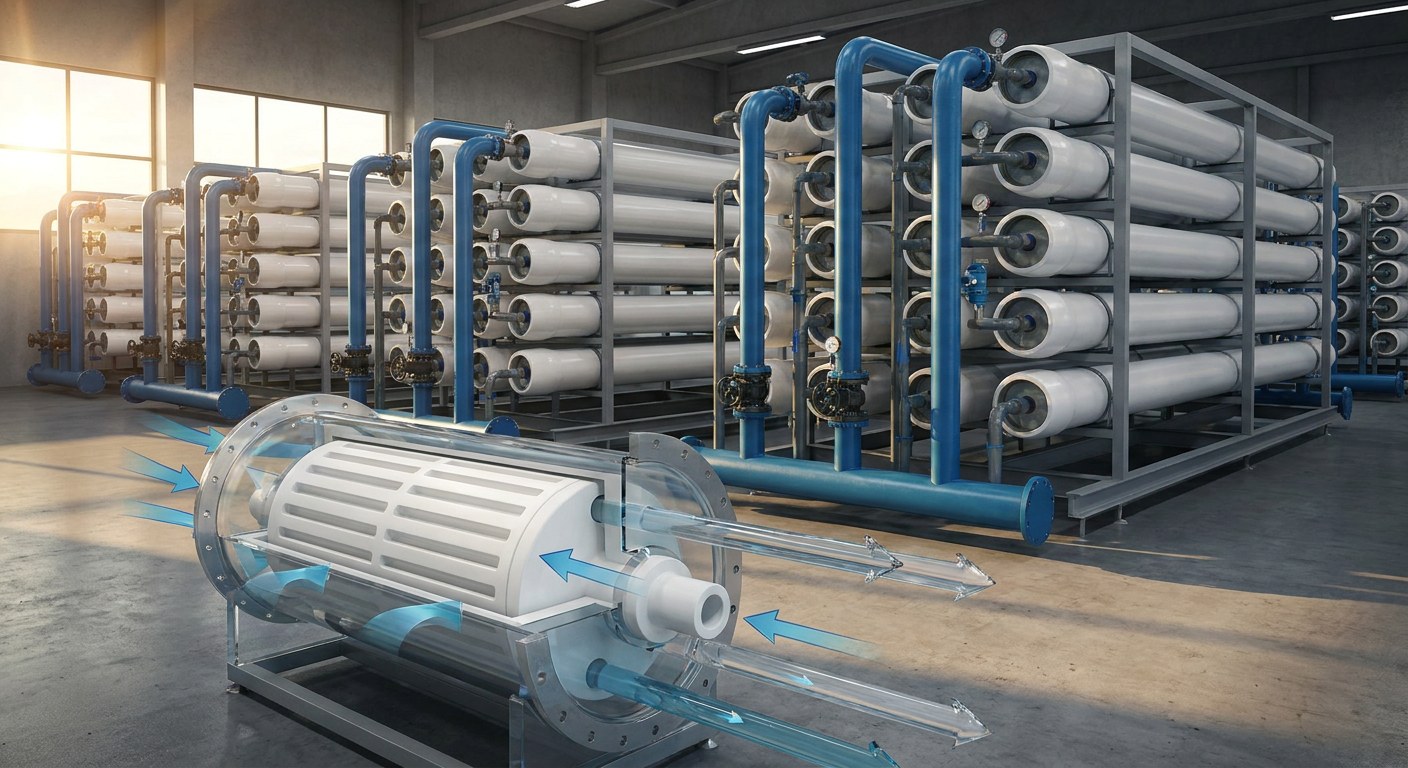
The module is a spiral wound assembly: two membrane sheets glued on three sides, with a permeate spacer in between, rolled around a central tube and separated by a mesh that forms the feed channel. Pressurised water travels that channel in a spiral, part of it crosses the membrane and is collected through the central tube; the rest, now more concentrated, exits the other end. Modules are stacked in racks, in trains of several stages: the reject from the first feeds the second, with intermediate pumping, to squeeze out extra recovery.
The energy bill: 3 or 4 kWh per cubic metre
The thermodynamic limit for separating salt from seawater is the Gibbs free energy of mixing, which at 50 % recovery is around 1 kWh/m³. In practice a seawater reverse osmosis plant consumes between 3 and 4 kWh per cubic metre, including high-pressure pumps, pre-treatment and distribution pumping. That is about ten times less than thermal distillation, the method that dominated until the 1990s.
The gap between the limit and real consumption is not just pump inefficiency: it is the irreversibility of the process. As water crosses the membrane, the concentration at the film surface rises and concentration polarisation forms, a saltier layer that forces the effective pressure at the interface upwards. That is why flow rate and spacer meshes matter as much as the material itself.
The part that gives back half the pressure
The reject leaves the module at 60 bar and with twice the salinity. Dumping it would mean dumping energy, so every modern plant carries an energy recovery device. The first ones were Pelton turbines: they turned pressure into rotation and fed the torque back into the high-pressure pump shaft, at 80-85 % efficiency.
The design that prevailed is different, because it converts pressure neither into electricity nor into rotation: it transfers it directly. It is the isobaric pressure exchanger (ERD), a ceramic rotor with axial channels that turns slowly between a stream of pressurised reject and a stream of already filtered seawater. The two liquids do not mix: they push each other like successive pistons, and the brine hands its pressure to the incoming water. Efficiencies of 96-97 % and a pressure drop of barely one bar between brine arriving at 65 bar and leaving at 1-2. The high-pressure pump only has to cover the shortfall.
The result is the figure that explains the economics of desalination: of the 3-4 kWh/m³ that separate the plant from its theoretical limit, more than half is recovered here. Without an ERD, a seawater reverse osmosis plant would consume in the order of 7-8 kWh/m³ and would be unviable at municipal scale.
What the water carries away before reaching the membrane
The membrane is very expensive and fragile in the face of dirt, so pre-treatment decides the life of the plant. Coagulation with ferric chloride or aluminium sulphate is applied, dissolved air flotation removes algae and organic matter, and sand filtration or ultrafiltration membranes finish the job. An antiscalant delays calcium sulphate and carbonate; chlorine is dosed to disinfect, but it is neutralised with bisulphite before the inlet, because polyamide degrades on contact with the oxidant.
Long-term consumption depends on chemical cleaning of the modules: every fouling event forces pressure up and a wash with caustic or acid. Instrumentation — conductivity, differential pressure, flow and temperature per train — is what makes it possible to catch a sick module before it drags the rest down with it.
The other bill: brine
For every litre of drinking water, a seawater plant returns one to two litres of brine at double the concentration. Near the coast it is dispersed through diffusers and its relative density makes it sink and drift along the seabed, where it can damage posidonia meadows if the outfall is badly designed. Hence new projects include plume modelling studies and, in some cases, salt recovery for industrial use.
With drought as the backdrop in the Mediterranean, the argument is no longer whether desalination works — it does, and it uses less than intuition suggests — but how much cheap energy and how many well-resolved outfalls fit on a coast that is also a habitat. The membrane does its part; the rest is pressure engineering, and almost all of that pressure is given back.