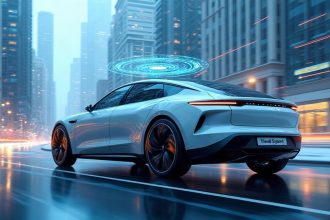

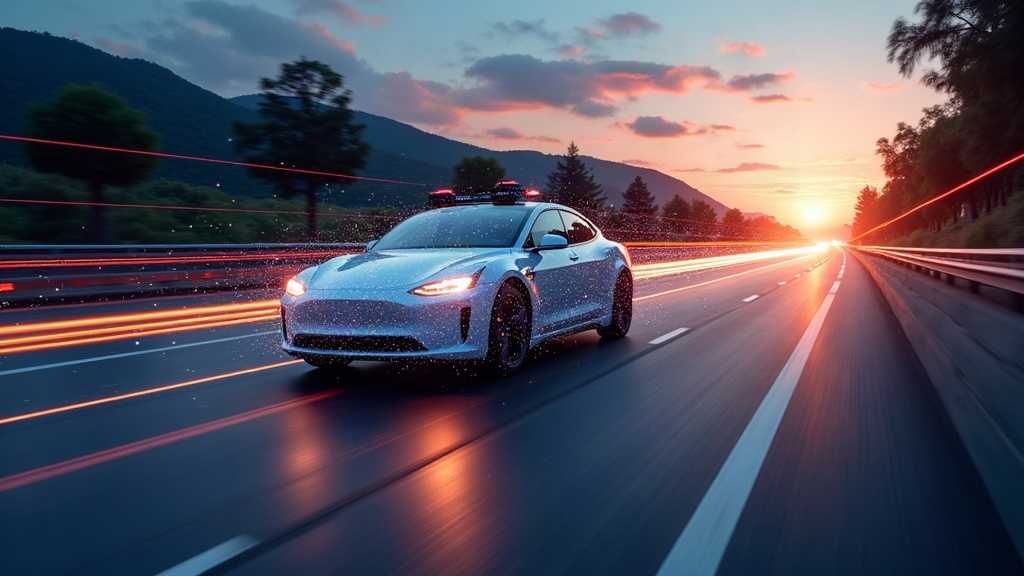
The steering wheel turns on its own. The driver’s hands — if they can be called that — rest on their lap while the car brakes at a traffic light, waits for a pedestrian and resumes driving without anyone having given it an order. What seemed like science fiction is already a reality driving through the streets of several cities around the world. But how does a car learn to drive itself?
A car that “sees” the world
A self-driving car has no eyes, but it does have a combination of sensors that fulfil that function. Cameras, radars and laser sensors (known as LIDAR) work at the same time to build a continuous image of what is happening around them. The cameras distinguish colours and traffic signs; the radars measure the speed of nearby vehicles; and the LIDAR draws a 3D map of the environment, detecting kerbs, streetlights and people even at night.
None of these sensors is perfect on its own, and that is why the secret is in combining them. What one does not capture, the other makes up for. It is what engineers call redundancy: if one system fails, the others keep watching.
The brain: the artificial intelligence that decides
All that information reaches an onboard computer that processes it in milliseconds. This is where artificial intelligence comes into play. The car does not have a manual with every possible traffic situation (they would be infinite), but it has learned to recognise patterns.
Before taking to the streets, these systems are trained with millions of images and real driving situations. By dint of repetition, the machine learns to distinguish a parked truck from a moving one, or a pedestrian crossing from a motionless object beside the pavement. It is the same kind of learning used by voice assistants, but applied to a life-or-death task.
Levels of autonomy: not all are the same
When talking about autonomous driving, several levels are distinguished, from 0 to 5. At the low levels, the car only assists: it brakes by itself in front of an obstacle or keeps the lane, but the human remains in charge. At level 3, the vehicle can drive itself in specific situations (such as a motorway) and only calls on you if something gets complicated.
The big leap comes with levels 4 and 5, where the car is able to drive without human intervention in most or all circumstances. Today, fully autonomous vehicles still drive in controlled environments or in test fleets, but they are becoming more and more common.
The challenges that remain ahead
Technology is advancing fast, but the road still has potholes. One of the biggest challenges is safety: deciding how the car should react in unforeseen situations is a question that mixes engineering and ethics. There are also legal doubts: if a self-driving car has an accident, whose responsibility is it?
Added to this is coexistence with cars driven by people, whose behaviour is much more unpredictable than that of a machine. That is why many experts believe the revolution will come gradually, first blending driver assistance before handing over full control.
Towards a future that is already emerging
Despite the challenges, autonomous driving promises enormous advantages: fewer accidents, more mobility for those who cannot drive and cities with fewer traffic jams. It is not a distant future: the assistance systems already present in today’s cars are the first step of that ladder.
Perhaps in a few years, the idea of having to drive yourself will seem as strange to us as starting a phone with a crank would seem today. Technology advances little by little, but when it takes a leap, there is rarely any going back.