
Hello techies, how are you all doing? Today I bring you news that sounds like science fiction but is completely real. China has just taken a giant step in its nuclear fusion program and has set a specific date for something we’ve been chasing for decades: replicating the process that powers the Sun. The country aims to generate electricity through nuclear fusion by 2030 and to start doing so commercially by 2035, a decade ahead of its competitors. If they succeed, we’ll be facing one of the most important technological advances in the history of humanity.
To understand the magnitude of this, we have to talk about what nuclear fusion is and why it’s so important. Fusion is the inverse process of the fission used in today’s nuclear power plants: instead of splitting heavy atoms like uranium, it joins light atoms to generate energy. It’s extremely unstable and the heat generated is enormous, but the process produces a far greater amount of energy and, most importantly, without long-lasting radioactive waste. We’re talking about almost unlimited and clean energy, the holy grail of electricity generation. That’s why all developed countries are investing billions to achieve it.
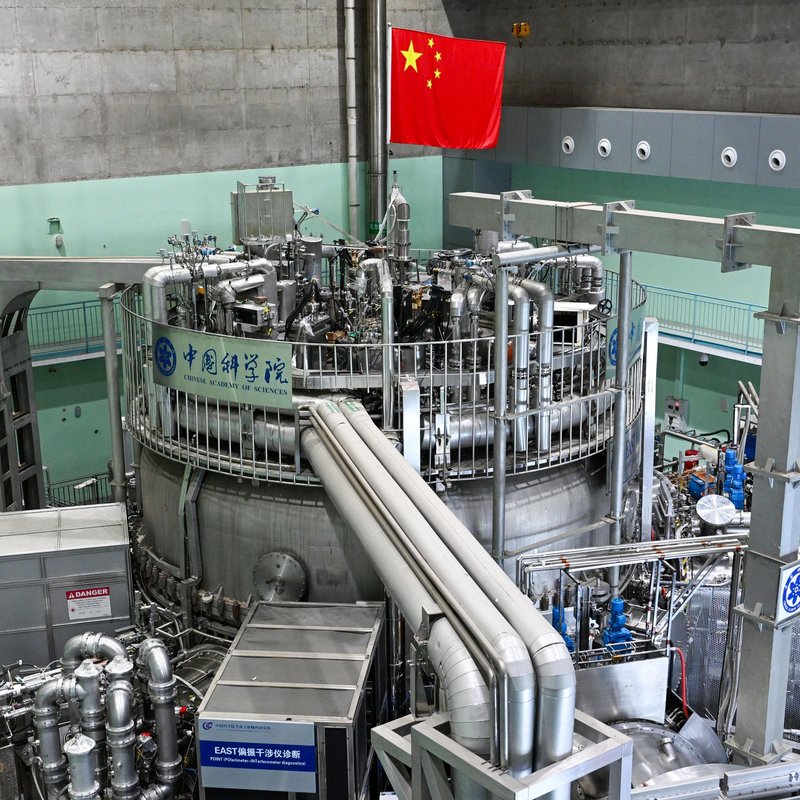
China has been developing the EAST program since 2006, which stands for Experimental Advanced Superconducting Tokamak, to test the viability of commercial fusion energy. In 2021 they achieved an impressive milestone: a continuous plasma operation lasting 17 minutes in which the core operated at 70 million degrees Celsius. To give you an idea, that’s five times the temperature of the Sun. And recently, researchers discovered that the reactor could operate at 165% of its theoretical maximum capacity without suffering disruptions. It’s as if you had a car designed to go 200 km/h and you discovered it could travel steadily at 330 km/h without overheating.
The BEST, which stands for Burning Plasma Experimental Superconducting Tokamak, is the spearhead of its nuclear fusion program. If EAST is the proof of concept, BEST is the demonstration of viability at full scale. China began construction of BEST in 2023 and expects to complete it by 2027 to start carrying out tests with plasma. If everything goes as planned, the CFETR reactor will be the one that finally pours fusion energy into the commercial power grid. If it reaches its goal, China will be the first country able to commercially emulate the power of the Sun to switch on the first nuclear fusion light bulb in history.
Meanwhile, the rest of the world isn’t sitting idly by, although it’s moving much more slowly. In France there is ITER, with a budget of 24 billion euros, the most expensive international program in history. The problem is that it keeps suffering constant delays, an overrun budget and an operational date that hasn’t been met. In the United States, a private startup is building SPARC, much smaller than ITER but potentially more profitable. The United Kingdom has STEP, Japan the JT-60SA and Russia the hybrid T-15MD. The curious thing is that the enormous energy needs of artificial intelligence are encouraging advances in nuclear fusion. AI needs so much energy that it’s pushing us to look for radically new solutions.
Best regards, Marta
Automatically published on 22/01/2026 at 12:05