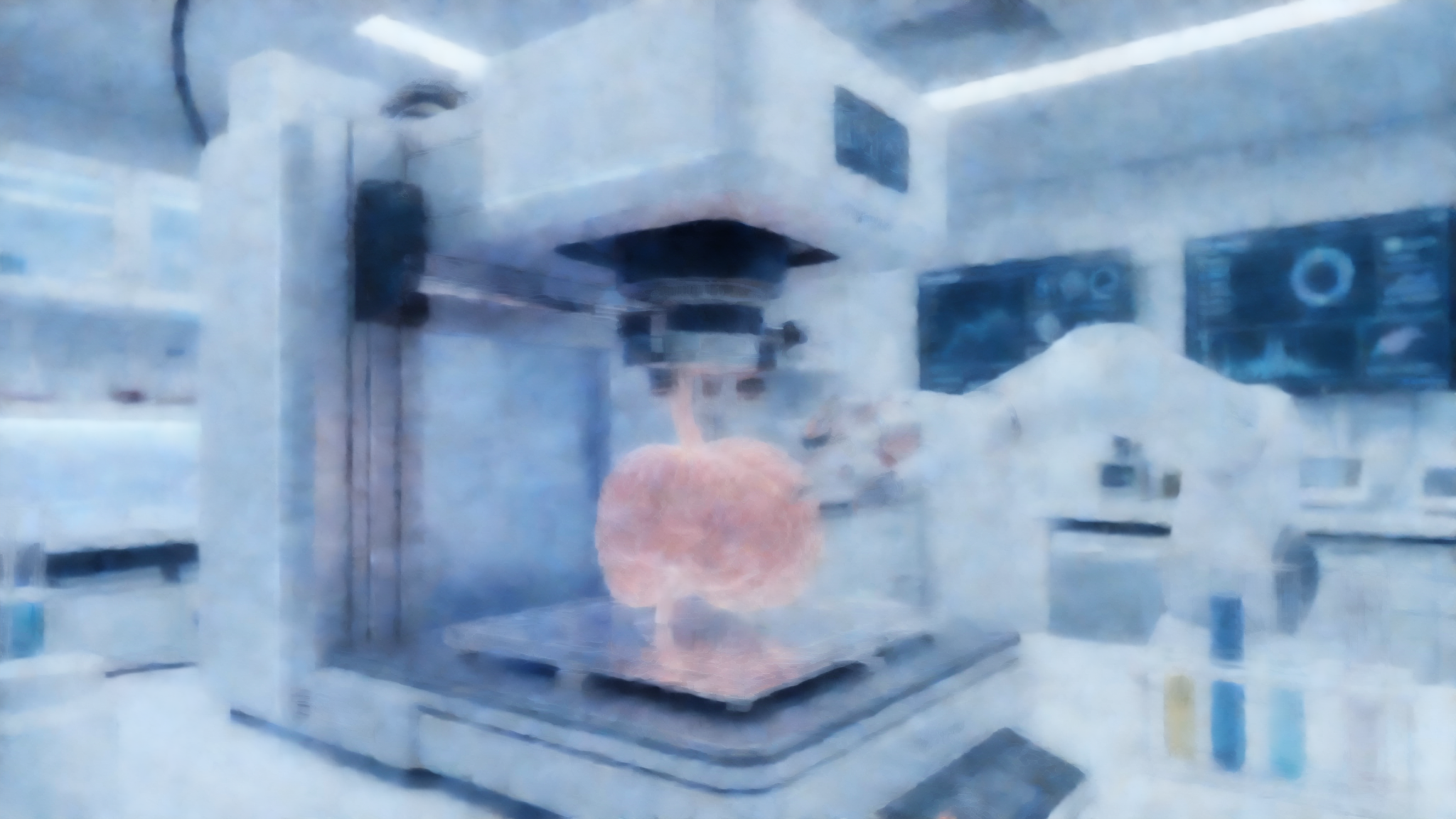
There is a limit that medicine has been trying to overcome for decades: transplants depend on donors, and they do not always arrive. But technology is opening a door that a few years ago seemed like science fiction. 3D bioprinting already makes it possible to build living tissues layer by layer, and its medium-term goal is for hospitals to be able to make something more than replacement organs: to print them.
What exactly is bioprinting
Imagine a normal 3D printer, like the ones that use plastic to make toys or parts, but changing the material. Instead of plastic filament, the bioprinter deposits a bio-ink: a mixture of living cells, nutrients and biocompatible materials. By placing layer upon layer, it manages to build structures that mimic the shape and function of human tissue.
It is not a simple laboratory toy. These machines place cells with millimeter precision and even fractions of a millimeter, following the exact map of the tissue they want to reproduce. The result is biological pieces that, under the right conditions, can stay alive and keep developing.
The advances that are already here
Bioprinting is not a promise of the distant future: there are already real results. In hospitals and laboratories around the world, artificial skin is printed to treat severe burns, cartilage to repair joint injuries, and small blood vessels that could connect to the patient’s circulatory system.
One of the great recent milestones has been the creation of cardiac tissue. Its researchers manage to print structures that beat in a coordinated way, an enormous step because the heart is, by far, one of the hardest organs to recreate because of its complexity and its constant demands.
How cells are kept alive
The great challenge is not only placing the cells in position, but keeping them alive during the process. When printing a compact tissue, the cells inside need oxygen and nutrients, and without a network of tiny channels to bring them to them, they die.
That is why the most cutting-edge research focuses on printing the tissue and its vascular micro-network at the same time, that network of tiny vessels that keeps blood circulating. When achieved, the printed organ can nourish itself, grow and, in theory, integrate better into the patient’s body.
Why it matters so much for the future
The waiting list for some transplants can last years. If hospitals eventually managed to manufacture compatible tissues or even organs, the anguish of waiting for a donor would disappear, and we would also drastically reduce a problem that today seems impossible to solve: scarcity.
In addition, by building them with the patient’s own cells, the risk of the body rejecting them would be much lower. That means less anti-rejection medication, fewer complications and a smoother recovery.
What still lies ahead
It is important to be honest: printing a complete, large, functional organ such as a kidney or a liver remains an enormous challenge. The technology is advancing fast, but turning those structures into organs that work inside the human body for years still requires a great deal of research and clinical trials.
The door, however, is open. Among the most exciting promises is in situ printing: taking a bioprinter into the operating room and repairing the patient’s damaged tissue directly, without having to manufacture it outside. It is one of the most promising lines and the one closest to becoming routine.
A medical paradigm shift
3D bioprinting is not going to eliminate transplants overnight, but it is changing the way we understand regenerative medicine. Skin, cartilage, vessels, cardiac tissue: each advance brings a little closer the idea that the human body can repair itself… with the help of a printer.
As we always say, when science makes possible what seemed impossible, the future is no longer waited for: it is built layer by layer.