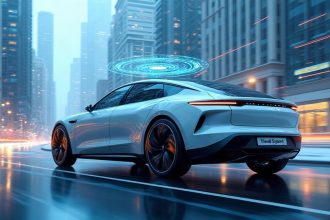

A video loads in an instant, your house responds to a gesture from your phone and a car warns of a danger before you even see it. Behind many of these little everyday pieces of magic there’s a technology that almost never makes the headlines: the mobile network. And right now we’re living through its biggest revolution in a decade.
You may have already seen the «5G» label in the corner of your phone’s screen. It isn’t a simple change of numbering. It’s such a big leap that it’s rearranging how people, businesses and machines connect. And while 5G is still being rolled out, laboratories are already talking about 6G. Let’s see what all this means in simple terms.
What really changes with 5G
To understand it, it helps to think of a motorway. Old networks were like a single-lane road: they worked well with few cars, but became saturated when everyone wanted to drive at the same time. 5G adds many more lanes and, what’s more, makes the cars go faster.
The result is noticeable in three specific things. The first is speed: downloading a movie or uploading a video goes from minutes to seconds. The second is latency, which is the time a message takes to go from one point to another. It’s so small that it allows, for example, operating a robot at a distance without noticing delay. And the third is capacity: many more people and devices connected at once without the network clogging up.
Beyond the phone: machines talk too
5G isn’t designed only for you to watch videos better. Its big bet is to connect the «internet of things»: sensors, factories, streetlights, energy meters, vehicles. A city that regulates traffic according to the cars on the road, a hospital that transmits a patient’s data in real time or a farm that irrigates according to soil moisture are examples already being tested.
This part is less visible, but it’s the one that can most change everyday life. When machines communicate with each other instantly and reliably, possibilities appear that were previously unthinkable.
The future: a glimpse of 6G
If 5G is a modern motorway, 6G promises something even more ambitious. Researchers picture it as a network that not only transmits data, but fuses the physical and digital worlds: real-time holograms, augmented reality integrated into light glasses or systems capable of making decisions autonomously.
It’s also expected to be much more energy efficient and to run at speeds that seem like science fiction today. Although it won’t arrive on a broad scale for several years, much of the research is already underway.
A change worth understanding
Technology advances so fast that sometimes it’s easy to get left behind. But you don’t need to be an engineer to make the most of it: knowing what 5G means, what’s coming with 6G and how these networks are connecting not only people but also things helps us better understand the world around us.
Next time you see those two letters on your screen, you’ll know it isn’t just a speed improvement: it’s the invisible fabric on which much of the technology of the coming years is built.