
For twenty years, every generation of Wi-Fi has been sold with the same number: megabits per second. 802.11n promised 600 Mbps, 802.11ac reached 3.5 Gbps, Wi-Fi 6 landed around 9.6 and Wi-Fi 7 sat in the region of 46 Gbps in theory. The next one, IEEE 802.11bn, does not raise that number. Not by a single megabit. And it is not a marketing mistake: it is the most important change of objective the standard has made in a long time.
The project is officially called UHR, short for Ultra High Reliability. Where earlier amendments competed over peak speed under laboratory conditions, 802.11bn has set targets measured against Wi-Fi 7 in the worst realistic scenario: 25% more throughput at the same signal-to-interference-plus-noise ratio (SINR), 25% lower latency at the 95th percentile and 25% less MAC frame (MPDU) loss, especially during handovers between access points. In other words: it does not promise to go faster when everything is fine, but to stop failing when everything is not.
The bottleneck was not the radio, it was the turn
The physical layer barely changes. Wi-Fi 8 still uses the 2.4, 5 and 6 GHz bands, channels up to 320 MHz wide, 4096-QAM modulation and up to eight spatial streams per link. The theoretical ceiling stays where it was. The reason is that the problem stopped being how many bits fit into a hertz and became who has the right to transmit in each microsecond.
Wi-Fi has worked with CSMA/CA since 1997: before transmitting, the access point listens to the channel and, if it hears it busy, waits a random amount of time. That sharing works beautifully with a handful of neighbours and turns into a traffic jam when dozens of overlapping networks sit on the same channel, as in an apartment block, a factory or a stadium. Every beacon, every retry and every management frame eats airtime that carries no useful data. The fix that arrived with Wi-Fi 6, preamble-detection spatial reuse (OBSS-PD), consisted of raising the listening threshold and transmitting even while hearing the neighbour: a blind bet on a static threshold that, in practice, many enterprise deployments left switched off because hope is not a link budget.
MAPC: access points start talking to each other
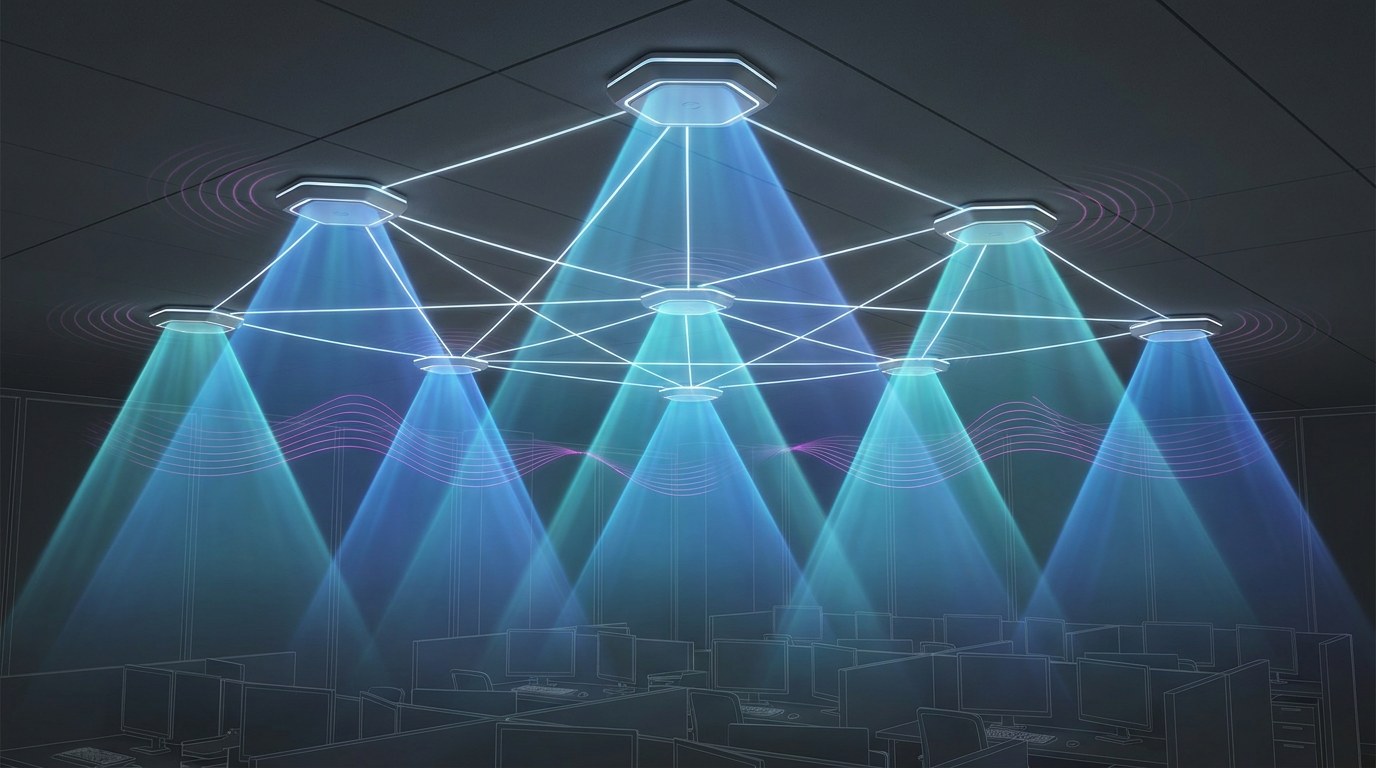
The heart of 802.11bn is MAPC, Multi-Access Point Coordination. The idea is not to replace CSMA/CA with centralised LTE-style scheduling, but to add a negotiation layer between neighbouring access points, even ones belonging to different networks (different BSSs) that share a channel. Before coordinating anything, APs discover each other, negotiate agreements that can be updated or torn down and, optionally, authenticate the inter-AP link with PASN (Pre-Association Security Negotiation), the pre-association security mechanism defined in 802.11az. That detail matters: a protocol that lets one AP ask another to lower its transmit power is a tempting target for a rogue access point.
With the agreement in place, the mechanism is opportunistic. The AP that wins EDCA contention becomes the coordinating AP (sharing AP) and can donate part of the airtime it has just won — the TXOP, a transmission window reserved in one go — to the coordinated APs. There is no referee handing out permits: there is a neighbour that won the turn and decides to share it under conditions. Five coordination modes made it into the draft.
Coordinated spatial reuse (Co-SR) is the simplest and probably the first to ship. It replaces the blind threshold with an explicit invitation: the coordinating AP sends the power limits and modulation and coding scheme (MCS) with which the neighbour may transmit simultaneously without ruining reception. Downlink only, with no channel-state information exchanged, so it is cheap to implement. Coordinated beamforming (Co-BF) goes a step further and uses antenna arrays to steer spatial nulls towards the other AP’s stations; it requires channel state information (CSI) and, in the draft, is limited to two APs transmitting at once. Coordinated TDMA (Co-TDMA) splits time into slices, coordinated R-TWT (Co-RTWT) reserves windows for latency-sensitive traffic — the same Restricted Target Wake Time introduced in Wi-Fi 7, but agreed across several APs — and channel recommendation (Co-CR) lets an AP suggest to its neighbours which channel to move to.
The working group’s own numbers, published in the tutorial on draft 1.4, are eloquent in one direction and honest in the other. In a favourable two-apartment scenario, Co-SR cuts channel access delay by roughly 95% compared with classic distributed access. In a high-interference scenario, delay stays low but throughput degrades because of packet loss: coordination is not magic, it is trade-off management.
Moving between APs without anyone noticing
The other big piece is SMD, Seamless Mobility Domain. Today, when a phone moves from one AP to another, it pays an interruption measured in hundreds of milliseconds: the handshake must be redone, keys renegotiated, sequence numbers reset and capabilities revalidated. SMD defines a logical entity that groups several AP MLDs — the multi-link access points introduced by Wi-Fi 7 — even when they are not in the same chassis, and lets that context be transferred between them before the client has finished crossing. It also allows a link-by-link transition, so the client changes AP in stages while keeping traffic on the remaining links. The intended result is roaming that is practically invisible, a prerequisite for virtual reality, mobile robots or Wi-Fi telephony inside an industrial plant.
The fine-grained tools: DRU, NPCA, ELR and UEQM
Underneath MAPC sits a handful of physical-layer and MAC improvements that also aim at robustness. Distributed resource units (DRU) let the tones of an OFDMA transmission be spread non-contiguously inside the channel, concentrating energy on fewer subcarriers and improving power spectral density: useful for range and for links with poor SINR. NPCA (Non-Primary Channel Access) allows secondary channels to be used even when the primary one is busy, something that today blocks entire transmissions. ELR (Enhanced Long Range) adds low-rate, high-sensitivity modes for distant or low-power devices. And UEQM (Unequal MCS) allows a different modulation per spatial stream according to the quality each one sees, instead of punishing every stream down to the level of the worst.
Where it actually stands, and what it means for users
The calendar is worth grounding. The TGbn working group started in November 2023, closed draft 1.0 in July 2025 and at the July 2026 plenary moved draft 2.0 into recirculation ballot with roughly three quarters of the comments resolved. Final publication is targeted for May 2028, although the group itself has also floated September 2028. Wi-Fi Alliance certification will probably arrive earlier, following the pattern of previous generations, with pre-standard gear on the shelves well before the text is approved. WPA3 is mandatory in the standard.
For anyone thinking of replacing their home router, the conclusion is awkward: Wi-Fi 8 will not make a 600 Mbps fibre connection any faster. Its value shows up in dense networks and in applications with strict latency requirements, and it needs both the access point and the client to implement MAPC; a Wi-Fi 7 phone on a Wi-Fi 8 network still behaves like a Wi-Fi 7 phone. On top of that, the air is shared: as long as old devices keep occupying the channel with slow frames, no coordination between APs can win that time back. The UHR promise is more modest than the brochures suggest, and also far harder to deliver than adding a bigger number to the box.