
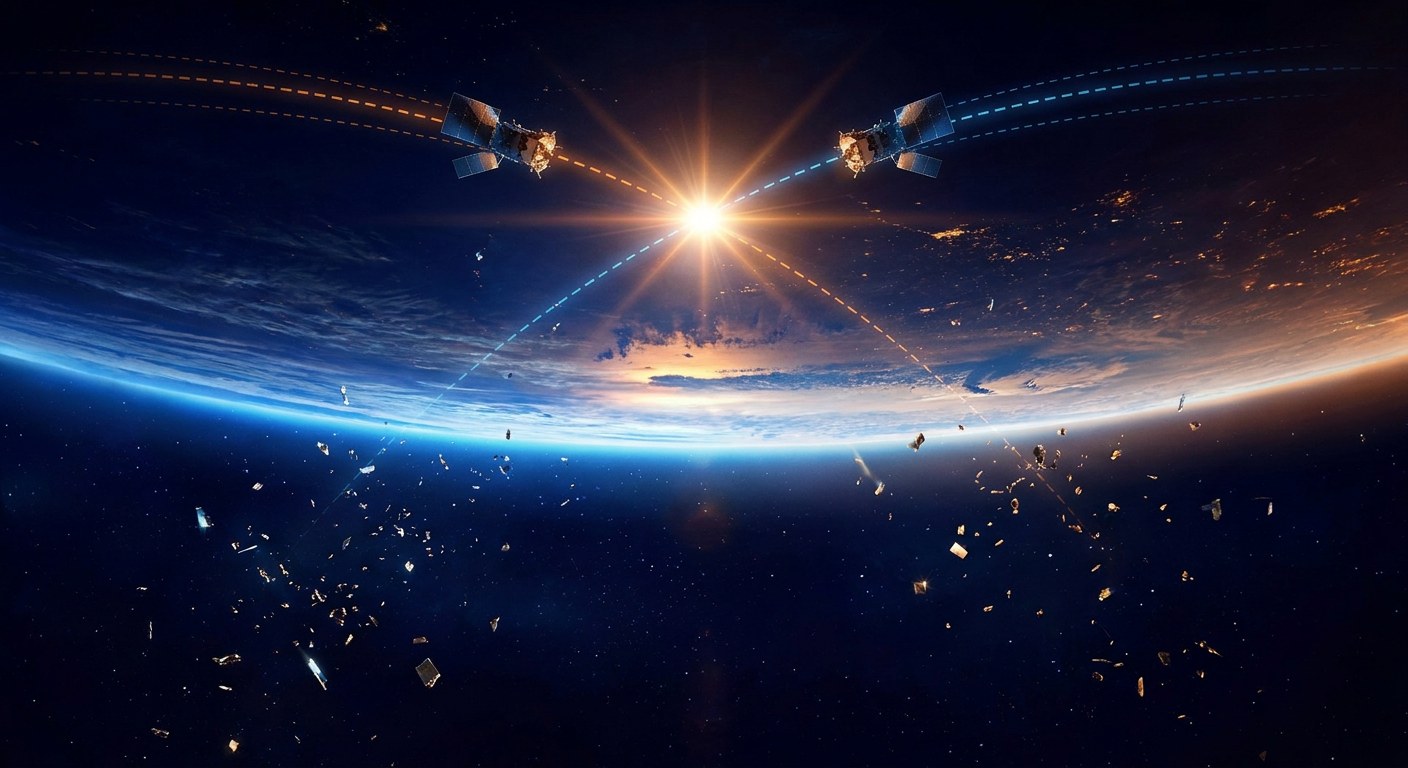
Somewhere in an operations centre a screen has just raised a flag: in 26 hours, one of your satellites and a rocket fragment will pass within 300 metres of each other. Nobody has lost control of anything; low Earth orbit has simply become a busy road with no hard shoulder, where traffic moves at 7.5 km/s and cannot brake. What follows is how the decision to swerve gets made, with numbers rather than nerves.
A catalogue of 68,000 objects that goes blind below 10 cm
The European Space Agency puts the number of objects larger than 10 cm in orbit at about 68,000, of which roughly 11,300 are active satellites. Below that size the catalogue sees nothing: radar networks — the US Space Fence in S band, among others — reliably track 10 cm objects in low orbit and objects around a metre across in geostationary orbit, far further out. Models estimate on the order of a million fragments between 1 and 10 cm, and some 130 million between 1 mm and 1 cm. Those cannot be dodged: against them the only defence is armour, such as the Whipple shields that spread an impact across successive layers until the last sheet holds.
From measurement to probability
From those observations, every object gets a fitted orbit — position and velocity, each with its uncertainty — which is then propagated into the future. When two orbits come close, the system issues a Conjunction Data Message, a CCSDS standard format containing the time of closest approach, the predicted miss distance and the covariances. Collision probability is not computed from distance alone: it is obtained by integrating a two-dimensional Gaussian in the plane perpendicular to the relative velocity. The covariances of both objects are combined — the error on each orbit is usually far larger than the predicted miss distance — and the calculation asks what fraction of that probability cloud falls inside the circle of the combined radius. That is why a 5 km pass can be reassuring while a 500 m pass is not: everything depends on how well the orbit is known. The physics of the encounter allows no nuance either: two objects on crossing orbits close at more than 10 km/s, and at 15 km/s if they travel in opposite directions. One kilogram at 10 km/s carries 50 megajoules, the equivalent of twelve kilograms of TNT; a one-gram fragment carries about 50 kilojoules, twenty-five times the energy of a rifle bullet.
Two thresholds: 1 in 10,000, or 3 in 10 million
The classic threshold for critical objects, such as the International Space Station, is 10-4: a one in ten thousand probability. Below that, the pass is accepted and watched. Starlink has pushed the bar far lower, to roughly 3×10⁻⁷, and executes the manoeuvres autonomously, with no operator in the loop. The consequence shows up in the figures: SpaceX reported 207,152 avoidance manoeuvres between December 2025 and May 2026, against about 149,000 in the previous six months. That is almost one manoeuvre per satellite per week. Most of them end in no collision at all and cost fuel and service, but the calculation is deliberately asymmetric: swerving costs a few grams of propellant, while failing to swerve can cost an entire satellite and multiply the fragments.
What swerving actually means
A typical manoeuvre is not a turn: it is a tiny burn that changes velocity by a few centimetres per second, just enough to shift the time of closest approach so the two objects cross with kilometres between them. It is planned twelve to twenty-four hours ahead so it does not interfere with the rest of the constellation. On satellites with electric propulsion, as Starlink uses, the thrust is minute, so the burn has to start earlier and last longer. Every avoidance also disrupts the service plan: coverage shifts, power consumption changes and, if it happens often, the useful life gets shorter. The problem stops being purely technical and becomes a question of who pays: whoever can swerve, pays; whoever has no propulsion can only hope.
When there is nobody to call
A large share of the catalogue is fragments with no owner, no telemetry and no way to manoeuvre. Against those there is no negotiation: only the unilateral manoeuvre of the operator who still can. And some events break the balance at a stroke. The Chinese anti-satellite test of 2007 left about 3,500 trackable fragments still in orbit; the Russian one in 2021, against Cosmos 1408, added around 1,500 and forced the crew of the International Space Station to shelter in their spacecraft. They are the practical demonstration of the cascade Donald Kessler described in 1978: above a certain density, every collision creates fragments that cause further collisions. The most delicate band is 800 to 1,000 km, where the residual atmosphere barely slows anything and debris stays for centuries.
Let them fall, and sweep up what does not
The first rule is not to leave new junk behind. The classic international guideline called for deorbiting within 25 years; in 2022 the US FCC tightened that to 5 years for satellites under its licences. A satellite at 550 km, like Starlink, falls on its own within a few years if its propulsion fails; one at 1,200 km would take centuries. The second rule is to remove what is already up there. In 2024 the Japanese company Astroscale showed with its ADRAS-J mission that a non-cooperative upper stage can be chased and photographed up close: eleven metres long, four metres in diameter and three tonnes, launched in 2009 and never designed to be grabbed. Its successor, ADRAS-J2, will attempt to capture it, which means matching orbits, measuring how the target is tumbling and latching onto a point that is not a handle.
Meanwhile the plumbing behind the data is changing. For decades the public catalogue arrived as TLEs, orbital elements of modest accuracy propagated with a simplified model. The United States is replacing it with TraCSS, a cloud system run by its Office of Space Commerce that blends declassified military data with commercial sources and works with higher-fidelity ephemerides; its conjunction message specification was updated in January 2026. The difference is not cosmetic: lower uncertainty means fewer false alarms, and with them fewer pointless manoeuvres and less fuel burned to perform them.
An infrastructure problem, not a heroic one
Low Earth orbit has no hard shoulder, no tow truck and no comprehensive insurance. What it increasingly has is something resembling air traffic management: catalogues, standardised messages, probability thresholds and manoeuvres of a few centimetres per second decided hours in advance. It works, but it is a patch: today’s collision is avoided and the object is left up there for tomorrow. The question the industry has not settled is who pays to remove what belongs to nobody, because as long as the answer remains “nobody”, the only strategy left is to keep swerving, a little more every year.