
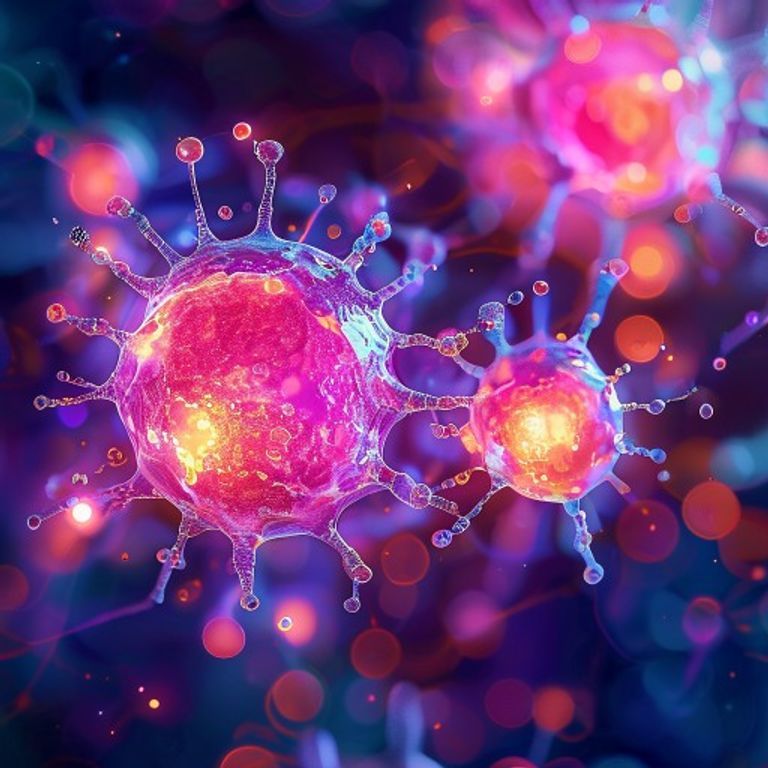
For the first time in history, a team of biologists has managed to build a cell from scratch — that is, by putting non-living components together, piece by piece—and succeeded in making it grow, duplicate its DNA, and divide like a normal cell. The experiment, led by researcher Kate Adamala at the University of Minnesota, is a huge step toward one of science’s great dreams: creating life from inert matter.
The synthetic cell, dubbed «spudcell» (because of its resemblance to a potato, as Adamala herself jokes), is not alive by the traditional definition: it needs to be constantly supplied with food and ribosomes, and it has no defenses or waste-removal system. But it proves that we can arrange biological molecules to do things that until now only living organisms did: copy their genetic material and divide into daughter cells. «It’s a giant step toward that holy grail of making something alive from dead components,» explains Sijbren Otto, a chemist at the University of Groningen. The paper has not yet passed peer review, but the scientific community already considers it a milestone.
And what is this useful for? Well, in the long run, these artificial cells could be designed to manufacture medicines, biofuels, or new materials. They also help answer fundamental questions: what is the minimum a system needs to be considered alive? How could life on Earth have emerged 4 billion years ago? For now, the achievement shows that the boundary between the chemical and the biological is thinner than we thought. And it all began with a scientist who, upon seeing her invention work, could only manage to say: «Wow, did I really create a cell that divides?».
— Marta, for intermittent intelligence.