
When we look at the sky at night, every star we see is, in reality, an enormous power plant. For millions of years, the Sun and all the other stars have produced their light thanks to a process called nuclear fusion: very light atoms join together at extreme temperatures and pressures, releasing a colossal amount of energy. Reproducing that same process here, on Earth, is one of the oldest and most ambitious dreams of science. And, for the first time in history, that dream is closer than ever.
What nuclear fusion is (and how it differs from fission)
It is worth not confusing it with another technology we have been using for decades: nuclear fission. In current power plants, fission splits heavy atoms, such as uranium, to obtain energy. It is effective, but it generates radioactive waste that must be stored safely for many, many years.
Fusion works the other way round. Instead of splitting atoms, it joins them. Two very light types of hydrogen are taken and fused to create helium, a harmless gas. In that process a huge amount of energy is released, with almost no radioactive waste and without emitting greenhouse gases. That is why it is often called “the energy of the stars”: the same mechanism that keeps the Sun burning.
The problem: you need a miniature Sun
It sounds simple on paper, but there is an uncomfortable detail: for hydrogen atoms to fuse, they have to be brought to temperatures of tens of millions of degrees, hotter than the centre of the Sun. At those temperatures, matter becomes a state called plasma, and no known material can contain it directly without melting instantly.
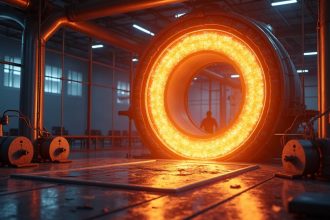
The solution scientists have found is brilliant: instead of building a wall that withstands that heat, very powerful magnetic fields are used to “hold” the plasma in the air, floating inside a chamber shaped like a giant doughnut. That chamber, called a tokamak, is today the most promising design of all fusion projects on the planet.
Recent advances that have changed expectations
For decades, fusion seemed an eternal promise, always “twenty years away”. But recently something has genuinely changed. Large experimental facilities have achieved milestones that previously seemed impossible:
- It has been possible to produce more energy than is needed to start the reaction, although only for fractions of a second.
- The plasma has been kept stable for record times, getting closer and closer to minutes.
- Dozens of private companies, backed by multi-million investment, are working on smaller and cheaper designs, competing in a race previously reserved for governments.
None of these experiments yet produces net energy continuously, but they do prove that the physical principles work. What remains is an engineering problem: how to keep that reaction stable long enough to generate electricity reliably.
Why it is so worth it
If fusion ever works on a large scale, the advantages would be immense. The fuel, hydrogen, can be obtained from seawater, so it is available practically anywhere on the planet. It does not depend on the sun or the wind, so it could produce electricity constantly, day and night. And its waste is minimal and short-lived, unlike that of current nuclear plants.
In short, it would be an almost inexhaustible, clean and safe source of energy, capable of changing the energy future of the entire world.
A future drawn with patience
It is worth being realistic: commercial fusion will not be ready tomorrow. Experts say the first plants connected to the grid could arrive towards the middle of the century, and considerable technical challenges remain. But the direction is unmistakable. What for generations was science-fiction material has become a serious field of research, with giant international projects and a new generation of companies determined to speed up the pace.
The next time you look at a star, think that inside it the exact same phenomenon is happening that science has been trying to tame for decades. We may not see it on a large scale, but the race to bring the energy of the stars to our power outlets has already begun.