

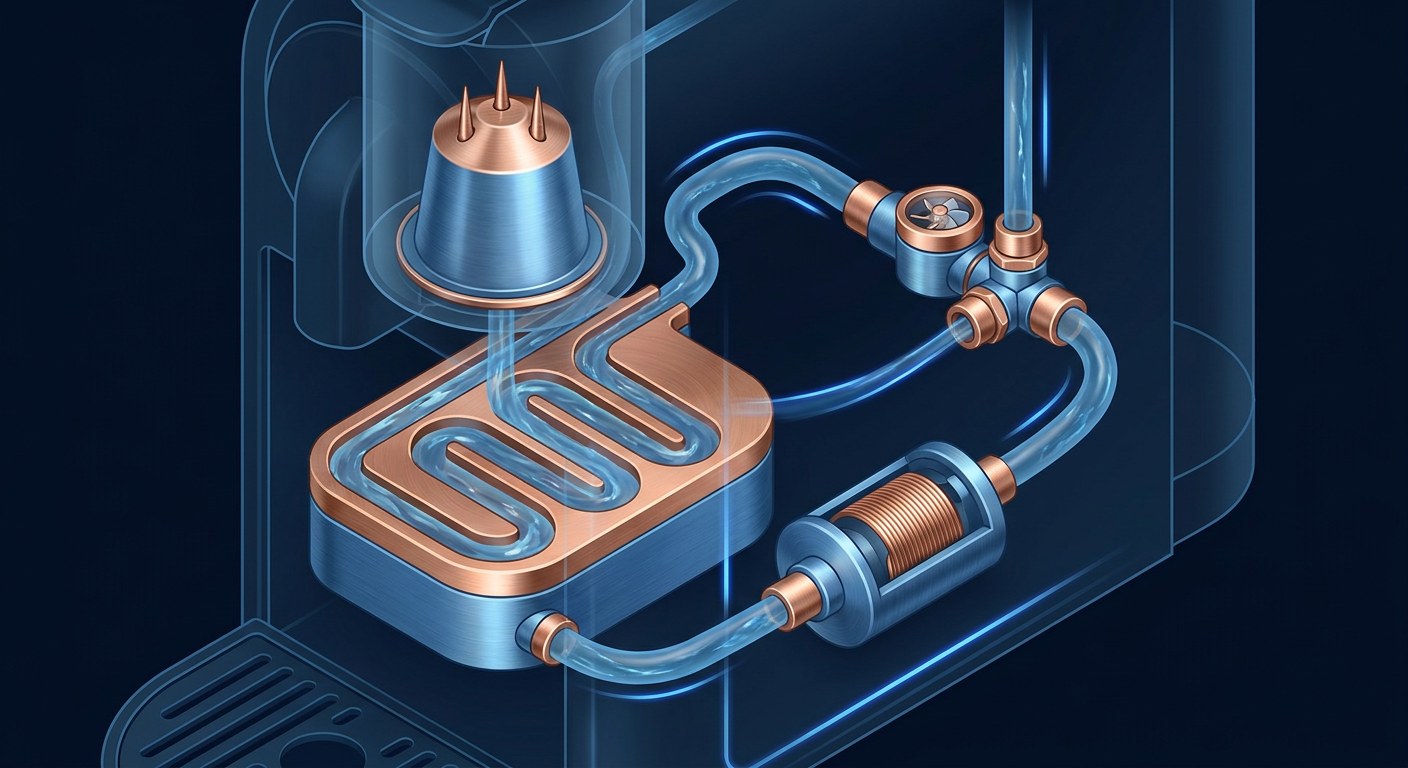
You press a button and twenty-five seconds later you have forty millilitres of coffee at 92 °C with a layer of foam on top. In between, the machine has pierced an aluminium capsule, heated water on the fly, pressurised it and counted the exact volume that came out: no boiler, no pressurised tank, and the water has not boiled at any point.
What sits inside is a small hydraulic circuit with four parts that talk to each other: the piercing needle, the thermoblock, the pump and the flow meter. And a fifth element almost nobody looks at: the barcode printed on the capsule rim, which decides the recipe before the first drop falls.
The needle pierces, but the capsule is the boiler
The capsule drops into a chamber that closes with the lever. On top, three pyramid-tipped needles pierce the aluminium lid and double as the inlet channel: the water does not arrive as a jet, it travels down the inside of the needles themselves. Below there is another plate with cross or star-shaped ridges that does not pierce at first: the aluminium tears once the internal pressure rises, and that ragged tear acts as both filter and restrictor.
That is the mechanical trick: the pressure vessel is not the machine, it is the capsule. Aluminium about 40 microns thick withstands 12 to 19 bar because it is confined inside a rigid chamber that stops it deforming; without that outer wall the capsule would split along its seam. That is why the chamber design matters as much as the coffee inside.
The thermoblock: twenty millilitres of water and 1,400 watts
A classic domestic espresso machine uses a 1.5-litre brass boiler and needs twenty minutes to stabilise: a lot of thermal mass, a lot of inertia. The capsule machine does the opposite. Its heater is an aluminium block with a thin-walled serpentine channel and a wrapped resistive element drawing 1,200 to 1,500 W. It holds barely 20 ml.
The result is minimal thermal inertia: the block is hot within seconds and the water is heated while moving, crossing the channel as the element holds the temperature. An NTC thermistor (a resistor whose value changes with temperature) measures the block and a PID loop —proportional, integral, derivative: correcting the present error, the accumulated one and the trend— switches the element on and off over a cycle of several seconds, rather than with a plain on/off thermostat.
The arithmetic explains the hurry. Raising 40 ml of water from 20 to 92 °C takes about 12 kJ, that is 3.35 Wh: at 1,400 W that is 8.6 seconds of element on. The rest of those twenty-five seconds goes on self-test, warming the block and pre-infusion.
The price of heating on the fly is scale. The calcium carbonate that water leaves in the channel acts as an insulator: the thermistor reads a temperature that is no longer the water’s and the machine starts serving lukewarm coffee. Hence it counts shots and asks for descaling per number of capsules, not per months of use.
The pump that shudders fifty times a second
Pressure comes from a vibration pump, not a rotary one. Inside there is a solenoid, a spring, a piston and a rubber diaphragm with two valves, one inlet and one outlet. The solenoid is fed from the 230 V mains through a diode, so it only conducts half of each cycle: the coil kicks fifty times a second and the spring pushes the piston back.
Each kick moves roughly a millilitre. At fifty strokes per second the flow rate lands around 48 ml per minute. That is why the pump buzzes at 50 Hz and why the water leaves in pulses rather than a steady stream: the thermoblock and the chamber damp that ripple. Pressure is not software-controlled; it is set by spring preload and by the circuit restrictor, which is why the same pump can deliver anywhere from 9 to 19 bar depending on the model.
It is worth knowing what the “19 bar” on the box means: it is the pump’s maximum pressure, measured at zero flow. Inside the capsule, with coffee resisting, the real extraction pressure stays between 9 and 13 bar. The useful hydraulic power is tiny: 19 bar pushing 48 ml per minute is 1.5 W, against the 50 W the solenoid draws. The rest goes into vibration, heat and noise.
A flow meter and a barcode
To know when to stop, the machine does not measure time: it measures volume. The circuit carries a Hall-effect flow meter, a small impeller with a magnet that spins as water passes, plus a sensor that detects each pass of the magnet. Every pulse equals a fraction of a millilitre, typically 0.05 to 0.1 ml. The firmware counts pulses and closes the solenoid valve when it reaches the target.
And the target is dictated by the capsule. Along the aluminium rim runs a barcode made of five concentric bands. It is not a QR code: these are short, thick stripes read by reflection with an optical sensor, encoding variety, water volume, temperature and whether pre-infusion is used. Some machines spin the capsule to read it; others read it on insertion. If the sensor fails or is dirty, the machine falls back to a default recipe: same coffee, different volume.
Pre-infusion and the three-way valve
Before pushing at full pressure, the machine wets the coffee for one or two seconds at low pressure. That is pre-infusion: the bed of coffee saturates evenly and the water is stopped from opening a preferred channel that would take the whole flow in three seconds and leave the rest of the coffee dry. Pressure then ramps up progressively.
At the end the three-way solenoid valve comes in, connecting the thermoblock outlet either to the capsule or to the drain. Closing it depressurises the circuit at once: the capsule stops dripping and can be removed without burning yourself. Without that valve, the machine would keep dribbling coffee for half a minute.
What fails first
In this order: scale in the thermoblock, an optical sensor clogged with grounds, a hardened pump diaphragm and a needle stuck with a dried puck. None of that is complicated electronics; it is the normal wear of a hydraulic system working at 90 °C and 12 bar several times a day. The capsule, meanwhile, remains the cleverest part: a single-use container that is also a pressure chamber, a filter and a memory of the recipe.