A 50 km/h crash into a rigid barrier is, in energy terms, the same as falling from a third-floor window. The car stops in a little over a tenth of a second; you do not. Your body keeps travelling at 13.9 metres per second, and in that gap it would cover half a metre towards the dashboard. The only way to stop that from happening is something soft, huge and extremely fast: an airbag that is fully inflated before your brain has even registered the noise of the impact.
What a blink takes, and what a crash takes
A blink lasts between 100 and 300 milliseconds. A driver airbag takes about 25 to 30 milliseconds to fill, and the passenger airbag, twice the size, between 30 and 40. In other words: the system does not react to the hit, it anticipates it. It has to decide, fire, generate gas and deploy a 60 to 140 litre bag in a quarter of the time it takes you to close your eyes. The whole chain —sensor, algorithm, detonator, gas generator, fabric— is dimensioned around that millisecond budget, and any part that runs five milliseconds late leaves the occupant outside the useful window.
The sensor: a silicon comb that reads a change in capacitance
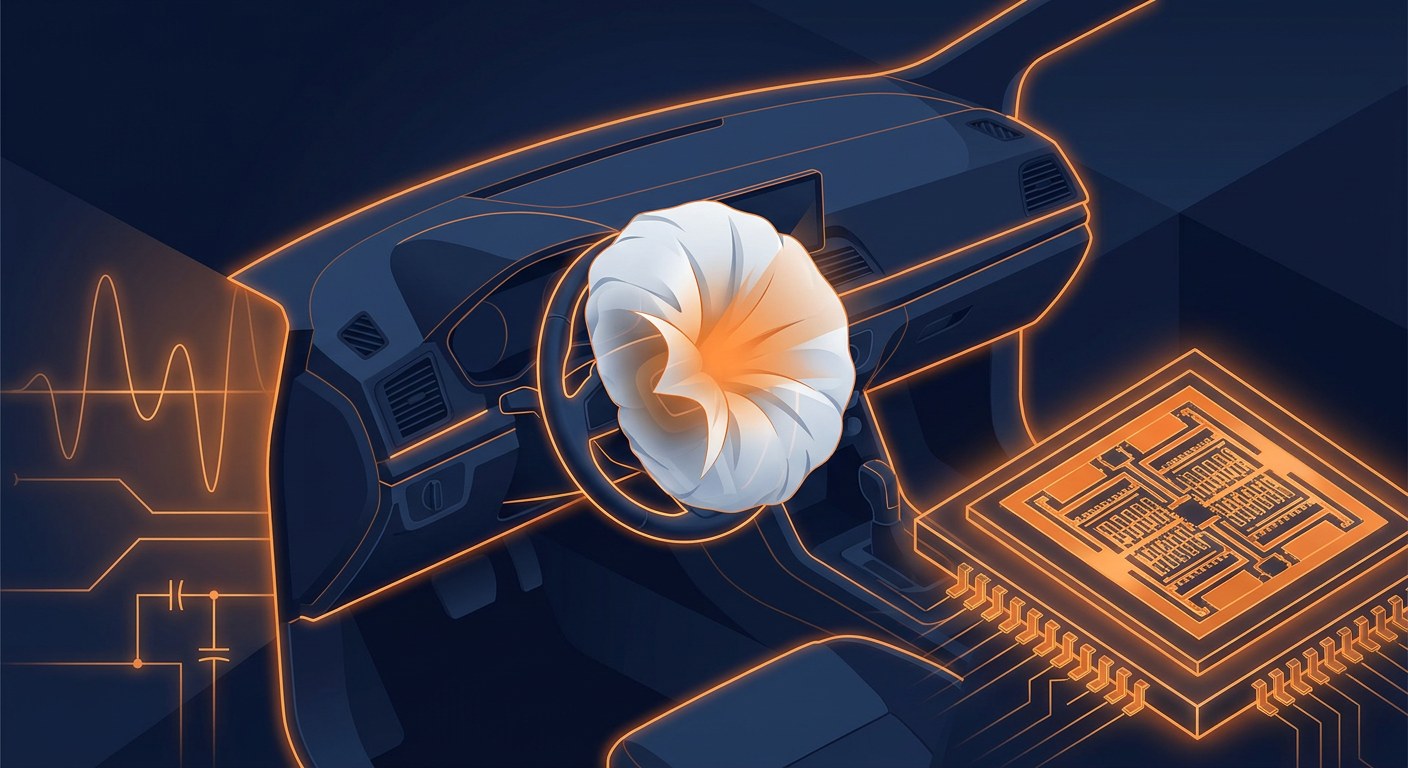
At the heart of the system is a MEMS accelerometer, a silicon part a few millimetres across, made with the same lithography techniques as a chip. Inside, a seismic mass hangs from microscopic springs and is surrounded by interlocking fingers, like the teeth of two combs pushed into each other without touching. Each finger and its partner form a capacitor of a few picofarads. When the car decelerates, the mass shifts by a fraction of a micron and that capacitance changes; a conditioning circuit turns the variation into an analogue voltage proportional to acceleration. Typical resolution is a few milli-g —thousandths of a gravity— and the sensor is sampled between 1,000 and 4,000 times per second on the crash channels.
The airbag control unit —the ECU, mounted on the central tunnel near the car’s centre of gravity— takes signals from several accelerometers: two at the front on the suspension towers, lateral ones in the B-pillars and doors, and on some cars a pressure sensor inside the door that detects the abrupt movement of the sheet metal before the deformation reaches the pillar. All of it is low-pass filtered to strip out road noise and combined to estimate the direction and severity of the impact.
The decision is not «there is a hit», it is «how much speed has been lost»
This is the interesting part. The ECU does not fire because acceleration crosses a threshold, because a kerb or a pothole would produce several g of spike with no consequences. What it integrates is the change in velocity, the so-called Δv: the area under the deceleration curve within a moving window of 10 to 30 milliseconds. A real crash into a wall at 50 km/h produces a Δv of about 14 m/s in under 100 ms, with a characteristic, sustained pulse shape. A speed bump produces a high but very brief, almost vertical acceleration, which barely removes any speed once integrated. The algorithm compares that curve against families of crash pulses calibrated in tests and decides on magnitude and shape.
Because a single channel could fail, almost every system adds a safety logic in series: the safing sensor, which can be a mechanical ball-and-tube switch or an independent second electronic channel. The detonator only receives current if the main algorithm and the safety sensor agree. It is a physical AND gate: two different conditions, two different circuits, one single firing.
The firing: two amps, one spark and eighty litres of gas
Once the decision is made, the ECU closes a solid-state switch and pushes a current of roughly 2 amps for 2 milliseconds through the detonator —the squib, a thin-film resistor inside the airbag connector— which heats a pyrotechnic initiator that ignites the gas-generating charge. The circuit is checked continuously by measuring loop resistance, which must sit between 1.8 and 2.5 ohms, and that measurement is made with less than 30 milliamps precisely so that it can never fire by accident.
The chemistry has changed a great deal. Early airbags used sodium azide, a salt that releases nitrogen almost instantly as it decomposes, but it was toxic and left hazardous residue. Today’s generators are hybrids: a small reservoir at 200-300 bar holding argon or helium, plus a pyrotechnic charge that, as it burns, heats the gas and opens a valve. The compressed gas escapes, expands and mixes with the combustion products. There is no explosion in the detonation sense: there is a pressure release controlled by a calibrated orifice, and the result is tens of litres of gas at around 200 degrees that inflate the bag in a fraction of a second. The white smoke people remember after a crash is largely talc or cornstarch powder used to lubricate the fabric, plus water vapour.
The bag: nylon with vent holes
The fabric is silicone-coated nylon 6.6, stitched and folded in a pattern that unfolds predictably: first towards the lap, then towards the chest and face, so it does not strike someone already pressed against the wheel. There are calibrated vent holes on the edge or at the back. That detail is essential: the airbag is not meant to be a firm cushion but to deflate while it brakes you. If it did not vent, you would bounce off it like off a wall. The combination of bag and seat-belt pretensioners spreads the deceleration over 60-80 ms, within what the human chest can tolerate.
Why it does not fire over a pothole (or when you change the battery)
Two protections prevent it. The first is the filtering and integration described above. The second is redundancy: every connector in the system carries a shorting clip that bridges the squib when unplugged, so no stray current can set it off, and the ECU keeps a backup capacitor that holds energy for about 150 ms in case the crash cuts the battery cable before the order arrives. That capacitor is also why the system stays armed for a few seconds after you turn the key.
The seat belt comes first: the airbag is only the supplement
The official acronym says it: SRS, Supplemental Restraint System. The airbag does not replace the belt, it complements it. Without a belt, the occupant meets the airbag in mid-deployment, with fabric leaving its housing at up to 200-300 km/h, and the outcome can be worse than having no airbag at all. That is why modern cars fire the pyrotechnic belt pretensioners first, a few milliseconds earlier, taking the slack out of the strap, and then the airbag; and why seats carry weight and position sensors —a capacitive film or a pressure bladder— that disable the passenger airbag when they detect a child seat or an occupant sitting too close.
The Takata case: when the generator ages badly
Recent airbag history has a dark chapter that illustrates materials engineering nicely. For years ammonium nitrate was used as a propellant, cheaper and cleaner than azide. The problem showed up with moisture and thermal cycling: the compound degraded, changed density and, in some cases, burned too fast inside the metal housing, which burst and threw fragments. The result was the largest vehicle recall in history, with more than a hundred million inflators affected worldwide and dozens of deaths. The lesson is the usual one in this industry: an airbag is a pyrotechnic device that lives twenty years in a dashboard, and its reliability is measured as much in the millisecond of the crash as in the decade of heat and humidity that comes before it.