
Some screens seem to never switch off, and yet they barely touch the battery. An e-reader lasts weeks on a charge that would drain a phone in hours, and it is not because its processor is a marvel: it is because the panel stops drawing power the instant the image comes to rest. That property is called bistability, and no liquid-crystal or OLED screen has it. Behind it there is chemistry, transparent electrodes and a thin layer of transistors deciding, pixel by pixel, where each pigment particle ends up.
Microcapsules: two pigments and a transparent fluid
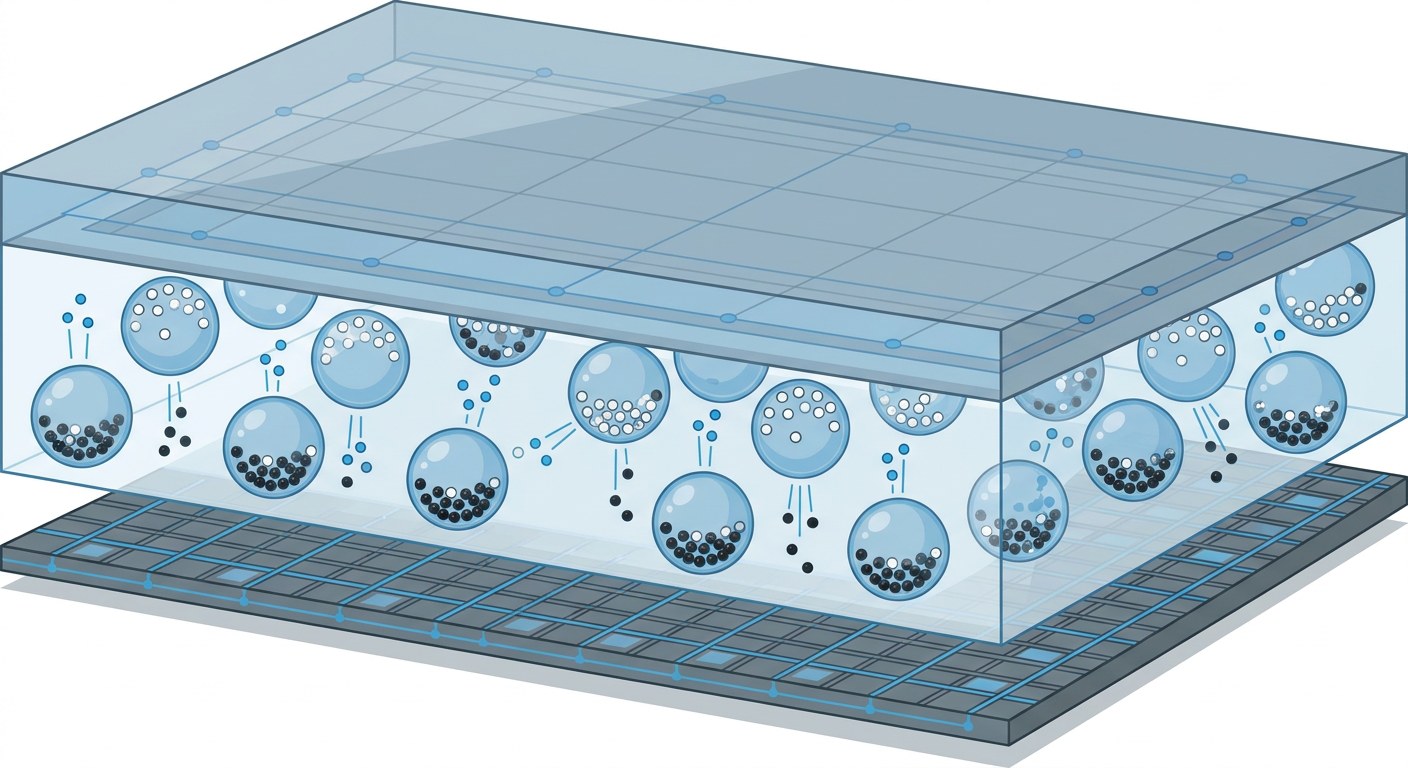
The technology under electronic ink is electrophoresis: moving charged particles with an electric field inside a liquid. In practice, the screen is built from millions of microcapsules about 40 micrometres across (less than half the thickness of a human hair) spread across the surface. Inside each capsule there is a low-viscosity transparent fluid and two kinds of pigment: titanium dioxide particles, which are white, and carbon particles, which are black. Both carry polymer coatings, known as charge control agents, that give them a positive or negative charge and keep them from clumping together.
When an electric field is applied, the pigments migrate towards the opposite electrode: if the white one rises to the surface, the pixel looks light; if the black one rises, it looks dark. Intermediate greys are not obtained by varying brightness as on an LCD, but by time — the longer the field is held, the more of one pigment lines up, leaving a fraction of white and black pigments visible at once.
The field comes from a layer of transistors
Moving pigment takes relatively high voltages — on the order of 15 volts, against the 3 or 4 of a chip — so the electrical side of the panel looks more like an LCD than like a processor. Over the substrate sits an array of thin-film transistors (TFTs), one per pixel, made of amorphous silicon or of oxide semiconductors such as IGZO, which conducts better and allows for smaller drivers. Each pixel works as a capacitor: the gate line selects it, the data line hands it a voltage, and the capacitor holds that voltage while the pigment moves. Above it goes the transparent electrode, usually ITO (indium tin oxide), and over that, the capsule and the front glass.
That scheme is identical to any active-matrix display. What changes is what happens next: when the field disappears, the pigment does not return to its place. The charge agents and adhesion to the electrode pin it down. There lies bistability. An LCD has to refresh its capacitor dozens of times per second so the crystal does not relax, and it also needs a backlight permanently lit; electronic paper needs neither. At rest, the panel draws practically zero, and what actually drains an e-reader is the processor and the frontlight, the side light guide that illuminates the text in the dark without backlighting it.
Waveform tables: the craft of refreshing without ghosts
If moving pigment were as simple as flipping the voltage, twenty years of engineering would not have gone into the controller. The problem is that particles are not perfect: they carry slightly different charges, they stick to the electrode with more or less force and they respond differently depending on temperature. That is why the display controller does not improvise sequences; it looks up waveform tables (waveform LUTs) kept in memory: lists of pulses of varying polarity and duration for every transition, say from black to mid grey. These sequences are calibrated to leave each pixel in the right state and, above all, to keep the DC balance: net charge injected over time must tend to zero, because an excess of single-polarity voltage would eventually shift the pigment irreversibly and leave permanent stains.
That is where the different refresh modes come from. A full refresh uses 16 grey levels and produces the black-and-white flash we all know: it is slow, but it leaves the image clean. Fast modes work with black and white only, jump between states in a few tenths of a second and in exchange produce ghosting — faded remnants of the previous image left in the background. Partial refresh updates only the region where the text changed and is what makes it possible to type fluidly on a keyboard or browse a menu; the trade-off is that ghosting builds up in that area and a full refresh is advisable every so often. All of this also explains why readers flash more when it is cold: the fluid gets more viscous and the controller stretches the pulses to compensate.
Colour, and why it is still no LCD
Getting colour out of this principle is expensive. One route is to add a colour filter (RGB matrix) on top of the black-and-white panel: the result is real and usable — thousands of shades — but light has to pass through the filter and the colour comes out muted, like watercolour on paper. The other route puts more pigments inside the capsule: besides white and black, cyan, magenta and yellow, stacked in layers of different thickness to produce each tone. Saturation improves, and the price is a much slower refresh, several seconds per image, and shorter life cycles.
Against an OLED, which lights every pixel independently and can reach thousands of hertz, electronic ink starts with clear limitations: no light of its own, slow refreshes and a glass panel that is harder to manufacture in large sizes than printed plastic. But it plays in a different league when it comes to power draw and readability in full sunlight, which is why it has found its niche wherever the image changes rarely and the cable does not reach: readers, electronic price tags that a supermarket updates over the air, transport signs running on batteries for years and, increasingly, city signage. The technological lesson is simple and elegant at once: sometimes you do not need to keep refreshing the image, you just need to be able to leave it still forever.