
A space rescue ship got stuck spinning on itself: the mission to save a NASA telescope
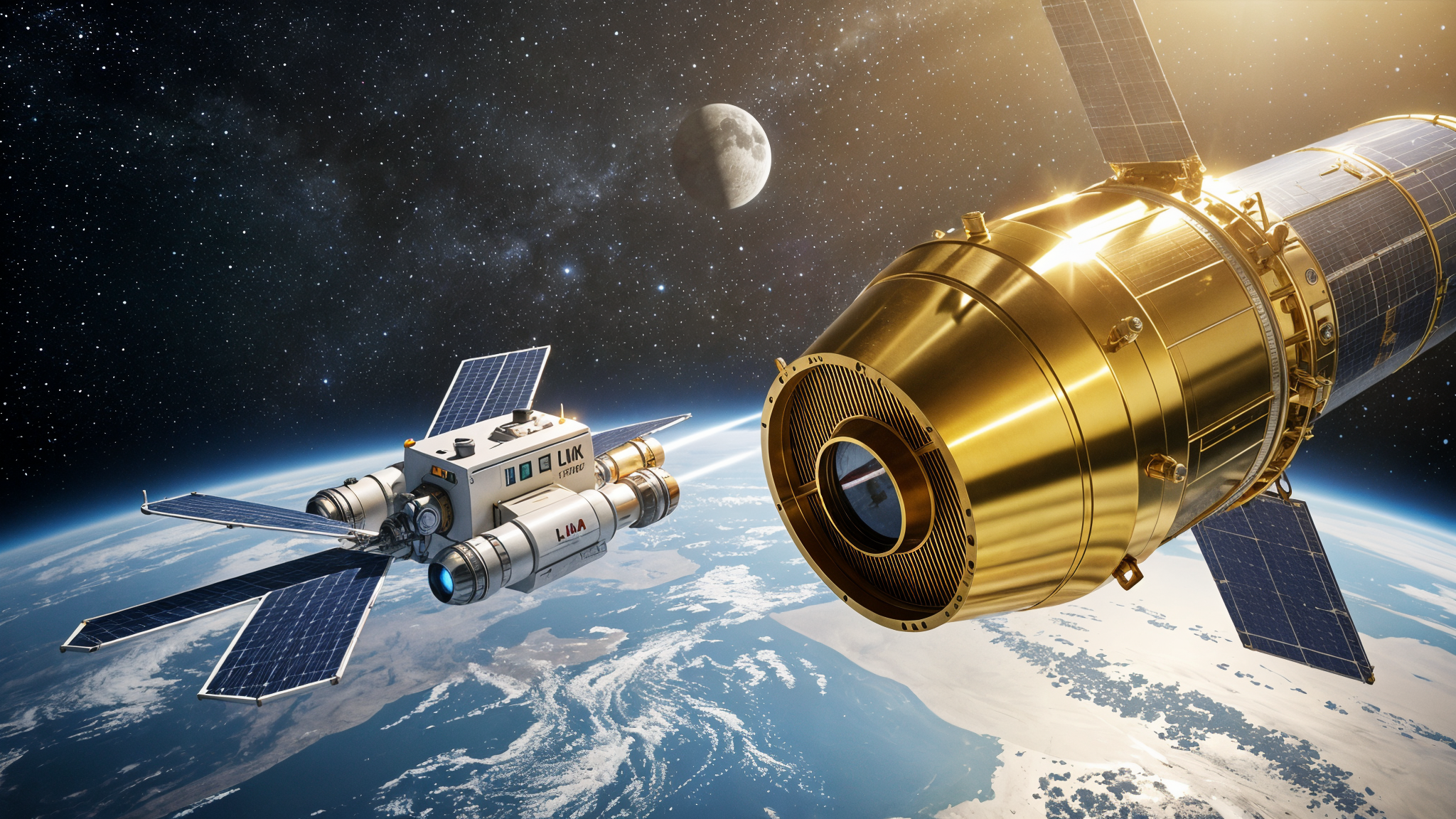
Imagine you have a boat in the open sea and suddenly it loses control of its rudder. It cannot change course and starts spinning around itself. Well, something similar has happened in space to a rescue ship called LINK. The good news is that its owners, the company Katalyst Space, have managed to stop it in time, though not without a few scares along the way.
To understand it, you first have to talk about why this ship exists. In space there are telescopes floating around the Earth. One of them, NASA’s Swift, has been working since 2004. It is used to study some very powerful explosions that happen in the universe, the strongest that exist today. We could say it is like a big eye that constantly watches the sky.
The problem: the telescope is falling
Swift cannot float forever. Although it seems strange, up in space there is also a little bit of air, very little, but enough to slow the spacecraft down gradually. That braking takes away its altitude. It is like when you throw a ball into the air: in the end it always falls back down.
Normally, a spacecraft can fire its engines to go back up. But Swift is already using its own and cannot compensate for the fall. Besides, recently the Sun has been more active than normal, and that has made the telescope drop even faster. If nobody does anything, within a few months it would plunge towards Earth and burn up as it enters the atmosphere.
To avoid that, NASA contracted Katalyst Space in September 2025. The mission was extremely complicated: design, build and launch a rescue ship in less than a year. Quite a record. And although it seems unbelievable, they managed it. The LINK ship went into space on 3 July 2026.
The scare: the ship lost control and started spinning
LINK’s mission was to travel to Swift, inspect it, grab onto it and raise it to a stable altitude. But at the end of July the unexpected happened. The ship has three small wheels inside that are used to orient itself, a bit like its hands for turning. Well, two of those three wheels failed. The result was that LINK started spinning around itself out of control, like a spinning top.
Spinning out of control is a serious problem in space. You cannot steer the ship, fire the engines in the right direction, or communicate properly. It had to be stopped, no matter what.
The remedy: using a tiny engine to stop the spin
The engineers did not give up. They sent orders to the ship to use one of its thrusters, but in a very gentle way and little by little, day after day. This is what is called an ion thruster: a very small and efficient engine that pushes bit by bit, instead of giving one big push all at once. Imagine blowing softly to stop a spinning top instead of slapping it.
It worked. The ship was spinning at about 9 degrees per second when it started slowing down. Now it spins much more slowly, at 1.47 degrees per second. It is not completely stopped, but it is a calm spin you can work with. And the best part: it barely used any fuel to achieve it, less than 100 grams. So it keeps just enough for the journey ahead.
What comes next
In the coming days, the engineers are going to send the ship an update to its internal program (the software, as we would say in mobile terms). That update includes a new system to control the position, tailor-made for the ship’s current state. With that, they hope to be able to steer it normally again and align its course with Swift’s.
The ship could reach its target towards the end of August, as long as no more setbacks arise. Just in time, because the telescope’s fall does not wait.
Why should you care about this story?
This news is not only for space lovers. Behind it there is an important idea: we are becoming more and more capable of repairing or saving objects that are already up there, instead of letting them fall and building new ones. It is like fixing an appliance instead of throwing it in the bin. That saves money, time and resources, and opens the door to keeping space cleaner and better used.
And it also reminds us that, even in the best-prepared missions, things can go wrong. The beautiful thing about the story is that human teams, with patience and ingenuity, find a way to turn problems around. Sometimes, even in the vacuum of space.