

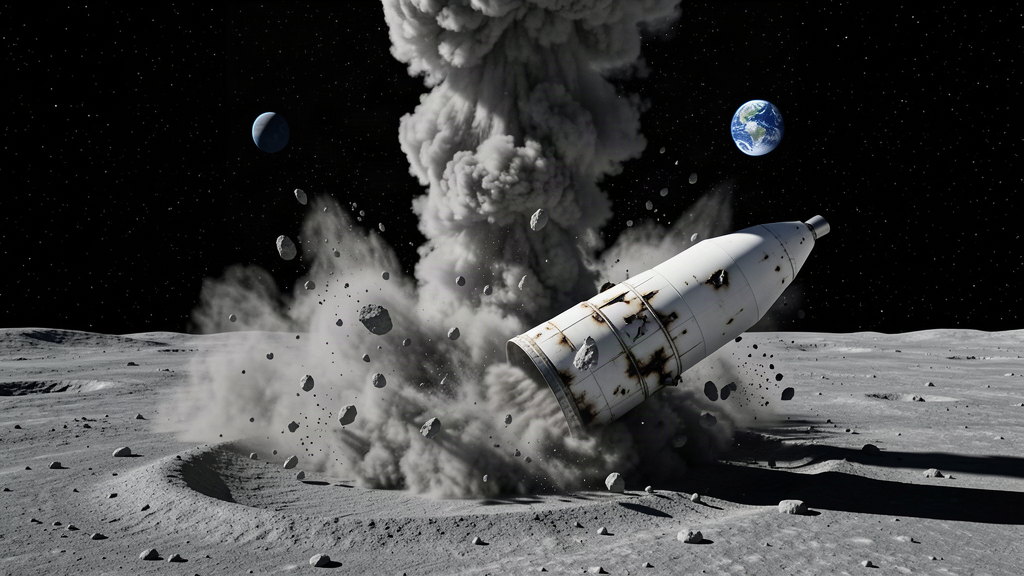
A piece of rocket has just crashed into the Moon
In the early hours of 5 August 2026, a piece of a rocket crashed into the Moon. It wasn’t a movie scene or an attack: it was the fall of a metal object of almost four tonnes that had been spinning out of control for more than a year and a half. The impact has caused no damage on Earth, but it has opened an important debate: we’re leaving rubbish on the Moon and that, sooner or later, is going to be a problem.
Which rocket are we talking about?
Rockets that travel to space aren’t a single piece. They’re made up of several parts that are released during the journey, like the carriages of a train. The part in question is called the “upper stage”: it’s the final section of a Falcon 9, a SpaceX rocket, the company of Elon Musk.
That piece did its job in January 2025: it propelled two landing modules towards the Moon, small uncrewed spacecraft carrying scientific experiments. One of them, the Blue Ghost, from the American company Firefly Aerospace, landed well and completed its mission. The other, the Resilience, from the Japanese ispace, lost communication during the descent and ended up crashing.
And the rocket stage that carried them, once its work was done, ran out of fuel. Without fuel it couldn’t return to Earth or place itself in a stable orbit, so it was left adrift. It’s like a car that runs out of petrol in the middle of the road: there’s no way to start it again.
A fall at full speed
For 18 months, that piece of metal kept spinning, pushed by the gravity of the Earth, the Moon and the Sun. On 5 August, at 6:35 in the morning (Spanish time), it ended its journey against the lunar surface, near the Einstein crater, on the western edge of the near side of the Moon.
It struck at about 8,700 kilometres per hour. To give you an idea: that’s about seven times faster than a passenger plane. And since the Moon has no atmosphere, that is, there’s no air to slow objects down, it reached the surface without losing speed.
The impact released an energy equivalent to the explosion of about three tonnes of dynamite. Scientists calculate it opened a crater between 20 and 30 metres in diameter, roughly like a swimming pool, and threw up a cloud of dust up to 15 kilometres high. To give you another idea: that’s higher than Mount Everest.
An experiment nobody planned
The curious thing about this accident is that it’s the first time we know in advance the exact time, speed and weight of such an impact. Normally, when a meteorite hits the Moon, it happens suddenly and without warning. This time, the astronomer Bill Gray, who tracks objects in space, calculated the trajectory months before and warned of the collision.
That’s why scientists see it as a free experiment: they’ll be able to compare photographs of the area before and after the impact and study how craters form. The satellites orbiting the Moon, like NASA’s LRO, will look for the new hole and measure its real size.
The underlying problem: space debris
This isn’t the first piece of rocket to crash into the Moon. In March 2022 it already happened with a stage of a Chinese rocket. And this is just the beginning: in the coming years, several countries and companies plan to send more missions to the Moon, including the construction of bases for astronauts.
The more traffic there is, the more likely it is that abandoned pieces are left spinning around and end up colliding with installations or people. It’s like throwing rubbish out the car window: it doesn’t matter that nobody sees it today, the problem appears tomorrow.
What’s more, the footprint this impact has left will last a very long time. On the Moon there’s no wind or rain to erase the marks, so the Falcon 9 crater could still be there millions of years from now.
Conclusion: a reminder in the shape of a hole
The impact poses no danger to Earth or to anyone. But it’s a reminder that space, and also the Moon, are not a dump. Experts have spent years asking for clear rules to safely retire or move aside rocket pieces when they finish their work. Until those rules exist, every lunar mission will leave its signature on the surface… forever.